|
Greetings all, it’s Wednesday June 10. At NC Local, we talk about community listening a lot. It’s part of the fabric of who we are, what we do and how we came to be. It starts from the very basic — but very important — idea that you can’t serve your community if you don’t know what matters to them, what questions they have, what assets they have built and the ways they prefer to get news and information.
Community listening looks different depending on where we are and who we’re partnering with. Last December, we did a listening lunch with news leaders from Clay, Cherokee and Graham counties to learn about their work in the far western part of the state, the questions their audiences have and where NC Local could fill gaps. In April, we held community listening events across the state at “NC News Cafes” to mark the inaugural Local News Day. And a recent event in Winston-Salem emphasized how much pre-listening matters — the time you take talking to community members both before and while you're planning your event.
Today, we’ll recap that event, share a bit about our process and what comes next.
Also in the mix:
-
Speaking of listening, NC Local’s Lilly Knoepp created a new type of event. Listening Hikes! And our next one is coming up on June 16.
-
As more media organizations use AI, one state is ahead of the rest with new legislation: "The government has a strong interest in the preservation of human news work."
-
Longtime journalist Rex Hodge faces a big life challenge. We share how you can help.
-
And, “With all due respect, the city should try harder…” An NC news leader calls out local government for clawing back transparency.
Glad you’re here, let’s get started. |
|
|
|
|
What we heard in Winston-Salem |
 |
|
|
|
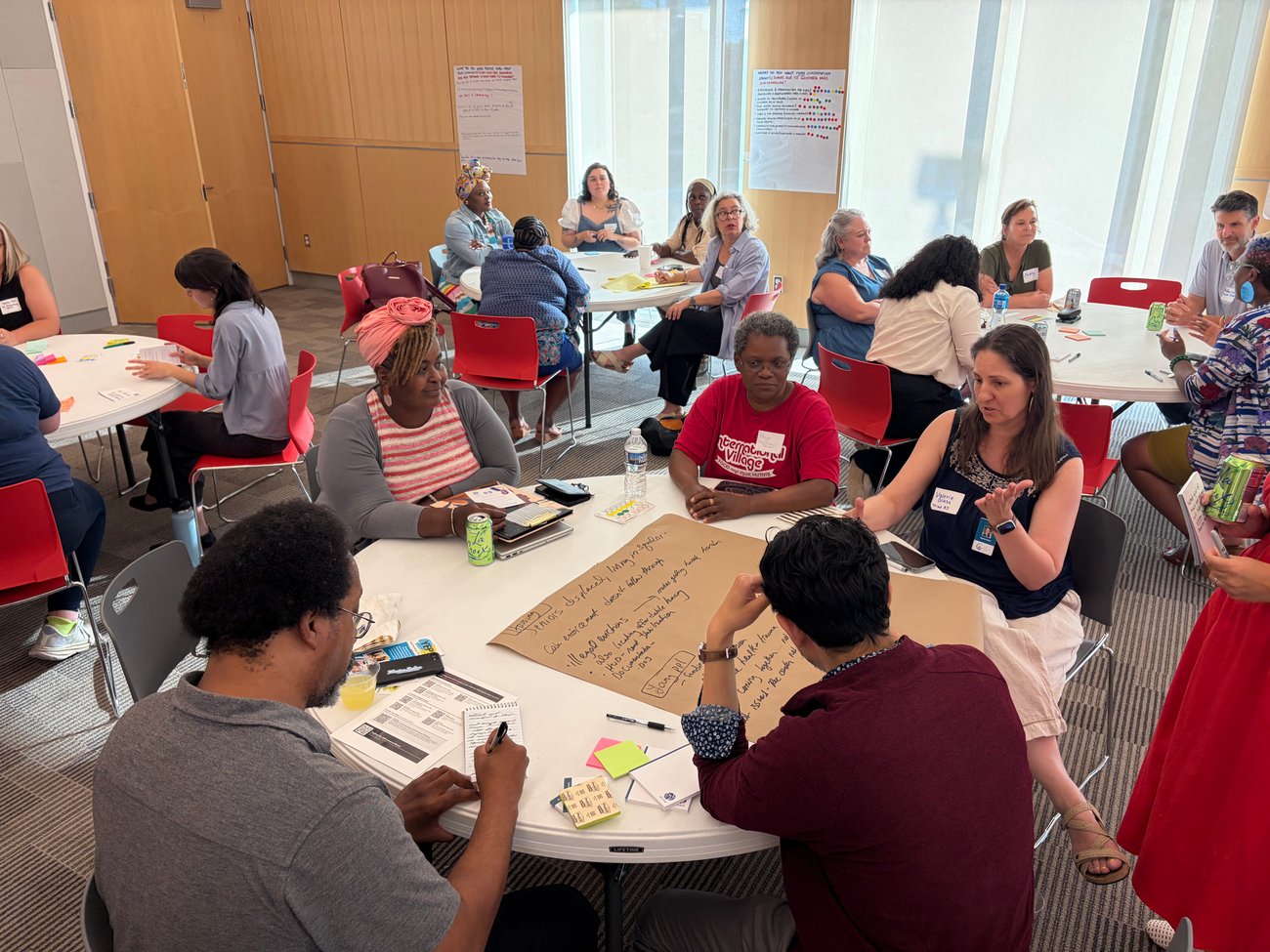
On Thursday, June 4, NC Local brought together Winston-Salem families, youth, community organizations and media partners for a listening session titled “It Takes a Village: Helping Winston-Salem’s families and children thrive.”
The event drew more than 50 people and we spent two hours sharing a meal, getting to know each other, exchanging resources and identifying both the issues and questions that are top of mind. We heard about the work of community organizations and surfaced ideas for what needs more attention in Winston-Salem. And, like many listening events, relationships formed (or were strengthened) by creating a space for community members and journalists to come together — not to report or produce a piece of content, but to simply share, listen and exchange information.
It was a valuable and rewarding evening but also the result of pre-listening to really figure out what the community would find valuable in an event like this.
Our Triad Ecosystem Ambassador Abē Levine started with mapping parts of the news and information ecosystem in Winston-Salem. He then scheduled virtual and coffee conversations with community leaders. What were their priorities? What challenges were they facing? What did they see as opportunities?
Education was a common topic, so we began thinking about an event that would partially focus on the school funding crisis that led to layoffs, program reductions and a lot of questions from the community. Then, a mass shooting at Leinbach Park happened in late April. A 16-year-old and 17-year-old were killed. Five other teens were injured.
Our community partners emailed that afternoon and asked for an extra layer of intentionality following this tragedy. We postponed the listening event, reconvened and talked about ways to more holistically look at systemic issues affecting youth and families, including safety. We brought on another partner, the Center for Just Journalism, to help both community members and journalists learn about new approaches to covering public safety.
We also learned from community partners that a decade earlier, the City had spearheaded a community wide collaboration called the “Poverty Thought Force.” There were six “World Cafe” style community listening sessions attended by more than 600 people focusing on many systemic issues: housing, food security, education, health and jobs — all things that, when addressed, lead to positive outcomes, including increased safety and well-being.
While a decade had passed, we recognized that many in this community had already contributed to identifying problems and solutions. So we reframed the programming and discussion to focus more on the building of relationships between community organizations and journalists —
and identifying how local news can be responsive to their needs. We heard a range of ideas from the first break out, where participants responded to the prompt: What is happening in your community that you wish was getting more attention?
-
There continues to be systemic issues with housing, including evictions and the growing number of students experiencing homelessness.
-
There aren't enough licensed foster homes in Forsyth, leading many kids to be placed out of the county.
-
When violent incidents do happen, media coverage can be very superficial, failing to provide context and connect the dots and leaving out what resources and programs are available to families and young people.
And from our youth participants:
-
Groups of kids hanging out together, doesn't mean they're up to trouble.
-
Youth need more safe spaces to go and better pedestrian infrastructure to feel safe getting there.
-
Youth want to feel more safe while they're in school.
-
And, there's persistent issues with school lunches: the food isn't healthy, portions aren't enough and sometimes it's spoiled.
|
 |
|
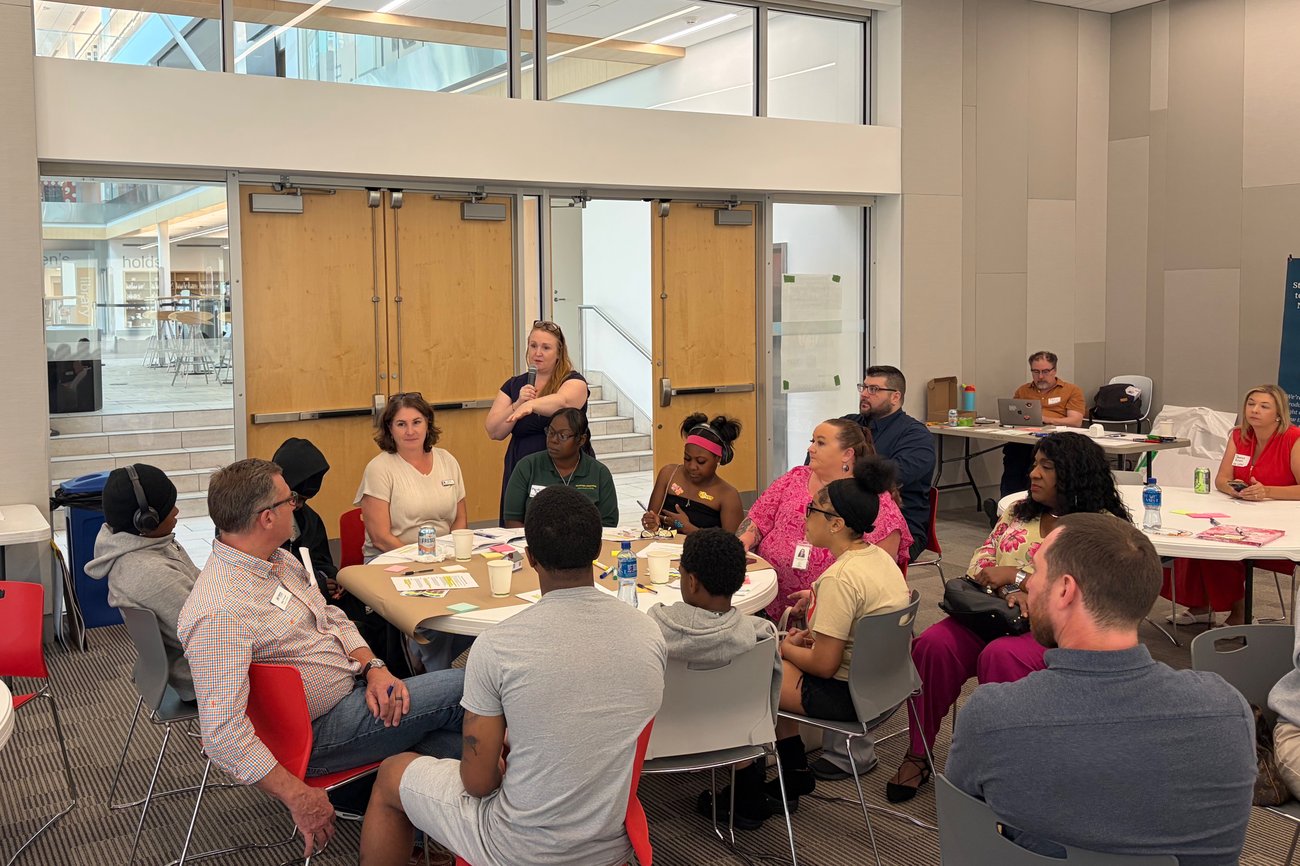
At the beginning of the event, Ecosystem Ambassador Abē Levine asked participants: What does an ecosystem mean to you? Their responses included, "sustenance," "life cycle," and "support."
“Creating a forum to inquire about the issues that matter most is a means to sustain one another with presence and curiosity — to tend to the social glue that bind us, in addition to understanding the struggle for life's core necessities like stable housing, healthcare, and nourishing school lunches,” said Abē, recapping the event.
What's next? We'll be convening our community and media partners later this week for a debrief. Then, we'll compile the input gathered and ideas generated to share with partners (and attendees). We'll identify some opportunities for NC Local to respond to what we heard, and we'll see if there are any collaborative opportunities. We will keep you posted on what local media partners may do in response as well.
Many thanks to Fiona Morgan with Branchhead Consulting for working with us on the months-long planning process with partners and co-emceeing the event with Abē (they are both so good at community engagement!).
And much gratitude to our community and media partners: How are the Children?, YEP!, Partnership for Prosperity at Action4Equity , Forsyth County Assoc. of Educators, Radio Onda de Amor, WFDD, The Assembly , Down from DC and The Center for Just Journalism.
|
|
|
|
|
|
📰 News about the news 📰 |
Crowdfunding campaign launched to support longtime WNC journalist Rex Hodge |
|
Friends and colleagues are helping raise funds for longtime journalist Rex Hodge, who retired last year from WLOS-TV in Asheville. Hodge was recently diagnosed with stage 4 cancer that has spread to his lymphatic system and lungs. The Gofundme campaign aims to raise $30,000 to offset the costs of medical treatment and ease of the burden while Hodge and his wife focus on treatment.
Hodge was based at the WLOS Waynesville Bureau, covering Haywood and other WNC counties. When he retired, many praised his dedication, reporting and storytelling skills building trusted relationships.
“I have the utmost respect for Rex. He made sure to thoroughly understand all of the facts surrounding a topic, no matter how pleasant or unpleasant. Rex builds relationships founded on trust and integrity. He truly is a remarkable reporter and man. He has told Haywood’s story for over a decade, and we are the better for it,” said Trevor Putnam, superintendent of the Haywood County School System, in this piece by Bill Studenc celebrating Hodge’s retirement.
Journalist Ted Canova, who organized the funding campaign, says he’ll be recording a Q&A with Rex soon and encourages folks to share the GoFundMe. |
Coastal NC localities claw back access to public records terminals |
|
In a recent Sunday Edition, WHQR’s Ben Schachtman gives readers an update on a series of moves by some Coastal NC governments that have rolled back access to public email terminals - where any member of the public could read emails from department heads, top administrators and elected officials.
“Not everything was on there, and emails marked ‘protected’ or ‘confidential’ would be kept off the server. But, in general, you could see what was going on, like what residents were saying to officials and what kind of responses they got. You could watch as draft versions of projects got debated, and see where problems or opportunities might be emerging, long before they were discussed in a public meeting,” wrote Schachtman.
Over time, the City of Wilmington started requiring appointments for its terminal. In 2022, it disabled the ability to view attachments. Then cyberattacks in Carolina Beach led to that municipality and Wilmington shutting down access completely due to security reasons.
New Hanover County, however, has not taken down access and doesn’t plan to, according to their Chief Communications Officer Josh Smith.
“It is a read-only archive, separated from the county's internal systems, and it is actively managed under a county policy designed to protect confidential information while preserving access for the press and public. As with any county system, IT may add standard security measures over time, none of which would deny public access.”
Schachtman then went back to the City and asked why they couldn’t do something like this. You’ll have to read his whole post to learn what happened next, but you might guess from his ending quote that there’s more advocacy to be done.
“On most things, it’s my job to explore the pros and cons, not advocate for policy decisions. But I will make an exception here,” he wrote. “With all due respect, the city should try harder to address its security and confidentiality concerns, as the county has, and install a public terminal in the lobby of City Hall or another convenient and accessible public location. It would be in the best interest of the press, the public, and the goal — which I think we all believe is important — of transparency.”
|
NY lawmakers pass bill to increase transparency of AI use in news production |
|
The New York Fundamental Artificial Intelligence Requirements in News Act (NY FAIR Act) is the first of its kind across the country, and requires media organizations to include clear disclaimers on content generated by artificial intelligence. The bill will require news, traffic, weather, sports and entertainment providers to conspicuously disclose, whether on webpages, graphics, video or audio/visual content, if the content was “substantially created by generative artificial intelligence.”
The bill’s preamble states “the government has a strong interest in the preservation of human news work.”
“There is an urgent need to prevent news companies from using artificial intelligence at the expense of both the broader public and of news workers, including human reporters, editors, news writers, directors, producers, voice actors, graphic designers and other newsroom professionals. It is therefore the intent of the legislature to establish clear, meaningful protections for both journalists and the broader public to ensure that the integrity of the news and its workforce are safeguarded.”
The bill was supported by a broad coalition of unions, including the NYS AFL-CIO, Writers Guild of America East, SAG-AFTRA, the NewsGuild of New York and the Freelancers Union. It was part of a package of legislation regulating AI , including a kids chatbot safety bill, an AI training data transparency act, a data center moratorium, and a ban on AI-assisted surveillance pricing.
|
|
|
|
Tuesday June 16: WNC Listening Hike |
 |
|
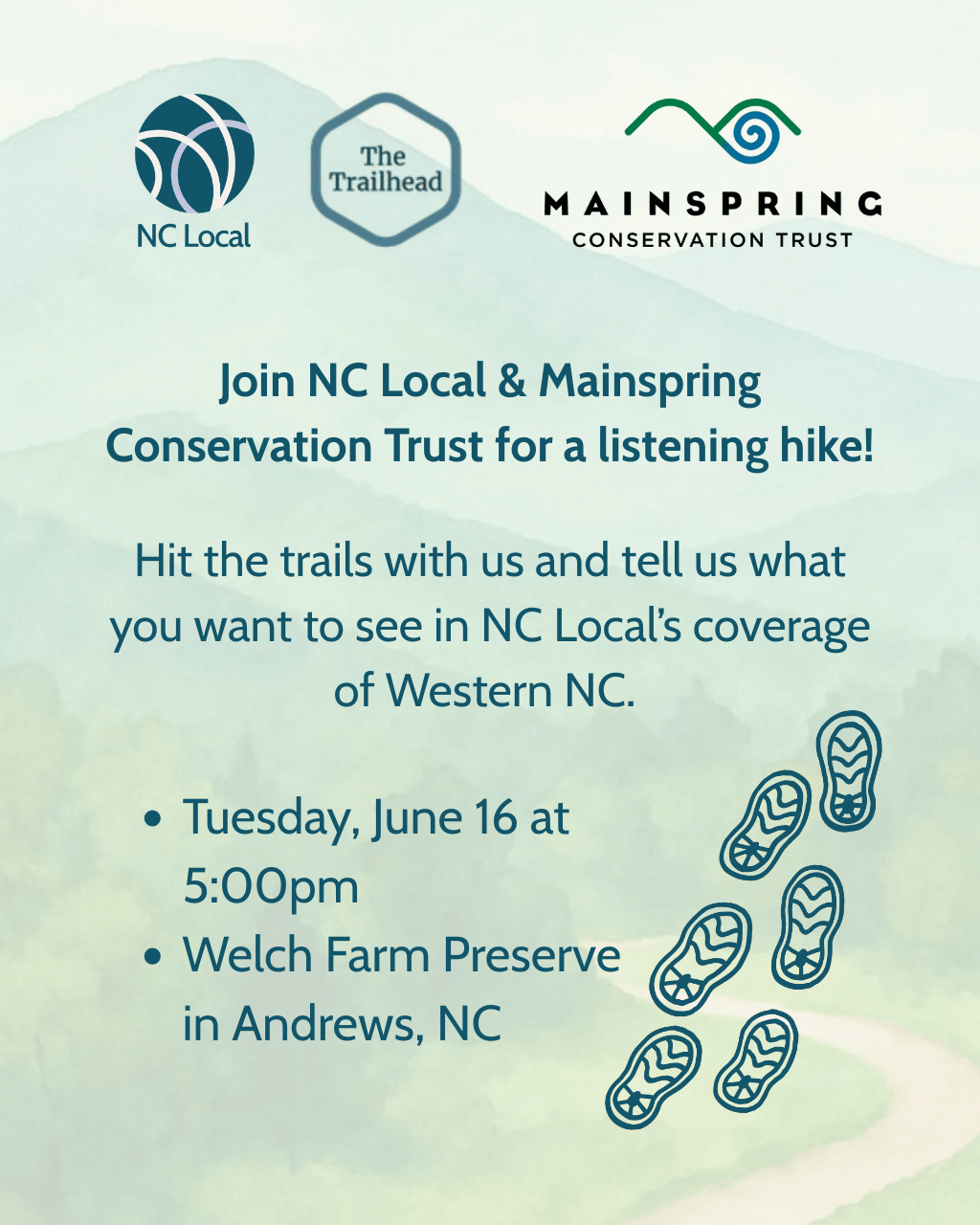
Join NC Local Tuesday, June 16 at 5:00 pm for our next Listening Hike. The Trailhead's Lilly Knoepp is teaming up with Mainspring Conservation Trust for a tour of Welch Farm Preserve in Andrews, NC.
We'll learn about the Trust's work in the region, including Welch Farm and hear from community members about what questions they have about state policy issues and how they impact Western NC.
This will be a less than 1 mile walk along natural surface trails, with no elevation gain along the Valley River. We will be back at the trailhead by 7:00pm.
Free! We just ask you to register here so we have a headcount.
Questions, contact Lilly at lilly@nclocal.org. |
|
|
|
|
|
Bulletin Board |
Jobs |
|
📌 Senior Editor, WFAE, Charlotte
📌 Reporter, The Mountaineer, Waynesville 💰
📌 Reporter, NC Newsline, Raleigh💰
📌 Editor-in-Chief, Asheville Watchdog 💰
📌 Executive Director, NC Health News (Remote in NC) 💰
📌 Reporter, The Sanford Herald, Sanford
📌 Magazine Editor, CityView/The Assembly, Fayetteville 💰
📌 Public Programming Director, The Assembly (Remote in NC, Triangle preferred)
📌 Local Government Reporter, INDY/The Assembly, Durham 💰
📌 Audience Lead, Food & Environment Reporting Network (Remote)💰
📌 Chief Content Officer, Religion News Service (Remote) 💰
📌 Partnership Lead, Enterprise & Programs, Indiegraf (Remote) 💰
📌 Sunlight Research Desk Contractors, MuckRock (Remote) 💰 |
Opportunities & events |
|
🌱Grist Call for pitches: Rethinking how America moves. Following a survey with audiences, Grist is developing a solutions-focused package exploring how the U.S. can break its reliance on fossil-fuel-powered transportation — and what a better system might look like. They’re looking for place-based stories that examine real-world progress, reveal barriers to change, and provide lessons other communities can use. They welcome ideas of all formats — features, essays, cultural commentary — and lengths. Deadline: today/June 10.
📅 Future-Proof Your Journalism Career by Mapping Your Career River: The Career River framework is a new navigation system for today's ever-changing working world. Join this free session with Career River creator Bridget Thoreson for a 30-minute mapping exercise followed by 15 minutes of Q&A. You'll learn how to visualize the progress you've made and skills you've developed over the course of your career to better adapt to shifts and proven tools to help you assess where you want to go next and design your action plan to get there. June 16, Noon ET.
📅 SRCCON 2026: This annual hands-on event hosted by OpenNews brings together developers, designers, journalists, editors and allies for hands-on workshops that reimagine newsroom tech, teamwork, leadership, community, and journalism itself. Sessions range from tech, product and editorial to safety, leadership and building better newsroom cultures, including:
About 75 tickets are left! Prices start at $295, plus ticketing fees. There are a limited number of need-based, free scholarship tickets as well as $500 travel or caregiving stipends. Sign up to volunteer and get complimentary admission. July 8 & 9 in Minneapolis, Minnesota.
🌱 The Kari Howard Fund for Narrative Journalism: This grant from IWMF honors Kari Howard, a storytelling editor who championed narrative journalism that combined the best nuance and poetry of fiction with journalism’s strongest power: truth. Grants average around $5000. This opportunity is open to women and nonbinary journalists and applicants may be freelance or staff journalists and may apply individually or as part of a multi-format team. Application deadline: July 12.
🌱 2026 Center for Health Journalism Data Fellow: A 5 month program that offers $2000 in funding and an opportunity to transform reporting by training journalists to “interview the data” as if it were a human source. Fellows finish the program equipped with the tools to find and obtain data and perform analyses that can yield new and important investigative insights. Fellows receive one-on-one mentoring as they produce a major investigative or explanatory health reporting project or a series of individual data-driven health stories that focus on issues important to their communities around the country. Application deadline: July 22.
|
|
|
|
|
That's it for this week, thank you for reading and as always know you are appreciated for all you contribute to the NC news and information ecosystem! —Catherine |
|
|
|
|
|
|