|
Greetings, all. It’s Wednesday, September 30. Diara J. Townes here, filling in for Catherine, who’s getting ready for our Voces de Charlotte event, a partnership with the Charlotte Journalism Collaborative, taking place tomorrow. Tickets are sold out - but you can join the waitlist here.
With the November election just 34 days away, today we’re highlighting what North Carolina’s news and information ecosystem is doing to inform communities, from voter guides and candidate profiles to local election boards and ballot questions. With the voter registration deadline coming up on Oct. 9 and early voting starting Oct. 15, we’ll share highlights and some terrific resources you can put to use.
Coming up in today's edition:
-
Want to dig deeper on candidates running for office? A new tool helps you sort through business ties, real estate holdings and outside income.
-
From the mountains to the coast, we round up your voter guides, ballot builders, and election events.
-
A big investment in local news & trusted messengers: the North Carolina Local News Lab Fund announces $1.27 million in grants.
-
And, are you craving time to brainstorm, build and collaborate on community-centered journalism? Apply for RJI’s in-person symposium, and get ideas, support and funds to launch your ideas.
Glad you’re here; let’s get started. |
|
|
|
|
A new tool helps journalists background local candidates and spot conflicts of interest
By Diara J. Townes |
 |
|
|
|
Curious about whether a candidate in November's election has little-known business ties, real estate holdings or outside income that might shape how they'd govern? Are you backgrounding a current or former state official running for Congress, and now you’re wondering what their past filings might reveal that their campaign bio won't?
That’s what the Statement of Economic Interest forms are for.
North Carolina law requires all elected officials and candidates to file Statements of Economic Interest (SEIs). These public filings can surface undisclosed business associations, outside income and potential conflicts of interest. But even though they’re publicly available on the State Ethics Commission website, they can be hard to search.
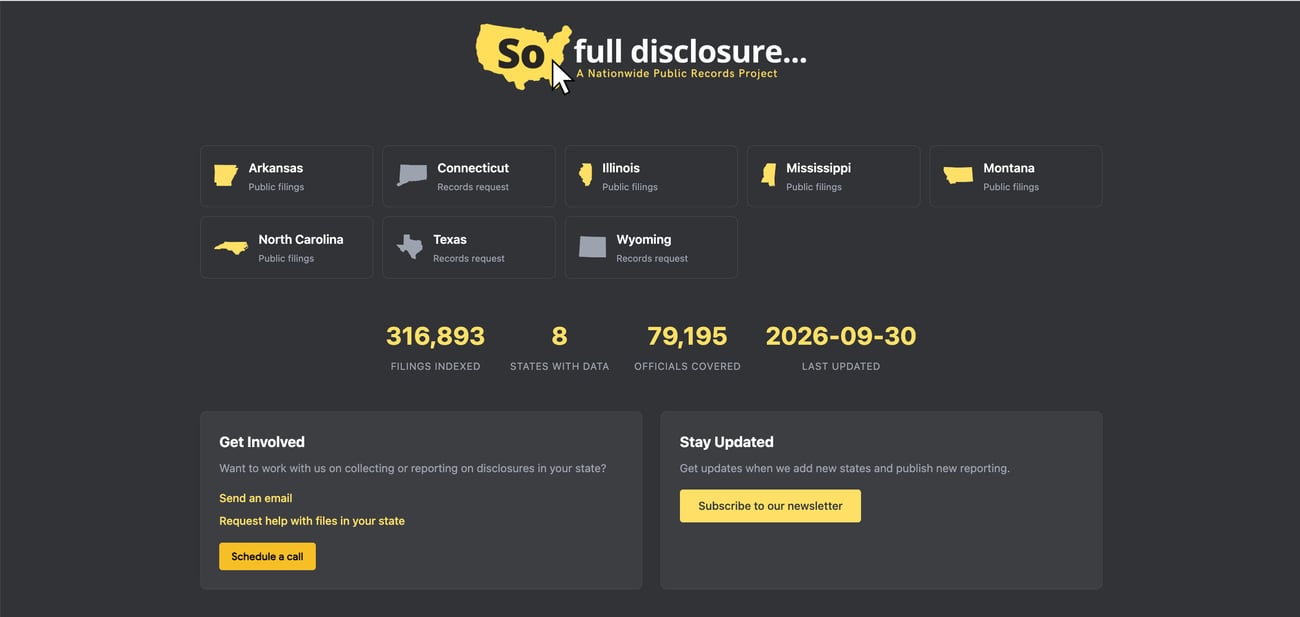
This challenge exists in other states too, so investigative data journalist Audrey Nelson has built a solution: SoFullDisclosure.com, a site that scrapes and organizes Statements of Economic Interest (SEIs) from North Carolina and other states.
This week, we chat with Audrey about what SEIs are, how the site works and how to use it to find reporting leads as we head toward Nov. 3 and beyond.
Before we jump in, a disclosure of our own! Audrey and Diara are former colleagues, and Diara has used “So, Full Disclosure” for her independent reporting. Diara also co-presented with Audrey on how to use SEIs at journalism conferences, including last year’s NC News & Information Summit. Our conversation has been edited for length and clarity.
Diara J. Townes: For reporters who haven't worked with SEIs before, what exactly is a Statement of Economic Interest, who's required to file one, and what kind of information does it actually capture?
Audrey Nielsen: It is broadly judicial officers, people who have state government jobs, people who serve as legislators and people who serve on boards and commissions for the State — and any candidates for those covered elected offices. The disclosures cover major North Carolina real estate — any residential or commercial real estate ownership worth more than $10,000 — as well as major stock interests and any company you have a relationship to that has business with the state or is directly regulated by the state.
Other things the SEIs cover range from other sources of income, debts, whether you're a licensed professional, and gifts for the previous year — you think about, like, I was given a bottle of wine by this sheriff's organization, or I was taken on this trip by this other company. One of the most interesting parts is the optional narrative disclosure, which many officials don't fill out at all, but some do—anything else they think the Ethics Commission might be interested in or should know about potential conflicts of interest. North Carolina is one of the states with the highest requirements for disclosure among public officials, ranging from your local municipal and county boards to your state-level legislators, without exception, which is pretty exceptional.
Diara J. Townes: How does this compare to disclosure tools reporters may already use, like campaign finance portals? What gap does SoFullDisclosure fill?
Audrey Nielsen: Campaign finance is easier to put in one format and make accessible, because it's a running sheet of exchanges — money coming in, money going out, and who that money's coming from. Whereas statements of economic interest have a huge mix of different kinds of information in them, and don't really have any kind of shared taxonomy state to state.
North Carolina actually lets you do a bit wider a search by category or year, but some states only let you search by name, so you have to already know who you're looking for. If you wanted to do any kind of comparative reporting, you better be ready to look at thousands of individual files one by one. That's the number one thing this project tries to improve in North Carolina: being able to look at the filing data all at once.
Diara J. Townes: Walk us through what SoFullDisclosure.com actually does — how the site is structured, and how it turns raw filings into something searchable.
Audrey Nielsen: Every filing portal we're trying to build as part of this project — the North Carolina one is the most built out — has a table of all the filings we've been able to source from the state. Every filing is linked both to a copy we've maintained, which is how we've created a searchable layer for those files, and to a copy on the North Carolina Ethics website, so you can verify that the filing you're looking at is the exact filing on file with the state.
The website lets you filter or search through it, and download an overview of all the filers in one go with a CSV linked to the relevant filings, so if you're doing data journalism based on the filings, you can mess around with the bulk data without doing your own scraping. The search also goes through the contents of the files themselves, so you can search for keywords that are in the PDFs — which makes it more expansive than what's available on the North Carolina website, plus you can do a bulk export, which isn't currently available from North Carolina directly.
Diara J. Townes: With North Carolina's November elections coming up, what should NC reporters be looking for in this data right now?
Audrey Nielsen: I would be looking at the opponents in these races and comparing their listed employers, their sources of income and the scope of their disclosed financial interests — in isolation or in comparison to their campaign finance information. I would not stick to only their most recent filings for those who've been there a while.
One of the most interesting things you can do, particularly for wealthy members of the state legislature, is look at their last several years of filings, and if they've submitted essentially identical filings for years, call them up and ask: has your financial situation not changed the entire time you've been in office? You might have a messy-filing story right out of the gate.
There is, commonly, a big problem of inaccurate or insufficiently disclosed financial interests on these forms. One of the potential benefits of more reporters getting involved in using these filings is that we'll be able to watchdog more and better for failures to file and failures to file accurately.
Audrey offers free office hours for journalists if you're interested in either contributing to the project or learning how to use So, Full Disclosure's resources for your reporting. Get in touch at audrey@audreynielsen.com or book a call here.
Find examples below of reporting that used financial disclosures:
In addition to North Carolina, the database includes financial disclosures for Arkansas, Illinois, Mississippi and Montana, and more states will be added in the coming weeks. Sign up here for their newsletter to get updates and alerts about the project. |
|
|
|
|
|
NC news & information ecosystem:
Guides to the 2026 Midterms
🗳️ Enlace Latino NC’s Voter Guide, Guía Elecciones 2026 Carolina del Norte is a fully bilingual resource covering key dates, registration, voter ID and eligibility requirements, as well as a searchable map where you can look up which candidates are running and see summaries of their positions on various issues. The guide also spotlights more than 20 Latino candidates running across the state.
🗳️ The Charlotte Ledger’s Election Hub provides detailed information on how to vote, what the offices are up for election actually do and independently reported candidate write-ups for voters in Mecklenburg, Gaston and Cabarrus counties. It began as a project by researcher Sucharita Kodali, who started posting candidate summaries on Reddit before partnering with the outlet and founder Tony Mecia to grow it into a full hub of resources that reach tens of thousands of people.
🗳️ The Assembly’s Election Guide offers key dates, an FAQ and a ballot tool that shows what will be on your ballot and includes summaries of the top races, using The Assembly’s reporting and other news coverage. The Assembly’s network, including The INDY, CityView and Border Belt Independent, are also using the same tool but localized for their audiences. The Assembly is also hosting an event, What to Expect in the Midterms, with Auditor Dave Boliek, Thursday, October 8.
🗳️ WHQR, Port City Daily, UNCW's The Seahawk and WECT are collaborating on 2026 election coverage in southeastern NC, including candidate questionnaires and upcoming forums held at UNCW's Burney Center. The first takes place on Wednesday, October 7 and features New Hanover County Commissioners and School Board of Education candidates.
🗳️ WFAE partnered with the League of Women Voters of Charlotte Mecklenburg and held a forum at Central Piedmont Community College about the three constitutional amendments on the ballot, what you need to know as a voter, and how decisions could impact you. Listen to the forum here. WFAE is also partnering with the LWVCM on a state and local judicial forum, taking place Monday, October 5, 2026.
🗳️ Mountain Xpress publishes an Election Voter Guide each cycle where candidates answer a standard set of questions. But they’re also continuing something new they started for the 2024 election: On the Record. Managing Editor Thomas Caleder meets one-on-one with each of the six Asheville City Council candidates at a location of their choice to learn their views while listening to an album that represents aspects of who they are and why they’re running for office. Bonus: downloadable playlists included!
🗳️ You Can Vote: In addition to unique voter guides on candidates and issues, You Can Vote has created a Ballot Builder where voters can enter their address to create a personalized ballot. Their Know Your Rights hub also includes population-specific guides, such as advice for Justice-Involved Voters, New Citizens, and Seniors. All of You Can Votes materials are available for republication.
🗳️ NC Local launched a pop-up show, Purple Primer , to break down what voters need to know about the process, how to vote and what happens behind-the-scenes as well as the candidates and issues top of mind for voters. Help your audiences understand what matters to voters and what role they play in our evolving democracy by sharing and embedding Purple Primer episodes. Hosted by The Trailhead's Lilly Knoepp and WCU Political Science Professor Chris Cooper, they're taking your calls at 919-626-2463 or through an online survey.
|
|
|
|
|
|
|
|
|
|
|
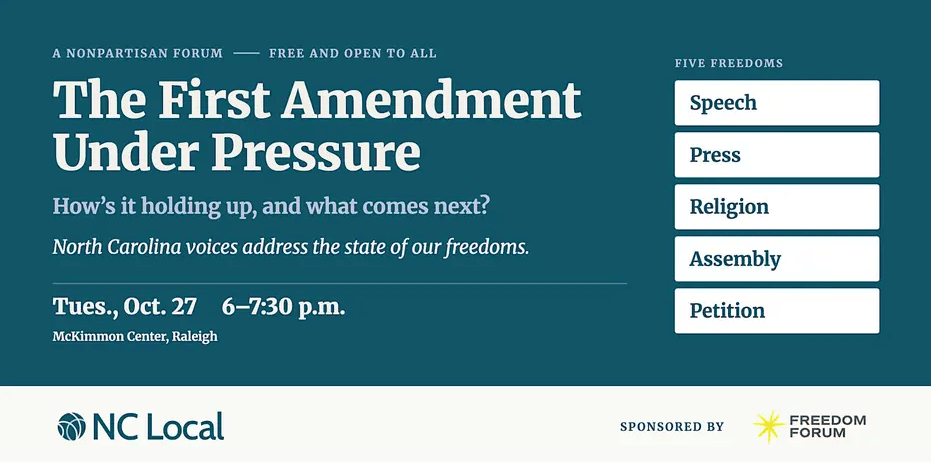
The First Amendment protects five freedoms: speech, press, religion, assembly and petition. North Carolinians can use them every day. But across the country, these rights face pressure in courtrooms, on campuses, in newsrooms and in public meetings.
What does that pressure look like here in North Carolina? How are our freedoms holding up, and what comes next?
Join NC Local for "The First Amendment Under Pressure" on Tuesday October 27 in Raleigh to hear from experts and First Amendment leaders who will provide insights and perspectives on the issues shaping our state.
We’ll bring together attorneys, advocates, journalists and policy leaders from across the political spectrum for a frank, nonpartisan conversation.
Moderated by Deborah Holt Noel, host of NC Weekend on PBS NC and longtime host and executive producer of Black Issues Forum. Speakers include:
- Israel Balderas, First Amendment attorney and assistant professor of journalism at Elon University.
- Kevin Goldberg, vice president and First Amendment expert, The Freedom Forum.
- Kristi Graunke, legal director, ACLU of North Carolina.
- Michael Hewlett, criminal justice reporter, The Assembly.
- John Hood, president of the John William Pope Foundation, cofounder and former president of the John Locke Foundation.
- C. Amanda Martin, longtime North Carolina press attorney and director of Duke Law's First Amendment Clinic.
- Robert Shibley, special counsel for campus advocacy, Foundation for Individual Rights and Expression (FIRE).
When: Tuesday, Oct. 27, 6–7:30 p.m.
Where: McKimmon Conference and Training Center, NC State University, 1101 Gorman St., Raleigh
Free. Registration requested.
Hosted by NC Local with support from The Freedom Forum. |
|
|
|
|
Bulletin Board |
Jobs |
|
📌 General Assignment Reporter, WBTV, Charlotte
📌 Photojournalist, WBTV, Charlotte
📌 Multimedia Journalist, WITN, Charlotte
📌 Multimedia Journalist, WITN, Charlotte
📌 News Producer, WBTV, Charlotte
📌 Multimedia Journalist, WECT, Charlotte
📌 Senior Enterprise Editor, The Assembly (Remote in NC)
📌 Business and Economic Development Reporter, The Daily Reflector, Greenville
📌 Business and Economic Development Reporter, Rocky Mount Telegram
📌 Public Safety Reporter, The Daily Reflector, Greenville
📌 Reporter, The Gaston Gazette, USA Today, Gastonia
📌 Director of Content Strategy, Deep South Today (Remote considered, but regular travel within Deep South’s footprint required)
📌 Associate Producer, What Next & What Next TBD, Slate (Remote) 💰
📌 Local Investigations Fellow, The New York Times 💰(Remote)
📌 Food and Farming Storytelling Fund Program Manager, Sentient Media (Remote) 💰
📌 Operations and Development Coordinator, Floodlight (Remote) 💰 |
Resources, opportunities & events |
|
🌱 2027 Alicia Patterson Fellowships: Alicia Patterson Fellowships support significant, in-depth written reporting on subjects of public interest. Six-month fellowships pay $20,000, and 12-month fellowships pay $40,000. Application deadline: Oct. 1, 2026.
📅 Press Play Durham: Press Play is a civic festival that convenes communities to build trust, nurture togetherness, and build a new kind of public square through story. Topics of discussion include: Who do you trust and why, local stories with big impact, extractive journalism, engaging to enhance media literacy and more. The event highlights what's working and what's changing across the media landscape while focusing heavily on video and innovation, including a screening of local shorts. October 3, 3:00-8:00 pm. Durham County Main Library, Free. Register here.
🌱McGraw Fellowships for Business Journalism: Fellowships “provide experienced journalists with a grant up to $15,000 and the editorial support needed to produce deeply reported enterprise and investigative stories that delve into critical issues related to the global economy, business or finance,” according to the listing. Applications are open through October 12. Apply here.
🌱Report for America: 2027 Host Newsroom Applications. Report for America is accepting applications from newsrooms to host a corps member starting July 2027. RFA covers part of the journalist's salary for a two-year commitment (renewable for a third), plus training support for both the newsroom and corps member. The application deadline is October 19. Apply here.
📅 Covering Immigration with Care: A Mental Health Reporting Project Webinar: Join Poynter as they lead a free 90-minute workshop on how to report on the effects of immigration on mental health with greater context, accuracy and care. This free webinar explores trauma-informed interviewing, ethical storytelling and practical reporting strategies. October 21, 2026, 12:00-1:30 pm. Register here.
📅 Community-Centered Symposium with the Reynolds Journalism Institute: Held on May 7-8, 2027, in Columbia, MO, this symposium is for community-centered journalists to share and create thoughtful and actionable ways to serve our communities better. Session topics are participant-led and inspired, with guidance and support from RJI to ensure actionable resources, activities and goals are incorporated into the weekend. Those accepted receive lodging, some meals and a stipend to implement an idea developed at the gathering. Application deadline is Friday, October 16. Apply here.
🌱 Early-Career Fellowship Program: The Open Notebook: During this paid, remote, year-long, part-time fellowship, each fellow will pitch, report, and write articles for publication at The Open Notebook, a mix of “story behind the story” interviews and reported features. The application deadline is October 31, 2026. Apply here.
|
|
|
|
|
That's it for today. Thank you Diara for filling in for me this week, and producing the election Q&A with So, Full Disclosure (love the name!) and compiling NC election guides and events, as well as our Bulletin Board. As always, thank you all for being here and all you do to support NC's news and information ecosystem. — Catherine |
|
|
|
|
|
|