|
Greetings all, it’s Wednesday October 29. Election Day 2026 is right around the corner and we know that typically, these off-year local races don’t get people out to vote—despite the impact a handful of ballots can have in tipping some races. But in at least one county, the numbers are way up. On Monday, the Charlotte Ledger reported that early voting increased by 51% in Mecklenburg compared to 2023, likely driven by the Transportation Sales Tax Referendum. How are local news and information orgs helping people understand how to vote and what’s at stake in this year's races? We’ll round-up your 2026 Municipal Election coverage.
Also in the mix:
-
NC lawmakers rushed through a new Congressional map last week. One reporter shares his approach to parsing the 12,000 public comments.
-
Dreaming of some time away from daily deadlines? Year-long fellowship opportunities are open to help you grow, experiment and find solutions to challenges in local news.
-
Interested in joining the team at NC Local? Applications close this Friday for a State Issues Reporter & Digital Engagement Producer.
-
And, we’re looking for a few more people to join the 2026 NC News & Information Summit Program Committee. Help us shape a diverse slate of sessions and speakers for next year’s gathering in Raleigh. Sign up here!
Glad you’re here, let’s get started. |
|
|
|
|
A reporter's guide to parsing public comments
|
|
|
|
|
|
|
Last week, just six days after unveiling a new redistricting map, North Carolina Republicans approved Senate Bill 249 which sets new boundaries for the 1st and 3rd Congressional districts. The new map takes Black voters out of the 1st District, making it less competitive and more friendly to Republicans, a result lawmakers were clear about ahead.
“This is sort of the Babe Ruth era of redistricting,” said WCU Professor and Political Scientist Chris Cooper on WBUR’s Here and Now. “They’re calling their shot and they’re putting the ball exactly where they told us they were going to.”
And it all happened very quickly, without public forums in the affected districts or any transparency in the map making process. The legislature did, however, set up an online portal on October 16. Within 45 minutes of a “test” being posted at 3:01 pm, the comments began to flood in.
“Democracy isn’t served when politicians get to change the rules mid-game. I urge you to reject partisan, mid-cycle map changes and preserve fairness, stability, and integrity in our elections,” wrote Mrs. Melissa Price Kromm.
“It's pretty obvious why the change--to dilute my vote. You have to be better than this, we expect better,” said James Morrison.
“No. Just no,” began George Brickhouse. “Give these maps to a non-partisan organization to do. I remember when we had fairer maps for the 2022 election. Let’s go back to those instead of this hot mess.”
Although the vote was over, the News & Observer’s Kyle Ingram saw an opportunity to help the public understand this limited public input process and shed light on what they had to say. His piece, "12,000 comments poured in on NC’s new Trump-backed map. And they weren’t positive," published very early last Friday.
Today Kyle shares with us some context about the public comment process, how these documents are released and his approach to analyzing a 900+ page PDF, including some cautions and limitations about using AI to help.
How were the public comments promoted and submitted? Was this a form that's generally offered to the public when there are bills up for a vote?
Kyle Ingram: For this round of redistricting, state lawmakers created an online portal where members of the public could submit comments about the new map. Similar portals have been used in the past for other map proposals, but this is not traditional practice for all legislation. However, members of the public can always email lawmakers about any bills that are up for consideration.
12,000 comments came in during a six day period. How does that compare to previous bills?
Kyle Ingram: I do not have direct access to the public comments submitted in previous redistricting rounds, but Rep. Pricey Harrison (D-Guilford) said on the House floor last week that lawmakers received 1,000 public comments in 2021 on new proposed maps and 600 in 2023.
Are PDFs of comments generally released to the public? Or is that something you'd typically have to ask a lawmaker to release/do a records request for?
Kyle Ingram: This is something you would typically have to ask a lawmaker to release. House Democratic Leader Robert Reives released the comments in this scenario without (to my knowledge) anyone submitting a records request.
How did you approach reviewing this 900+ page PDF?
Kyle Ingram: I knew I wouldn't be able to review all 12,000+ public comments, so my goal was to adequately express the themes that emerged throughout them and get a general sense of where the majority of respondents were. I attempted to analyze the PDF using an AI bot, but I found some of its generalizations to be unreliable and unsupported. It told me that roughly 95% of the public comments were in opposition to the bill, but I did not feel confident actually using that number in our reporting. However, doing my own random sampling, spot-checks and explicit searches for supportive comments, I did feel confident reporting that the comments were overwhelmingly opposed to the new map.
While I didn't use AI to make generalizations, I did find it helpful in identifying specific comments within the pdf that fit certain themes or viewpoints. For example, I asked it to pull out comments in support of the map or comments that objected to the map on racial grounds. These were easy to fact-check, because I could return to the original pdf document to ensure that the AI hadn't hallucinated its response. I also did random manual spot-checks throughout the document to see if I was missing any important themes.
The info included is date & time, name, organization and comment. What other information would be helpful for you to analyze the comments?
Kyle Ingram: Well, for one, it would've been helpful if the file had been released as a .csv or .txt file instead of a PDF. That would've made it far easier to sort. I would also hate to diminish the nuance of any response, but it also would've been very helpful if each respondent had been asked to check a box for whether they were supported, opposed or were neutral/unsure about the map. That data point - in addition to the more extensive comments, would've helped us get a better general feel on where the majority of respondents stood.
Any guidance for other reporters when reviewing public comments on a bill?
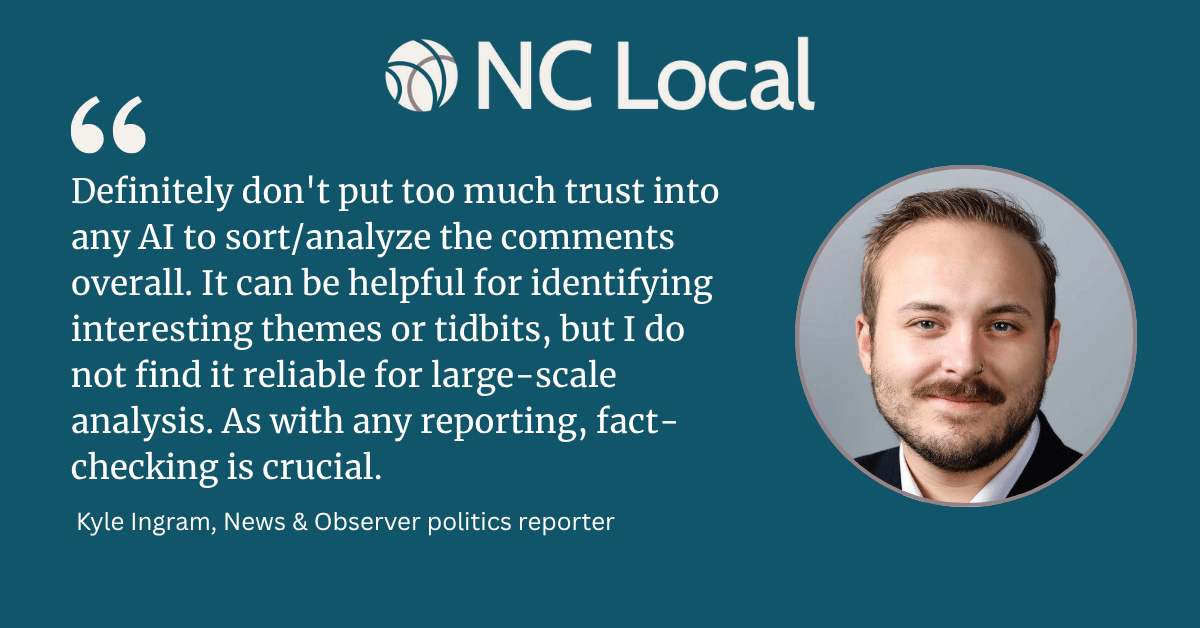
Kyle Ingram: Definitely don't put too much trust into any AI to sort/analyze the comments overall. It can be helpful for identifying interesting themes or tidbits, but I do not find it reliable for large-scale analysis. As with any reporting, fact-checking is crucial.
Thank you Kyle for helping us understand the nuances of public comments for policy issues and your tips for wading through massive documents. Here's hoping the right people get the message on CSV files!
|
|
|
|
|
|
Available for republication |
|
|
|
✅ NC Local is pleased to share our first in a series of plain language Q&As to help audiences make sense of state policy. Use the "Republish this Story" button at the end of each piece or simply copy and paste the text. You can use these alongside your own coverage, feature them in newsletters and for broadcast journalists or content creators, as a resource when interviewing guests or doing videos on these topics.
➡️ The North Carolina legislature just changed the voting maps. What happened?
➡️ Forever chemicals explained: What are PFAS? Why do they matter?
➡️ What is the N.C. budget process? And why is the 2025 budget delayed?
✅ For Inside Climate News, Lisa Sorg has a new deep-dive series on PFAS in North Carolina, highlighting the residents who fought for years to get state and federal regulators to do something about the dangers of the "forever chemicals." Find her first installment below and look for future ones following the legal challenges against the companies using and dumping these chemicals.
➡️ A Short-Lived Win in a Never-Ending Fight Over Forever Chemicals
For seven years N.C. activists overcame political and scientific hurdles to convince the EPA to enact PFAS regulations in drinking water. Now they’re confronting a Trump administration intent on quashing their success.
✅ For Carolina Public Press, Jane Winik Sartwell has a multi-part series examining North Carolina's system of economic distress tiers which are used to identify counties for economic development programs. Jane examines how the system has failed to improve outcomes and create jobs in the state’s poorest areas and looks at alternatives under consideration that could lead to better results.
➡️ Trapped By Tiers
A system designed to promote NC job growth has strayed from its original purpose. Distressed counties remain distressed, suggesting the need for different approaches. |
|
|
|
|
|
👏 Well Done 👏
2025 Municipal Election edition
👏 One thing we learned from WNC's Chris Cooper and You Can Vote's Caitlin Metzguer during our 2025 Municipal Election training earlier this year is that is odd-year elections can be really, really confusing. So I really appreciated this clear and practical Early Voting Guide from Enlace Latino NC which walks people through the process, provides a list of early voting sites and times by county, and a way to search the 67 municipalities that have opted out of early or mail-in voting.
👏 The Ledger’s new nonprofit, The Election Hub, offers a comprehensive but digestible overview of the 1% transportation sales tax referendum in Mecklenburg County, looking at what it funds, the bottom-line impact on households and candidates’ positions, while also offering plenty of ways to dig deeper. (The Election Hub is worth checking out for all it’s coverage and their partnership with QCity Metro on candidate forums.)
Axios Charlotte and QCity Metro also have notable coverage of the referendum, providing details on the new governing body that would oversee spending of the $20 billion dollars in transit funds. And WFAE’s Steve Harrison took another approach, examining the language people see on their ballots (and why past referendums may have failed) as well as the General Assembly’s role in having to first approve the 1% increase, which they did last Spring through the PAVE Act.
👏 Even in odd-year elections, NC journalists are busy trying to track down who’s behind mystery mailers. “There’s a special place in hell for the inventor of the campaign mailer, notorious for providing little to no information (and often a fair amount of fear mongering and misrepresentation),” writes WHQR News Director Ben in the latest Sunday Edition. But duty called and Ben did some digging into “The Future Empowering Committee, NC” which sent out the seemingly bipartisan mailer featuring four Wilmington candidates and the words “A team of Democrats and Republicans we can get behind!” Ben talks to candidates, uncovers that this Super PAC (technically an “independent expenditure political committee”) appears to have registered after the mailer was sent and connects the dots to conservative players and groups.
👏 In Durham, INDY Week’s Lena Geller wanted to provide something concrete and factual after conspiracy theories about a campaign treasurer began to circulate on social media. So she and Stuart Robinson turned to sorting through (sometimes manually) campaign finance records for Durham mayoral and city council races, prompting some candidates to file missing reports. The piece, which has some nice data visualizations, looks at what’s been spent, who’s donating and continued issues (for both candidates and reporters) with the state’s clunky and outdated campaign finance software.
Have you seen other well-done election coverage in the NC news and information ecosystem? Send us a link and/or share in our "Check it out" channel on Slack. Not a part of our Slack community yet? See how to sign up below. ⬇️
|
|
|
|
|
Find jobs, events and people in NC Local's new Resource Directory |
|
NC Local's new Resource Directory brings together the people, opportunities and tools that power North Carolina’s news and information ecosystem. Now you can access many of the features we share in this newsletter any day of the week, plus a new talent directory:
📌 A job board highlighting openings across NC in local news and information fields.
✨ A talent directory of reporters, editors, photojournalists, fundraisers, audience experts and more that you can sort by interest, expertise and county.
📆 An events list featuring your local news events, trainings, discussions and other in-person and virtual gatherings.
💡 A handy compilation of links: playbooks, guides, toolkits and other resources to help you learn, grow and experiment.
The Resource Directory is for anyone working in the NC news and information ecosystem, including journalists, educators, researchers, PIOs, publishers, fundraisers, technologists, civic information experts and more. In addition to the above resources, you can join journalists across the state in our Slack community. We look forward to hearing from you! |
|
|
|
|
|
NC Local welcomes Lilly Knoepp & Diara Townes! |
|
|
|
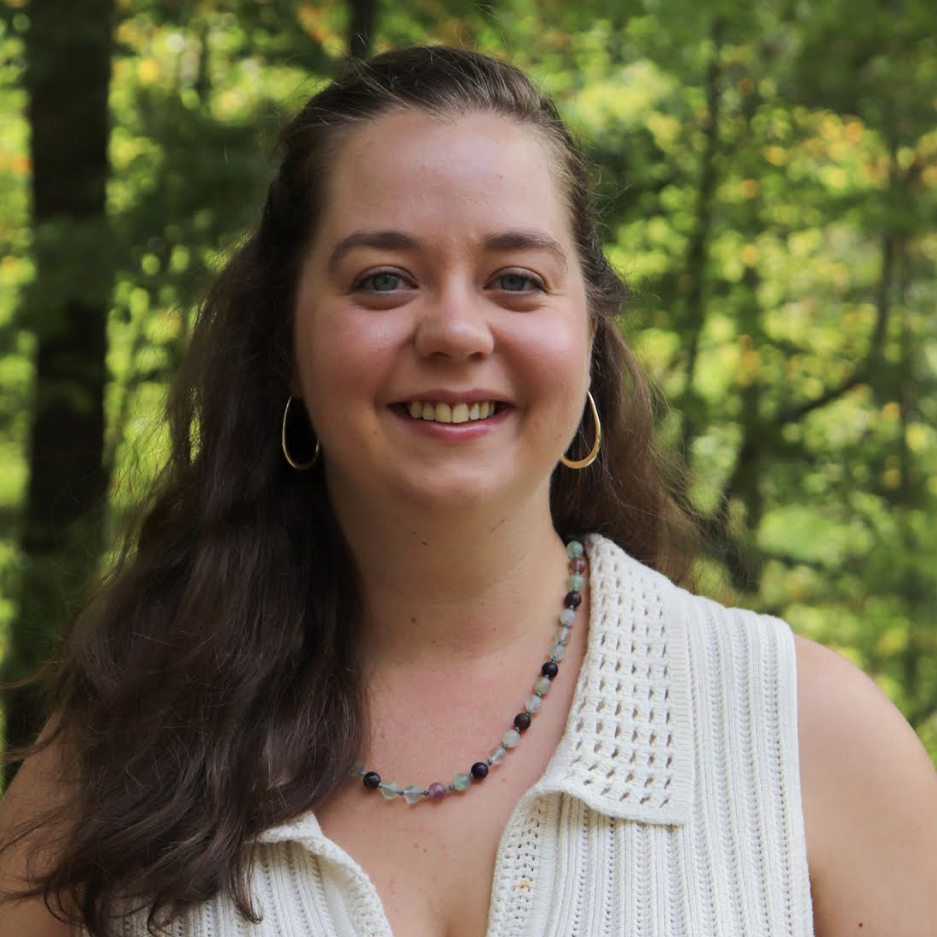
The NC Local team is getting bigger! This week, Lilly Knoepp begins her new role as Western NC Senior Engagement Reporter. A native of Franklin, Lilly has called Sylva home for the last six years. Between 2018 and 2025, Lilly served as BPR’s first full-time WNC reporter, covering local politics, culture, health and the economy while developing innovative partnerships and community engagement initiatives. At NC Local, Lilly will help residents make sense of how state policy issues affect their mountain communities through a soon-to-be launched newsletter (sign up here!), community engagement initiatives and news collaborations.
“I love calling these mountains home,” said Lilly. “And I’m excited to share the important stories of Western North Carolina at NC Local!”
Have a question about WNC or want to get in touch, reach out at lilly@nclocal.org. |
|
|
|
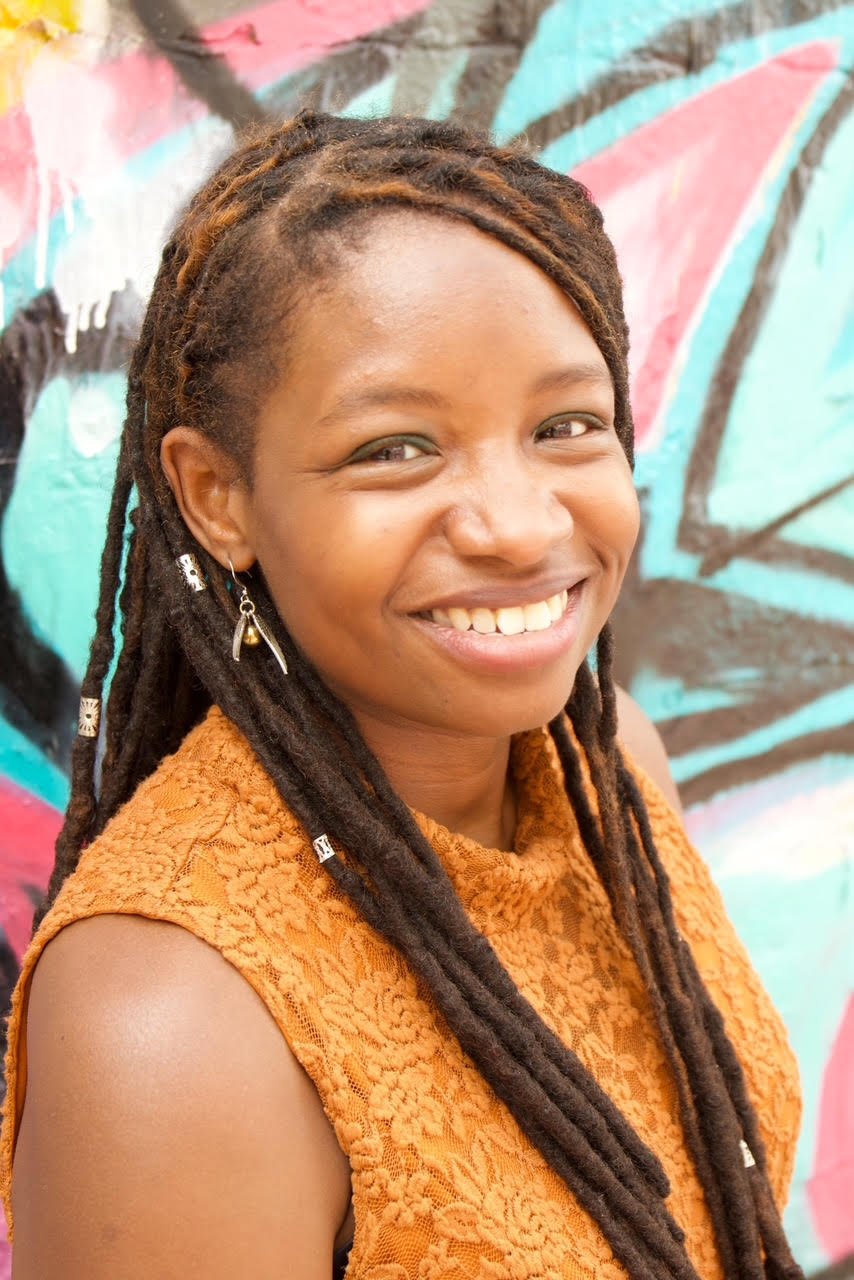
We are also pleased to introduce you to Diara Townes, who is supporting NC Local’s programs as a Program Manager. Diara will assist with our 2026 NC News & Information Summit and our partnership with Open News and Newspack to create disaster preparedness resources for newsrooms, among other initiatives including events. Diara has the perfect background for these roles, including program management with Aspen Digital and Lenfest Institute’s Local News Summit, audience engagement for the Sunlight Research Center and teaching at CUNY’s Newmark School.
“I’m inspired by North Carolina’s colorful and varied journalism ecosystem, and by the journalists and information providers dedicated to supporting their communities,” said Diara. “Through NC Civic Health and my freelance reporting, I’ve seen firsthand how much passion and promise there is here, and I’m excited to support NC Local in strengthening those connections statewide.”
Residing in Sanford, NC, Diara is also a Wake Forest Environmental and Epistemic Justice Fellow and a contributor to Sandhill News, The Rant and NC Local. Follow her work through The Curious Scout newsletter.
Please help us give a warm welcome to Lilly & Diara!
|
|
|
|
Bulletin Board |
Jobs |
|
📌 Digital Engagement Producer, NC Local (Remote in NC) 💰
📌 Senior Reporter, State Issues, NC Local (Remote in NC) 💰
📌 Editor in Chief, CityView, Fayetteville 💰
📌 Higher Education Reporter, The News & Observer, Raleigh 💰
📌 News Director, Blue Ridge Public Radio, Asheville 💰
📌 Development Communications Specialist, Blue Ridge Public Radio, Asheville 💰
📌 Digital Fundraising and Marketing Associate, WUNC 💰
📌 Chief Engineer, WUNC 91.5 (Chapel Hill, Durham) 💰
📌 Community Engagement Manager, Charlotte Business Journal (Charlotte)
📌 Assistant Professor of Practice or Assistant Teaching Professor, Journalism Program, Wake Forest University (Winston-Salem)
📌 Investigative Reporter, Asheville Watchdog (Asheville) 💰
📌 Data Reporter, The War Horse (Remote) 💰
📌 Training Director, IRE (Remote) 💰
📌 Managing Editor, The Marshall Project (Remote) 💰
Internships:
📌 Summer 2026 News Interns, News & Observer & Charlotte Observer
|
Opportunities & Events |
|
📅 Teaching Asset Mapping through Community-Engaged Projects: While geared toward an academic audience, journalists could also benefit from this training by Duke University Professor Andrew Nurkin on asset mapping to help understand your community on a deeper level. Participants will introduce participants to the fundamentals of asset mapping and hear about some examples, including students who mapped music assets in the mountains after Helene. October 30, 1:30-3:00 pm. In person registration is full, but you can stream the training here.
📅 Solutions Journalism Chatbot preview: Join RJI’s monthly community conversation for a look at their partnership with El Colectivo 506 to build a solutions journalism pitchbot to help turn typical news pitches into solutions stories. The tool will be multilingual, accessible and free for journalists. Learn about the project, sign up to be a beta tester, and ask your questions. November 5, Noon.
📅 Making News: Media Access Workshop. NABJ Raleigh-Durham presents a training for businesses, nonprofits and other groups who want to strengthen how they work with news media. Learn what journalists want in a press release, how to craft PSAs and tips to get your stories covered as well as prepare for interviews. Moderated by CBS 17 News Anchor Rod Carter, panelists include WRAL-TV News Anchor Lena Tillett, Sheer Social President Alice Fuller, The Assembly Criminal Justice Reporter Michael Hewlett, WUNC Radio News Host Naomi Prioleau-Brown, and Center for Community Self-Help Director of Public and Media Relations Jenny Shields. November 8, 10-2 pm, NC State.
🌱 2026-2027 Nieman Fellowship: This fellowship offers mid‑career journalists the chance to spend an academic year at Harvard University studying independently, honing leadership in journalism, and expanding their networks. Fellows receive a stipend of $85,000 paid over a nine-month period to cover living costs, some financial support for child care and health insurance. Application deadline: January 31, 2026.
🌱 2026-2027 Knight-Wallace Fellowships: This eight-month-long fellowship is also aimed at mid-career journalists to provide an opportunity to step away from daily deadlines to study, research and develop innovative solutions to the challenges in journalism while on campus of the University of Michigan. Fellows receive a stipend of about $85,000, plus relocation support, full tuition and health insurance coverage. Application deadline: February 1, 2026.
🌱 Rich Passan Sports Writing Scholarship: Open to rising college juniors and seniors who demonstrate excellent sportswriting skills, this new scholarship from the National Press Club offers a $5,000 award. The first recipient will be announced in early May 2026, with funds to be disbursed for the 2026–27 academic year. Application deadline: March 1, 2026. |
|
|
|
|