Share
Plus, why NC Local filed suit against the federal government.
 ‌ ‌ ‌ ‌ ‌ ‌ ‌ ‌ ‌ ‌ ‌ ‌ ‌ ‌ ‌ ‌ ‌ ‌ ‌ ‌ ‌ ‌ ‌ ‌ ‌ ‌ ‌ ‌ ‌ ‌ ‌ ‌ ‌ ‌ ‌ ‌ ‌ ‌ ‌ ‌ ‌ ‌ ‌ ‌ ‌ ‌ ‌ ‌ ‌ ‌ ‌ ‌ ‌ ‌ ‌ ‌ ‌ ‌ ‌ ‌ ‌ ‌ ‌ ‌ ‌ ‌ ‌ ‌ ‌ ‌ ‌ ‌ ‌ ‌ ‌ ‌ ‌ ‌ ‌ ‌ ‌ ‌ ‌ ‌ ‌ ‌ ‌ ‌ ‌ ‌ ‌ ‌ ‌ ‌ ‌ ‌ ‌ ‌ ‌ ‌ ‌ ‌ ‌ ‌ ‌ ‌ ‌ ‌ ‌ ‌ ‌ ‌ ‌ ‌ ‌ ‌ ‌ ‌ ‌ ‌ ‌ ‌ ‌ ‌ ‌ ‌

Click here to view in your browser

Did someone forward you this email?

👋 Click here to sign up

Greetings all, it’s Thursday June 18. We’re arriving in your inboxes a day later than usual this week because we have been busy! Shannan was here in Asheville and we had the opportunity to gather with local news friends, community organizations and of course the NC Local team mates based in WNC. Even when the world brings us lots of challenges, I always leave energized by the spirit of collaboration, problem-solving and creativity that abounds in the local news and information ecosystem. And that stretches from the mountains through the Piedmont to the coast. We are doing something special in North Carolina and so much of that is rooted in the understanding that we serve communities better when we work together. 


With those themes of partnership, vision, solutions & determination top of mind, here’s what we have lined up for you: 


  • What happens when you mix the efficiencies of AI with the context only a local can provide? The homegrown platform SeeGov is perfecting that recipe and making it easier for you to report on local government.

  • It’s been 212 days since NC Local requested public records about who was detained in last year's immigration operations. Now, we've filed a lawsuit.

  • Following federal funding cuts, NC’s public media stations come together to build shared infrastructure & a more resilient future.

  • And, how do communities build the trust and connections needed to solve problems together? Join Narrative Arts this summer for a three-part series exploring storytelling, journalism, public health, and civic engagement. 


A quick housekeeping note: The Hub is taking a break next week as I'll be gathering with about 60 news leaders for the API Summit on Measuring Impact for Civic Discourse. I'm really excited about who I'll meet and what we'll learn together thinking through better ways to track, measure and assess how local news contributes to civically engaged communities. I will report back in early July!

Glad you’re here, let’s get started.

Expanding participation in democracy, one reel at a time

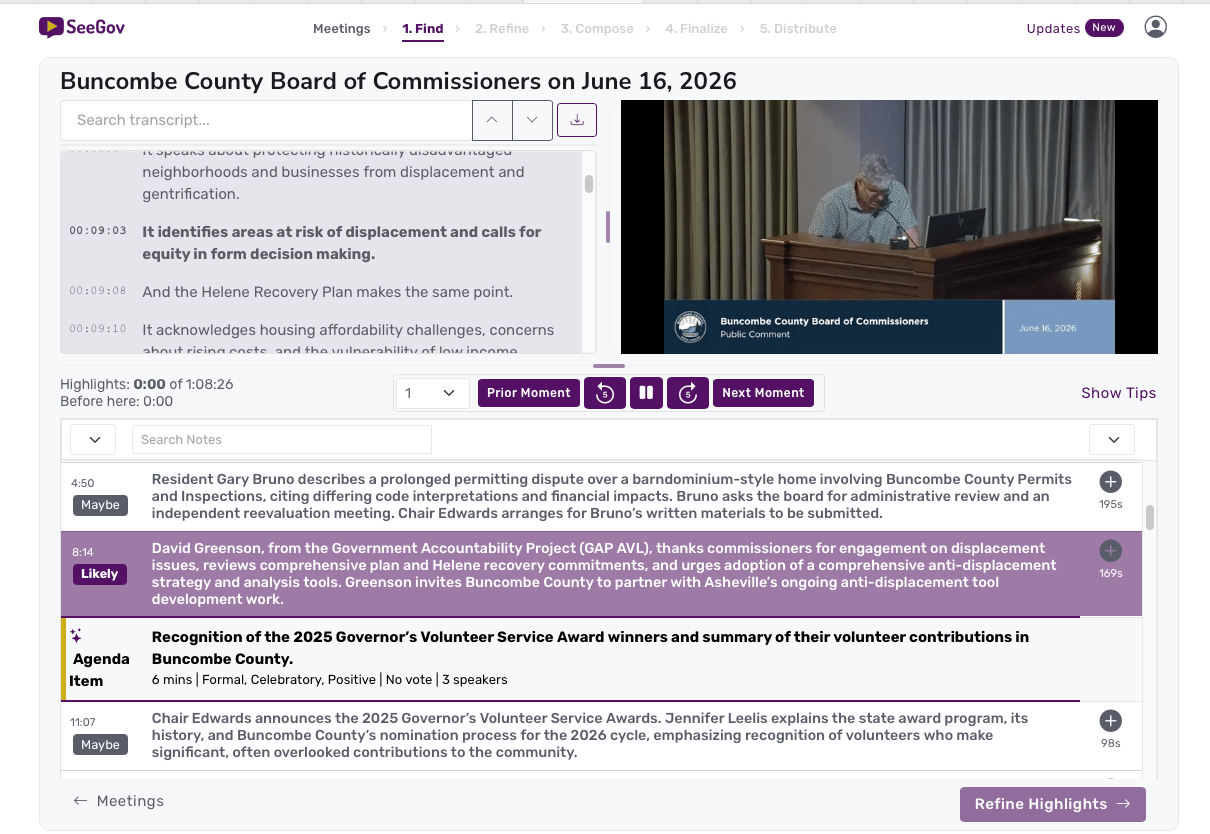
The backend of the SeeGov platform, which provides a user-friendly platform to monitor local government meetings and create highlight videos and social reels. 

A couple years ago, Durham resident Alex Rosen made a list of problems in the world that he thought were worth focusing on. At the time, there were some hot topics at Durham City Council that people were chatting about — but who’s sitting through those long, boring meetings? 


Rosen, a technologist, had been experimenting with the new wave of AI and he started thinking through how it could be used to capture those meetings for local journalists, civic creators and engaged residents. A platform where people could easily review agendas, speakers and transcripts and then — without any video editing skills — easily produce a video or reel to share with the public.


Rosen started tinkering and had the first prototype ready in April 2024. Two years later, the SeeGov platform is now capturing meetings from 200 local governments, including 65 in North Carolina.


Southpoint Access produces weekly highlights from Durham City Council, including this recent meeting discussing the impact of drought and a one-year moratorium on new data centers and crypto mining. The Carrborean began this week’s video with Carrboro Poet Laureate Dr. Amanda Bennett reciting a poem in honor of Juneteenth, followed by updates on a county crisis diversion facility, emergency operations and storm preparedness, and the impact of state legislation that prevents local governments from “down-zoning” in land use policies. And Ashevegas elevated the push for better public safety infrastructure through “Lenny’s Law” at a Woodfin Town Council meeting following the deaths of cyclists. 


The platform is easy to use and includes lots of helpful guidance as you navigate meetings and select your clips. And, with recent seed funding from the Knight Foundation, SeeGov will be able to expand to 1000 communities across the country. 


To learn more, we chatted with SeeGov Founder and Executive Director Alex Rosen about what the platform does, how it can lead to more civically engaged communities and why all AI platforms need a human co-pilot. Our conversation has been edited for length and clarity. 


How does SeeGov work?


Alex Rosen: We have a system that monitors the feeds where local governments post their videos. We download the video and transcribe it. We do speaker identification, we detect the agenda items, and we do these moment by moment breakdowns. 


Once all that is processed, we notify the insiders who are monitoring those meetings that there's a new meeting ready, and it's time for them to review and inform their community. They get an email, they jump in, they can see everything that happened. They can watch the video, and they can mark specific moments that they think are important as highlights from the meeting.


The next level is you can take those highlights and refine them as video elements to share. We make that super easy. We have AI suggestions, but you also can use the words in the transcript to select which ones you want to include in your video. There's no video skills required, which is key.


We then suggest some text to contextualize what happened, but all the text that we suggest is provided as a suggestion that is editable. We really want people to add context and to fix anything if there's an error. And we require you to do that before you move on. So you refine these moments that you've identified as the highlights of the meeting, and then you can compose videos from those moments. You might do a full highlight reel, like a 10 minute recap of the meeting, or you might be focused on just a social video, because you saw something related to a story you did, and you can maybe put it on Instagram, and point people to your story. So you can choose your video format, there's a little bit more tweaking to potentially crop the video, you review the captions, add a headline and then you push the button, and the system goes and does the work.


We tried to make it as easy as possible for that “find news” use case, and then for the “enhance my stories with video” or “create a video product” use case that could be standalone as well. All of this material is generated by the platform. We also generate suggested social posts, and you can distribute this material through the platform, or you can take it and embed these videos on your site,you can get them out to wherever they should be.


Our desire is not to be a destination that competes with news organizations. We want to get this material out, and we trust that news organizations know how to reach their audiences, and we want to help them grow and deepen those relationships with their audiences.


Some local governments do share livestreams, videos and transcripts of their meetings, and there's a few other AI platforms recording meetings and offering summaries. Where does SeeGov fit into this and what gap are you all filling?


Alex Rosen: Typically what you get from the governments is not easy to navigate. If they do tie their video to agenda items, the significant agenda items often take an hour to go through. You might get pointed to the start of an agenda item, but you can't see the pieces within there. So SeeGov makes these really long meetings much more navigable. We break down the meeting into what we call moments that are typically like two to three minute portions of the meeting, logical break points, and then summarize that. You can think of it like YouTube video chapters, it's that same concept, but at a much more granular level to allow you to navigate through this long meeting content.


We identify the agenda items, and then each moment underneath the agenda item, and we do speaker identification as well, so that you can start to see, when did this city council person talk about this issue, those types of things. 


The navigation aspect is really big for journalists, because even if they attend a meeting, they might want to get back to a specific point in the meeting, and it's very difficult to find with either government platforms or YouTube, often. So we have a better transcript, we have these moments that make it much more navigable. 


As far as other tools that are out there, what we've seen is there are AI tools that try to go too far: they try to write a report about a meeting. And to be honest, coming at it from a technology background, we originally thought we could make these video recaps fully with AI. But being in the role of the person, actually trying to identify what's important, and being someone who lives in the community, and having that kind of context, it became clear that the AI at that time was not ready for it. I don't think it's ready for it today, and I'm not sure I even want it to be. 


I like that we make it easy for a human who's committed to a community to look through with their knowledge of the community and identify what's important. We're not trying to pick out the five things that happened and just present that. We are giving you every public comment, everything that happens, so you can use your journalistic judgment to determine what is really newsworthy within your community context.


If you go to the SeeGov website and don’t see your local government, it doesn't mean you don’t offer those meetings, right? 


Alex Rosen: Correct. We just need them to sign up and let us know what local governments should be added, and they will get them very soon thereafter. Also, I'll just note that on the website you see the longer form highlight reels, but you don't see the short form verticals, which are actually out on Instagram in county-specific SeeGov accounts. When reels are published there, the creator has the opportunity to invite their organization as a collaborator, so that they can easily add it to their own reels on Instagram. And all of the material can be downloaded and published to other platforms as well.


How many people are involved? I'm guessing you all are pretty small.


Alex Rosen: It's been just me, and my AI assistants doing as much as possible to build this out. And now I’m super excited to have Andrea Verykoukis as our lead on the partnership and development side of the house. Andrea has done some great things previously in terms of growing a nonprofit newsroom nationally and bringing a journalistic lens to the things that we're doing. She's North Carolina based with a great network across North Carolina; that's important to us as well.


One of the bigger goals is that SeeGov leads to more civic engagement and participation. Why do you think getting more digestible clips of local government on social platforms could lead to that? 


Alex Rosen: I have done get out the vote door knocking for municipal elections before and it was not uncommon to meet people who had an interest in participating but felt that they didn’t know who was who or what the issues were. So they were more likely to opt out of participating in their local democracy. And that to me is a problem that SeeGov can be a big part of addressing. When they know who the people are, when they see them in the grocery store, or maybe they realize how groups show up to city council, it might be just 10 people who got together on an issue, they get heard and action is taken and things really do work. Democracy can work. I want to show more examples of that because that will increase participation not just during elections but between elections when our officials need to hear from the community about what’s important and what would make their communities better. So I’m very excited about the opportunity. 


Learn more about what SeeGov offers local journalists and civic creators and sign up to get your local government meetings on the platform. 

📰 News about the news 📰

NC Local files federal lawsuit to compel release of information about immigration operations

If you’ve been on the NC Local website recently, you may have seen the counter we added documenting the number of days since we filed a public records request to get basic information about the people CBP and DHS detained during “Charlotte’s Web” last Fall. It’s been 212 days.

With an inadequate response from the federal government, NC Local sought support from the Reporters Committee for Freedom of the Press ProJourn program, who paired us with the firm Covington & Burling. In March, they sent a letter on our behalf repeating our request. With the counter ticking upward, this month we made the careful decision to file a federal lawsuit.


"Pursuing legal action isn’t something we take lightly, but it is often the only available recourse when the U.S. government fails in its legal obligation to keep public records open and accessible to taxpayers,” said NC Local Editorial Director Laura Lee. “We are pressing for this information because frankly, the records aren’t ours. They are yours — they belong to the public.”


Read more and stay updated on the lawsuit here

NC public media stations collaborate to strengthen resiliency

Following five months of facilitated dialogue about how to strengthen public media after the loss of federal funds, the North Carolina Local News Lab Fund announced seed funding to help the organizations continue to collaborate. The Fund is providing $85,000 to the North Carolina Public Radio Association (NCPRA), a collective of 13 public media organizations, to develop new collaborative infrastructure and pilot network-wide initiatives. Stations include BPR, WFAE, WFDD, WHQR, WRVS, WNCU, WSNC, WUNC and others. 


The pilot initiative will focus on four areas:

  • Emergency communications: A coordinated statewide alerting system will reduce redundant newsgathering and ensure verified, timely information reaches communities during crises.

  • Reporting and distribution: Collaborative journalism shared across partner stations will expand local coverage statewide without proportional cost increases.

  • Underwriting sales: Pursuing regional and statewide sponsorships will generate new earned revenue.

  • HBCU journalism pipeline: Structured mentorship and newsroom integration will give HBCU students direct pathways into public media careers — building a more diverse workforce while expanding reporting capacity now.

Stations based at HBCU’s were hard hit by the federal funding cuts with WRVS losing more than 70% of its revenue. 


“WRVS, along with other public media stations at HBCUs, have long shown up for the communities we serve. Helping to bridge the gap between campus and community, our platforms amplify cultural narratives through local programming and student education,” said Station Manager Melba Smith. “HBCU stations and our students are shaping the future of public media every day. By helping to craft this plan, it means the perspectives and stories that we carry into this work have a seat at the table.”

Tyler Dukes named UFCJC Knight Chair in Journalism and Technology

Longtime North Carolina journalist Tyler Dukes is Florida bound. Dukes announced he is joining the University of Florida College of Journalism and Communications as the Knight Chair in Journalism and Technology this Fall. 


"I'm thrilled not only to teach the next generation of journalists, but to explore the future of journalism through computational reporting, artificial intelligence and whatever comes next," Dukes said on LinkedIn

Dukes has been leading AI innovation for McClatchy's 30 newsrooms. Prior to that he spent more than a decade doing data-driven investigative and accountability work at the N&O and WRAL, including creating a massive dataset of hedge funds and equity firms buying up single-family homes and, with Travis Fain, exposing how an unlicensed group home got millions in federal funds to house unaccompanied migrant children. Dukes also taught "Journalism in the Age of Data" and "Gerrymandering and the Press" at Duke University and teamed up with Bill Adair on this AI Journalism Lab that guided students as they built AI tools for local newsrooms.


Tyler has always been so generous in sharing expertise and inspiring other journalists (including at the past two NC News & Information Summits).  Thank you for all your contributions to the NC news and information ecosystem and congratulations on this very exciting new chapter! 


Have something to share about your news and information organization? Send a note to catherine@nclocal.org.

Available for republication 


✅ NC Local: A sweeping election bill is on hold as Senate leaders propose giving auditor more power over voting process. Here’s how to weigh in.


✅ NC Local: Lawmakers propose giving state auditor new powers after Jackson Board of Elections controversy 

✅ NC Health News: Record crowds, hot stadiums: Extreme heat could be a player during this summer’s World Cup


✅ KFF Health News WNC Coverage: They’re Uninsured After Obamacare Became Too Costly. And They’re Far From Alone.

Bulletin Board

Jobs

📌 Editor, The Sylva Herald, Sylva

📌 Senior Editor, WFAE, Charlotte 

📌 Reporter, The Mountaineer, Waynesville 💰

📌 Reporter, NC Newsline, Raleigh💰

📌 Magazine Editor, CityView/The Assembly, Fayetteville 💰

📌 Public Programming Director, The Assembly (Remote in NC, Triangle preferred)

📌 Local Government Reporter, INDY/The Assembly, Durham 💰

📌 Audience Lead, Food & Environment Reporting Network (Remote)💰

📌 Chief Content Officer, Religion News Service (Remote) 💰

Opportunities & events

📅 LEGENDARY - Celebrating the Legacy of John R. Hayes: Celebrate the legacy of the late Asheville community leader John R. Hayes, founder of WRES, the Hillcrest Enrichment Program and the High Steppin’ Majorettes & Drum Corps. The event includes a preview of a new documentary in the works by Sekou Coleman documenting the life and contributions of Hayes and the lasting impact he had. Today/June 18, 6:00-9:00, Asheville. 

📅 Civic Health Summit: The second annual summit is an opportunity to learn, explore and discuss ways to strengthen civic life in North Carolina. Sessions will highlight best practices, tools, and models to ensure residents are better informed, connected, engaged, and empowered to shape the future of our state. Registration is free and open until we reach capacity, which is 200 individuals. June 29, 9:30-4:00, Elon University. 


📅 Building Narrative Infrastructure Series: How do communities build the trust and connections needed to solve problems together? This July, Narrative Arts, the Coastal Journalism Hub, and the Collaborative Journalism Resource Hub are hosting a three-part webinar series exploring how storytelling, journalism, public health, and civic engagement can work together to strengthen community health and community power. Topics include: building trust between communities and local journalism; creating local coalitions that connect residents, health workers, storytellers, journalists, and civic leaders; and turning community stories into stronger public dialogue, learning, and civic infrastructure. Tuesdays, July 7, 14 & 21, 2:00 pm ET.


📅 SRCCON 2026: This annual hands-on event hosted by OpenNews brings together developers, designers, journalists, editors and allies for hands-on workshops that reimagine newsroom tech, teamwork, leadership, community, and journalism itself.  Sessions range from tech, product and editorial to safety, leadership and building better newsroom cultures, including:

Prices start at $295, plus ticketing fees. There are a limited number of need-based, free scholarship tickets as well as $500 travel or caregiving stipends. Sign up to volunteer and get complimentary admission. July 8 & 9 in Minneapolis, Minnesota.

That's it for this week, thank you for reading and as always know you are appreciated for all you contribute to the NC news and information ecosystem!  —Catherine


Email Marketing by ActiveCampaign