|
Greetings all, it’s Wednesday July 1st. Let’s begin with appreciation for all the reporters pouring through the 600+ page state budget (and even longer Conference Committee report). The N&O’s Dawn Baumgartner Vaughan, WUNC’s Colin Campbell, The Caucus’s Bryan Anderson and NC Local’s own Will Michaels break down some of the major parts of the $34 billion spending plan, including teacher and state employee raises; $1 billion toward rising costs of Medicaid; $700 million for Hurricane Helene relief; income tax cuts and much, much more.
WRAL’s Paul Specht and Liz McLaughlin dive into some specifics, including $15 million to address PFAS contamination while Emily Walkenhorst highlights some K-12 provisions, including changes to math education, book challenges and a prohibition on serving less food to students who are behind on meal payments.
The NC Health News crew has a round-up of impacts on Medicaid, SNAP, mental health programs and the Healthy Opportunities Program while the NC Newsline team highlights the elimination of state programs that address racial disparities, $49 million for Farmland Preservation and $2.2 billion for the state prison system, much of that going to raises and staffing. On the coast, SamWalkerOBXNews analyzed the impacts of ending free ferries for locals who depend on the system to get around. And The Assembly’s Korie Dean has been following the Campus Survivors Act, included in the budget bill, that would exempt records of disciplinary proceedings that include personally identifiable information from state public records law.
Whew, that is not all the coverage and not all that’s in the bill. Scanning for other public records impacts, I spied Section 8.27.(g) which would exempt some of the PFAS data the state is collecting from public records law and Section 8A.12.(a) which would exempt test performance data from nonpublic schools receiving Opportunity Scholarships from public records law.
Once again, there’s very little time for anyone (lawmakers included) to review what’s in the bill ahead of expected votes tomorrow. It seems counter to transparency, open government and good governance — and makes the work you all are doing that much harder. So thank you to all the reporters, editors, audience staff, open government advocates and others in the ecosystem helping all of us make sense of what’s happening and how it impacts communities.
Here’s what we have lined up for you today:
-
Emergency Mode for News is live! A project by OpenNews, Newspack and NC Local, we chat with the team that worked on this important resource for newsrooms.
-
Ready to have fun getting things done? Join publishers, editors, audience directors & product leaders for a three day Local News Camp in Durham.
-
Want to mobilize people & information for public good? CJC is hiring for North Carolina’s first Documenter’s program.
Glad you’re here, let’s get started. |
|
|
|
|
Emergency Mode for News is live!
Resources, tools and training to support newsrooms before, during and after climate disasters |
 |
|
|
|
Responding to fast-moving climate emergencies, like wildfires or floods, or the more slowly-moving ones, like drought and extreme heat, is becoming an increasingly frequent event for local newsrooms. Whether you’re a soloprenuer, a small newsroom or a larger one, it can feel daunting to put together (or update) emergency plans for all the scenarios we face.
But emergency preparedness is about more than a piece of paper and a supply list. It’s about relationship building. Learning from peers. Getting better acquainted with trauma-informed practices to support your staff and your community.
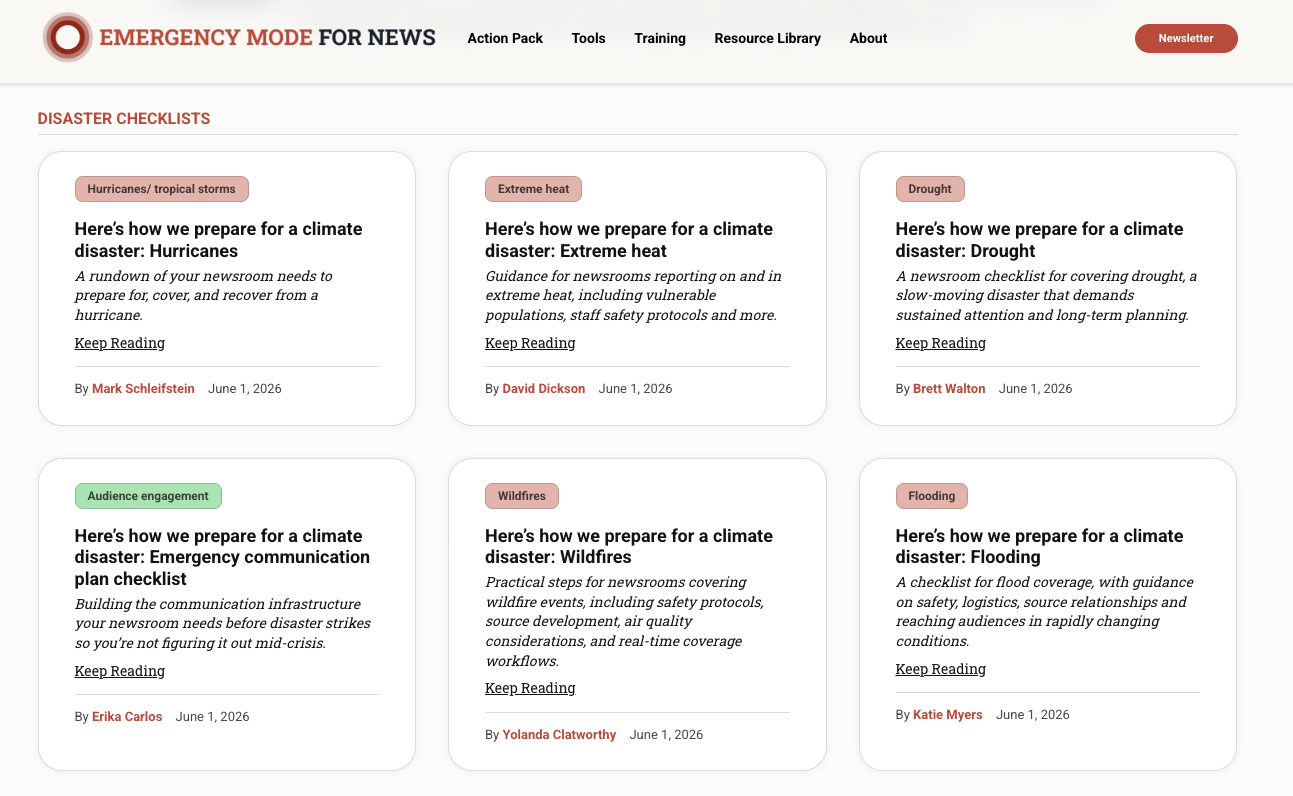
This week, we are pleased to share a new dynamic resource to help newsrooms and journalists across the country: Emergency Mode for News. A partnership between OpenNews, Newspack and NC Local and funded through an infrastructure grant from Press Forward, Emergency Mode for News offers a collection of resources, a peer-learning program, mini grants and a point of connection and collaboration.
The project kicked off last fall with a design sprint (read more about that here), followed by several months of research, building, testing and working with journalists across the country who’ve navigated disaster coverage (read more from NC Local’s Diara J. Townes here). As Emergency Mode for News is made for people just like you, we’re hoping you’ll check it out, share feedback and help us refine the offerings as we move ahead.
This week, we chat with some of the Emergency Mode for News contributors about what the project is all about.
What is Emergency Mode for News and what are the goals of the project?
Jessica Morrison, Open News Co-Executive Director: Emergency Mode for News is a program with resources, software and training to help newsrooms and journalists plan for disasters. We’ve heard from many news leaders that they know they should have an emergency plan to keep their newsroom running and support their staff, but it’s hard to prioritize that work. Our goal is to make emergency planning and operational preparedness a shared, industry-wide effort so that more newsrooms feel confident in their capacity to handle emergency situations rather than scramble.
Emergency Mode was built based on interviews and surveys with newsrooms. What did you learn when you asked them about their preparedness plans, capacity and needs?
Sasha Koren, Emergency Mode Project Manager: During an early round of research, we had conversations with editors of small newsrooms in the southern U.S. about their experiences with environmental emergencies. Almost every editor we talked to had steered their newsroom through at least one extreme weather event and several had gone through more, most frequently hurricanes and tornados, along with a freak ice storm in one case. Unsurprisingly, then, they all recognized the importance of making emergency plans, even though none had been able to set aside time to create them, largely because of staffing and time constraints, with issues always cropping up that need their attention at the moment. This feedback mirrored the results of a small but meaningful survey of small U.S. newsrooms, in which 65% of respondents indicated that they did not have an emergency plan. These two sets of feedback validated that the resources Emergency Mode was planning would address a tangible need. A few respondents made the observation that editors and other news managers often carry a lot of emergency expertise and technical knowledge in their heads, making them indispensable during emergencies, but putting their organizations at risk if they should leave the outlet, be cut off from communication or, worse, sustain an injury.
Emergency Mode took insights from those interviews and surveys to build out a set of resources for newsrooms. What are those resources are and how they can be used?
Diara J. Townes, NC Local Project Manager for Emergency Mode: One of the resources is a collection of checklists: downloadable, adaptable guides that help newsrooms navigate safety and wellness, and operations and editorial planning before, during and after disasters. The checklists cover six disaster types: drought, extreme heat, flooding, hurricanes, wildfires, and winter storms (coming soon). We also included a checklist that dives into emergency communications, given the various platforms we use as newsrooms and journalists.
Lived experience was a primary factor in how we selected contributors. These aren’t generic preparedness documents; they were written with practicality in mind. Later this summer, we'll also have a Language Access Guide to help newsrooms reach more people in their communities.
We also have several templates, including a Phone Tree to help news leaders plan for how they’d communicate with staff should a communications blackout occur. We created a Source Template as well — but it’s more than just a list of names and contact info. We designed that guide to help newsrooms develop relationships ahead of a disaster. And, tapping into the expertise of the Committee to Protect Journalists and Editors Safety Hub, we built an Assignment Risk Template to help news leaders have conversations with their journalists (including freelancers) before going out on assignment — and really think through wellness and a duty of care.
These are also all adaptable, based on a newsroom’s needs. As with all the resources, the goal is for newsrooms to begin building something functional; not a perfect plan, but a real starting point.
The resource library also features several case studies — what do these focus on and how do they help news leaders serve both their communities and their staff?
Diara J. Townes: The case studies were where we most fully realized the goal of making this project human. While the checklists and templates are built for speed and utility, the case studies go deep into the real, specific decisions that newsrooms made when disaster was on the doorstep: from capacity planning for small newsrooms, to engagement strategies, to trauma-informed practices for your staff and community. They span regions and disaster types, from Hurricane Maria in Puerto Rico to tornado and flood response in Kentucky, with a focus on surfacing strategies that are replicable, not just accounts of what happened. |
 |
|
We know it can be overwhelming to have to sift through a giant list of resources. Emergency Mode has another feature called an Action Pack to help match resources with newsrooms and journalists. Could you explain how this works?
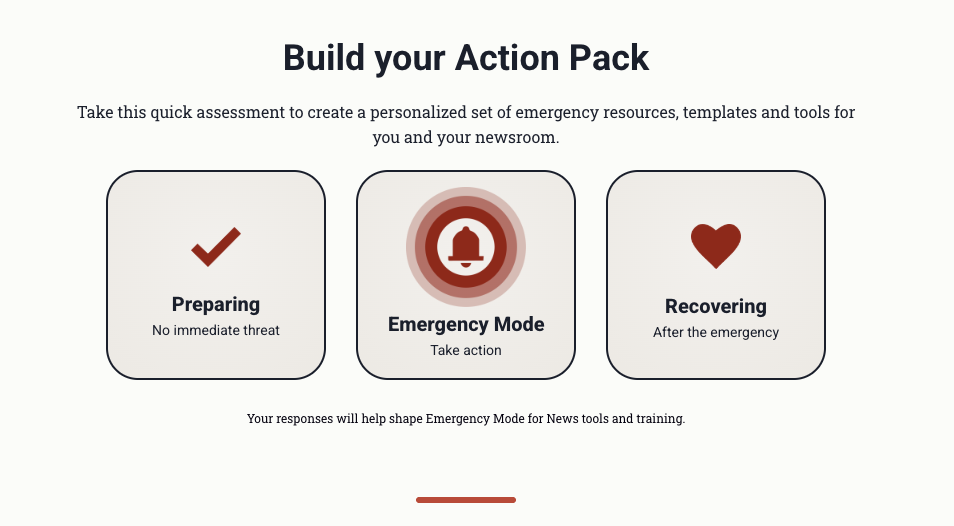
Abby Reimer & Tiff Ferr, Composition Collective & Newspack: We adapted a quiz-like format to drive our resource recommendation system, where we ask journalists about 10 questions (on average) about their current emergency and newsroom context. As they answer, we prioritize topics in our Resource Library that best match a given newsroom’s needs. During the Q&A steps, if a specific answer directly matches an important resource or tool (like Lite Sites), we’ll surface it immediately. The quiz questions themselves are meant to focus the mind. Journalists are often faced with a million questions and concerns before, during and after an emergency, and our goal was to keep it focused on the most essential things.
The quiz has three “paths” within, focused on preparation, immediate needs, or recovery after a disaster. At the end, journalists receive a list of specific and recommended items in their “Action Pack.” We create a custom URL for each Action Pack, so journalists can return later to see prior items and maybe new recommendations. They can pick and choose what resources fit best for their news org and community.
From a product perspective, we aren’t trying to maximize engagement, “time-spent” or “quiz completion.” If a journalist only has five minutes and we’re able to solve one big problem in that five minutes, that’s a win. We think there’s a lot of opportunity to build on top of this feature, make it better or even adapt it to other use cases. All our code is open and integrates with Newspack, so we see lots of opportunity here to adapt for other challenges like elections.
Emergency Mode also includes peer-learning cohorts and you’re kicking off a pilot this summer. What will these look like and what can you tell us about future cohorts?
Ryan Pitts, Emergency Mode Learning Program Lead: We’re organizing a workshop series that gives busy journalists dedicated time to design disaster response resources for their newsroom. Each workshop will have a guest speaker who shares expertise on planning and coverage, a conversation where peers exchange questions and ideas and learn from each other, and working time to take templates and checklists from the EMFN library and customize them for each participant’s newsroom.
One of the things we heard during early research was how strapped for time journalists are right now — it’s hard to fit in another professional cohort or join yet another Slack channel! So we’re keeping this pilot workshop series short and focused: four weeks of 90-minute workshops with concrete takeaways that newsrooms can roll out right away. I’m excited to start meeting with our first group this summer, and we’ll learn a lot from them about what people need from EMFN.
This summer’s pilot series will bring together newsrooms from regions affected by hurricanes. Future cohorts will be open to newsrooms all over the country, to work together on resources in regions affected by wildfires, drought, winter storms and other emergencies. We think participants have a lot to learn from each other, and it means a lot to connect with people who share the same challenges. Stay tuned for announcements about our next workshop series! |
|
|
|
|
|
Additional Emergency Mode Resources
Emergency Mode for News is also offering two tech tools, developed by Tiff Ferr and the team at Newspack. The Lite Site plugin will enable newsrooms to have a text-only “mini-site” during low-connectivity emergencies (readers of this newsletter may remember we worked with Newspack during Helene to provide this to WNC news organizations). Another tool is a Rolling Coverage plugin, to provide audiences with real-time updates during break news events.
Stay up to date on the launch of these tools later this summer, future peer learning cohorts, mini grants and more by signing up for the Emergency Mode newsletter.
There are a lot of resources and guidance in the Emergency Mode for News initiative and over the weeks and months, we'll be sharing out ideas in The Hub newsletter that you can put to use here in North Carolina.
Also, a big thank you to the North Carolina contributors to this project! Please check out their contributions including: David Dickson's extreme heat checklist, Katie Myers’s flooding checklist, Chelsea Naughton’s audience engagement case study and Sara Murphy’s trauma-informed practices case study, which features NC Local's Editorial Director Laura Lee. Jose Sandoval and Patricia Serrano are currently working on the Language Access Guide, which will be added to the Resource Library in the coming weeks. |
|
|
|
|
|
Bulletin Board |
Jobs |
|
📌 Documenters Program Manager, Charlotte Journalism Collaborative, Charlotte 💰
📌 Director of Audience & Content, BPR, Asheville💰
📌 Editor, The Sylva Herald, Sylva
📌 Senior Editor, WFAE, Charlotte
📌 Reporter, The Mountaineer, Waynesville 💰
📌 Reporter, NC Newsline, Raleigh💰
📌 Magazine Editor, CityView/The Assembly, Fayetteville 💰
📌 Public Programming Director, The Assembly (Remote in NC, Triangle preferred)
📌 Local Government Reporter, INDY/The Assembly, Durham 💰
📌 Vertical Video Reporter, The Marshall Project (Remote) 💰
|
Opportunities & events |
|
🌱 Trusting News Trusting News Creator Journalists Fellowship : Applications are open for this five-month-long program aimed at helping creator journalists test how they can demonstrate credibility to their audience. Topics include communicating who the journalists are, why they are credible, and the ethics and integrity that drive their work. Fellows receive $4,000 for completion of the program and one year membership to the Project C community. Deadline: July 10.
🌱 Fulcrum Fall Journalism Fellowship: Applications are now open for the Fall 2026 Fulcrum Fellowship, a solutions‑focused journalism program designed to train emerging reporters in narrative complexity and community‑centered storytelling. Fellows receive mentorship from the publication’s editorial team and opportunities to publish original reporting. Each fellow who completes the program receives a $1,000 stipend. Deadline: August 3.
📅 Building Narrative Infrastructure Series: How do communities build the trust and connections needed to solve problems together? This July, Narrative Arts, the Coastal Journalism Hub, and the Collaborative Journalism Resource Hub are hosting a three-part webinar series exploring how storytelling, journalism, public health, and civic engagement can work together to strengthen community health and community power. Topics include: building trust between communities and local journalism; creating local coalitions that connect residents, health workers, storytellers, journalists, and civic leaders; and turning community stories into stronger public dialogue, learning, and civic infrastructure. Tuesdays, July 7, 14 & 21, 2:00 pm ET.
📅 Getting started with WhatsApp to serve Immigrant Communities: RJI and the Immigrant News Coalition are hosting a conversation to help newsrooms learn how to get started with WhatsApp. Presenters from Documented, Conecta Arizona and El Tecolote will share how to build trust, relationships and connection through using WhatsApp to answer questions directly, have conversations and share vital information with the communities they serve. July 21, 3:00 pm ET.
📅 Local News Camp Durham: Blue Engine Collaborative, BlueLena and Newspack are hosting a three-day hands-on, collaborative gathering for local news organizations to tackle challenges and find solutions to immediately put to use in your business models. Subjects include: Implementing AI in your business operations; Marketing; Product development; Being an elite salesperson; Making money with video; Expanding into new markets and more. October 14-16.
|
|
|
|
|
That's it for this week. Budget readers, a reminder to take breaks from the screen. And everyone, stay safe in this heat and know you are appreciated for all you contribute to the NC news and information ecosystem. —Catherine |
|
|
|
|
|
|