Share
Plus,‌ are you ready to respond to 1st Amendment threats?
 ‌ ‌ ‌ ‌ ‌ ‌ ‌ ‌ ‌ ‌ ‌ ‌ ‌ ‌ ‌ ‌ ‌ ‌ ‌ ‌ ‌ ‌ ‌ ‌ ‌ ‌ ‌ ‌ ‌ ‌ ‌ ‌ ‌ ‌ ‌ ‌ ‌ ‌ ‌ ‌ ‌ ‌ ‌ ‌ ‌ ‌ ‌ ‌ ‌ ‌ ‌ ‌ ‌ ‌ ‌ ‌ ‌ ‌ ‌ ‌ ‌ ‌ ‌ ‌ ‌ ‌ ‌ ‌ ‌ ‌ ‌ ‌ ‌ ‌ ‌ ‌ ‌ ‌ ‌ ‌ ‌ ‌ ‌ ‌ ‌ ‌ ‌ ‌ ‌ ‌ ‌ ‌ ‌ ‌ ‌ ‌ ‌ ‌ ‌ ‌ ‌ ‌ ‌ ‌ ‌ ‌ ‌ ‌ ‌ ‌ ‌ ‌ ‌ ‌ ‌ ‌ ‌ ‌ ‌ ‌ ‌ ‌ ‌ ‌ ‌ ‌

Click here to view in your browser

Did someone forward you this email?

👋 Click here to sign up

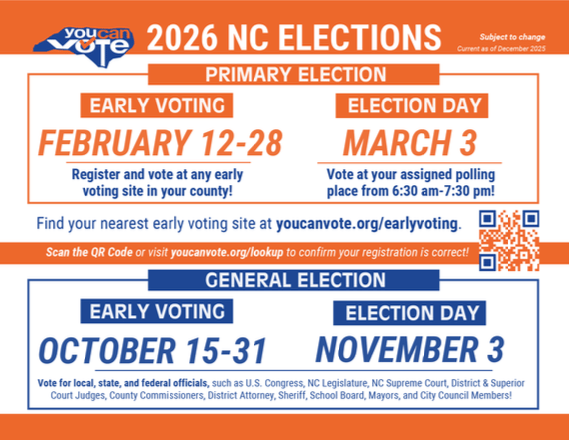
Greetings all, it’s Wednesday February 11. Early voting starts tomorrow for the 2026 Primary and you all have been busy! The Election Hub, a partnership with The Charlotte Ledger, has a comprehensive guide for Mecklenburg, Cabarrus and Gaston counties. Chapelboro produced a series of “candidate introductions” for voters in Chapel Hill, Carrboro, Hillsborough. Holly Springs Update looks at why the primary will likely be the general for Wake County District Attorney. Asheville’s WPVM invited all 20 city council candidates to participate in virtual forums. The seven who responded had plenty of time for Q&A with WCU Professor Chris Cooper. WHQR, WECT and Port City Daily partnered on in-person forums, including School Board, which takes place tomorrow at 6 pm. And, many of you are following the student lawsuit challenging the removal of early voting sites on several college campuses by the state Board of Elections. As of Monday, a US District Judge denied the students' motion for a preliminary injunction.


As you continue your coverage over the next few weeks, today our friends at You Can Vote share some practical tips and resources to help your audiences get what they need to make their voting plans. 


A few more highlights:

  • Does your organization serve a rural area in NC? Applications are open for RJI's two-day Rural Revenue Transformation workshop to help you develop strategies that work for your audience. 

  • How should you prepare for 1st Amendment threats? A new guide walks you through steps you should start taking now. 

  • The annual DTH/Chron Rivalry Challenge raises a record amount of donations to support independent student journalism. 

  • And, this Sunday is the deadline for the 2026 Sunshine Awards and Frank Barrows Award for Excellence in Student Journalism. Nominate yourself or someone deserving of these recognitions for transparency, accountability and open government! 


Before we get to it, in last week's edition we highlighted the new national Local News Day, which is taking place April 9th. Want to hop on a meeting next week to brainstorm ideas of how NC news and info orgs can participate? Send me a note to catherine@nclocal.org or reply to this email. 


Glad you’re here, let’s get started.

Your Plain Language Primary Playbook

With early voting beginning this week, we reached out to You Can Vote, the North Carolina nonprofit focused on voter education and outreach across the state. With a presence in 60+ counties and lots of on-the-ground community engagement, they’ve learned a lot over the last 12 years. One big takeaway: most people need information about the basics of voting: how do you register? How do you find your sample ballot? How do you make your voting plan? What are the election dates and deadlines?


To help make this information accessible, each election You Can Vote creates a series of guides, graphics and tools. All are available for news organizations to use and republish, with many available in Spanish


We called up Deputy Director Caitlin Metzguer to learn more about some of the key messages news organizations should highlight this primary and what You Can Vote resources you can put to use. 


Primary Day is Tuesday, March 3rd. What changes should news organizations highlight for their audiences?


Caitlin Metzguer: The one big change for absentee voting is that the request for anyone who wants to vote by mail is due a week earlier. So February 17th is the deadline to request a ballot, if people are voting by mail. 


This is not new for '26, but there is also no longer a grace period and that might catch some people off guard. Meaning, if people vote by mail, the ballot has to arrive by 7:30 pm on Tuesday, March 3. There's no grace period if it arrives a couple days later.


Early voting is generally the best option for the most people. What news organizations can help share is the sites and dates and locations. Early voting sites change based on the election. There are more sites of early voting for the primary, but less hours, because not everybody has weekend hours.


So, I would push information out about early voting sites, which we have the link on our voter guide page to those. And make sure that folks know that the 2026 primary early voting schedule is the only thing that they should be using, because those dates, times, locations do vary by election.


Is that something you recommend news outlets specifically mention: “the place you voted in the last election may have changed?”


Caitlin Metzguer: Right, exactly. I think it's very helpful to say, don't assume that you're going to go to the same spot as in ‘24, or even ‘25. Make sure you know the latest sites, and that is either on the county board websites or on our voter tool.


What are your recommendations for alerting people about the Registration Repair Project?


Caitlin Metzguer: The Registration Repair Project is still causing a little bit of confusion. The best thing to do if you find yourself on the list is to update your registration, which you can do at early voting. So, the message hasn't really changed since ‘25. If you're on the voter Registration Repair list, take care of that by taking action with your county board of elections. Now that we're past the voter registration deadline, the best thing to do is utilize same-day registration and go vote early between February 12th to 28th.


There's definitely been a lot of press coverage about Registration Repair, and there are still about 70,000 people on the list. That's a small percentage compared to over 7 million voters, so I wouldn't lead with that. I don't think that's the takeaway from this election. But because it rolled out in 2025, and more people will vote in 2026 because it's a bigger election, there's likely going to be people who find out that they’re on the list when they go to vote. That's okay, don't panic, just take care of it right then, and don't go home without voting if you are an eligible voter.


We’ve seen a lawsuit by students challenging the rollback of early voting sites on several campuses. What are your recommendations here?  


Caitlin Metzguer: There's been a lot of press coverage of course on not picking campus sites for early voting. However, we still want to promote early voting, and I know the campuses are doing a great job of supporting their students to go out and vote.


It's unfortunate that those campus sites were not picked, and there's another round of early voting advocacy over the summer, so if folks want to see more access in the fall for the general election, there's time to take action. I would say go to your local board of elections meeting, once they start talking about early voting again, and just start advocating for the sites that you want to see.


What guides are you offering for the primary, either new ones or existing ones?


Caitlin Metzguer: We have a communications toolkit, which is similar to the ones we've done in the past with sample emails, sample social media, sample graphics that groups can use, including newsrooms if you wanted.


We also have a high school toolkit that is specifically focused on supporting young voters and an updated campus toolkit for college-age students. People can download those and use that content.


Also with regard to young voters, one thing to highlight about the primary is that voters who are 17 right now, but will be 18 by November 3rd, can vote in the primary as a 17-year-old. So, there are some great messages to share specifically with those young voters who might think they have to wait, but they are eligible, as long as they're 18 on or before November 3rd, Election Day.


You Can Vote is on the ground, talking to voters and would-be voters all year round. What have you learned about the best ways of reaching people with information about voting? 


Caitlin Metzguer: Our Voter Guide is the best snapshot of resources and also our Ballot Builder. But it’s really having conversations with people about what's on the ballot. It's not an effective message to say, "Go vote, go vote, go vote." It's more effective to say: “the Primary is on March 3rd. That's when we whittle down a whole bunch of candidates who voters want to see on the general election ballot.” It’s really helpful to explain what a primary is.


And talking to people about what's on the ballot in terms of the issues they care about. That's always going to be the most effective conversation. If you're interested in education, we're voting for school board, we're voting for county commissioners which fund our schools. We're voting for the legislature, which is supposed to fund everything in our state, right? If you're interested in public safety, there are sheriffs on the ballot, district attorney, clerk of courts; the state Supreme Court is back on the ballot this year. Meeting people where they are by matching their interest with the office that impacts that issue is always going to be the most effective conversation that we can have.


Anything else you’d like to share that’s important for news organizations to be thinking about, or to be communicating to their audiences about how to vote this primary season?


Caitlin Metzguer: I will mention Voter ID, which is still required in North Carolina. You do not need a Real ID to vote. A normal driver's license works, if that's what you have. There's a full list of accepted IDs, and it's not too late to get one from the county boards of elections if you still need one. Each county board offers a free photo ID to anyone registered in that county. Finally, if people do not have photo ID, there is an exception form, and people should still go vote and ask to use that exception form. They'll need to give a reason why they don't have an ID, but will still be offered a ballot.


Lastly, I'll just mention there's an Election Protection Hotline, and so if anyone has questions, problems, issues, they can always reach out to 888-OUR-VOTE, which is the North Carolina nonpartisan Election Protection hotline, and it's run by trained volunteers and election attorneys who answer questions. They’ll be available starting today, right as early voting begins.


Thank you Caitlin for sharing these tips and resources for the 2026 Primary!


 👏 Well Done  👏


👏 For The Assembly & ProPublica, Ren Larson has the next in her series looking at rebuilding in Western North Carolina following Helene. Larson examines the problems that plagued ReBuild NC, the program to help Eastern NC residents rebuild after Hurricanes Florence and Matthew and the reforms made by the state in the new Renew NC program. But so far, the program's only completed 16 of the 2,700 homes in WNC on the list for repairs and rebuilding. Also for The Assembly, Jessica Wakeman brings a behind-the-scenes look at the people who've been working to reunite Helene survivors with personal items swept away in the floods. No matter how small they may seem, artifact recovery technician are carefully cleaning water stained photos, children's toys and even a Reba McEntire coffee mug and working to get them back to their owners. 


👏 The annual Rivalry Challenge between The Daily Tar Heel and The Chronicle wrapped up Saturday ahead of the tip off for the big game. Now in its 8th year, student journalists spend nine days trying to outdo each other in fundraising for their respective publications, while also collaborating on a 32-page Rivalry Challenge special edition. Both are independent, student-led news organizations that do not receive any student fees. 


While the Tar Heels may have prevailed on the court, The Chronicle’s team got bragging rights for a second year in a row, raising $79,834.  But it was also a win for the DTH too, bringing home $66,781 — $18,000 more than last year! 


“Though we’re competing, this is about something we all care about deeply — making sure our audiences have strong news organizations they can trust and that our student journalists have the training, resources and editorial freedom they need to do the job,” said Chronicle CEO Chrissy Murray in a press release. “With all eyes on issues in higher education this year, some of the most important reporting is coming from those who are here on the sidelines asking tough questions.”


Since 2019, the Rivalry Challenge has collectively raised more than $700,000 for these nonprofit newsrooms. 


NC Local pieces available for republication


Should North Carolina’s short-term rentals be taxed as commercial property?

A lesser-known state body, the Property Tax Commission, will hear a case about how to value Airbnbs and other short-term rentals.


Changes at the Alamance County jail after ICE deal ends and Iryna’s Law goes into effect
Sheriff Terry Johnson says his focus shifted to current needs: changes to jail operations under Iryna’s Law, funding, and the possibility of working with federal authorities again.


A federal rule change could affect NC wetlands, making communities more vulnerable to flooding and poor water quality


Plus, customizable social graphics for the wetlands story. 

Bulletin Board

Jobs

📌 Accountability Reporter, NC Local (Remote in NC)💰

📌 Community Reporter, Beacon Media, Franklin & Granville Counties 💰

📌  Democracy, Immigration and Community Affairs Reporter, Enlace Latino NC, Durham 💰

📌 Editor, QCity Metro, Charlotte 💰

📌 Director, North Carolina Local News Lab Fund, Remote in NC 💰

📌 Breaking News Reporter, The News & Observer, Raleigh 

📌 Endowed Chair in Journalism and Public Policy, Duke-Sanford School of Public Policy, Durham 

📌 Senior Investigative Reporter, The Lever (Remote) 💰

Opportunities, events & resources 

🧭 How to build a newsroom plan for responding to First Amendment threats: Poynter has a new guide to help leaders prepare in advance for their newsrooms to do journalism when First Amendment rights are threatened. The guide helps journalism leaders assemble the information and resources you’ll need if equipment is seized, your reporters are arrested, or they’re in the field covering violence or unrest. The guide lays out what you should start doing this month, over the next 3 and 6 months, to make the process a bit easier to accomplish. 


🌱 Rural Revenue Transformation Workshop: RJI invites applicants for this inaugural training, which includes two days of in person, hands-on sessions and collaborative activities April 12-15. The sessions will help surface ideas and solutions that are specific to news organizations serving small, low-income, geographically dispersed communities without access to broadband and other civic infrastructure services. RJI offers hotel rooms, breakfast and lunch, and a limited number of flight scholarships as well as post workshop support implementing one of your ideas. Application deadline: February 14.


📅 How to Understand Reach and Survive in AI-First Era: AI platforms are rewriting—not just ranking—content, fundamentally reshaping how audiences discover and engage with news. In this INN webinar, John Shehata, founder and CEO of NewzDash, will break down how Google’s AI Overviews and chatbots are transforming visibility, user behavior, and publisher revenue and share the practical actions publishers need to take to navigate AI citations, protect visibility, and build sustainable audience and revenue models in an AI-first world. February 12, 1:00 pm ET.


📅 Physical Safety Training for Journalists and News Organizations: ProJourn, IWMF and the American Journalism Project present a training on physical safety for journalists. Jeff Belzil, Security Director at the International Women's Media Foundation, will cover topics including identity-aware risk assessments and how to report safely on law enforcement activities and during times of civil unrest in the US. February 17, 3:00-4:30 ET.


📅 2026 IIJ Conference: Solo Together. A conference for independent journalists and creators to find community and build thriving businesses. 12 live, online sessions, plus bonus Q&A videos and editor panels, delivering over 20 hours of learning. March 5-6.

That's it for today, thank you for reading. As always, know you are appreciated for all you do to support the North Carolina local news and information ecosystem.  —Catherine 


Email Marketing by ActiveCampaign