Share
Plus,‌ get your legal questions answered this Friday.‌
 ‌ ‌ ‌ ‌ ‌ ‌ ‌ ‌ ‌ ‌ ‌ ‌ ‌ ‌ ‌ ‌ ‌ ‌ ‌ ‌ ‌ ‌ ‌ ‌ ‌ ‌ ‌ ‌ ‌ ‌ ‌ ‌ ‌ ‌ ‌ ‌ ‌ ‌ ‌ ‌ ‌ ‌ ‌ ‌ ‌ ‌ ‌ ‌ ‌ ‌ ‌ ‌ ‌ ‌ ‌ ‌ ‌ ‌ ‌ ‌ ‌ ‌ ‌ ‌ ‌ ‌ ‌ ‌ ‌ ‌ ‌ ‌ ‌ ‌ ‌ ‌ ‌ ‌ ‌ ‌ ‌ ‌ ‌ ‌ ‌ ‌ ‌ ‌ ‌ ‌ ‌ ‌ ‌ ‌ ‌ ‌ ‌ ‌ ‌ ‌ ‌ ‌ ‌ ‌ ‌ ‌ ‌ ‌ ‌ ‌ ‌ ‌ ‌ ‌ ‌ ‌ ‌ ‌ ‌ ‌ ‌ ‌ ‌ ‌ ‌ ‌

Click here to view in your browser

Did someone forward you this email?

👋 Click here to sign up

Greetings all, it’s Wednesday November 19. You’ve covered hurricanes, a pandemic, racial justice protests, the recent government shutdown and other big stories that affect the day-to-day lives of your communities. Now, we’re facing something new: masked and heavily armed federal border patrol agents conducting operations in neighborhoods, shopping center parking lots and outside people’s homes


The last week has felt confusing, chaotic and stressful, especially for the communities targeted and immigrant-led news and information organizations. 


Today, we’re bringing you perspectives, resources and guidance from our ecosystem and from colleagues up North, who share their expertise and experiences after months of ICE and CBP operations in Chicago. 


A few items up top we want to highlight: 

  • How can NC Local support you? What resources would help your newsroom? What editorial gaps could NC Local fill? Please reach out to me and/or Editorial Director Laura Lee at laura@nclocal.org.

  • Are you a Spanish-speaking freelancer or can you connect us with one? Get in touch with catherine@nclocal.org  and/or fill out this form to be added to the Resource Directory.

  • Get your legal questions answered this Friday at a training organized just for North Carolina journalists by Reporters Committee for Freedom of the Press and Ballard Spahr. Register here.

  • Want to talk through your ideas for a session at the 2026 NC News & Information Summit? Sign up for office hours December 4 at Noon with Program Manager Diara Townes.


Before we jump in, a housekeeping note. The regular Hub newsletter is scheduled to take a pause next week, but we’ll continue to monitor things and will be in touch with urgent resources or opportunities. 


Glad you’re here, let’s get started.

‘Accompanying the community’ during challenging times

Covering federal immigration actions in North Carolina presents significant challenges for all journalists, but especially for Spanish-language reporters and news and information organizations within our ecosystem. Many operate with small staffs and limited resources. Journalists of color may also face racial profiling when reporting on the ground. And there is a real mental-health toll that comes with spending months (and years) responding to anti-immigrant rhetoric and legislation while working to keep communities safe and informed. Enlace Latino NC Co-Founder Paola Jaramillo took some time out of an extremely busy week to answer a few questions about what they’ve been doing since Customs and Border Patrol forces arrived in Charlotte and have since spread to other parts of the state. 


What are you prioritizing in your coverage? 


We are prioritizing coverage of immigration enforcement actions by Border Patrol and immigration agencies in Charlotte, Raleigh, and Asheville. Our reporters are on the ground—walking the streets, talking with community members, and documenting in real time the impact these operations have on immigrant families.


We have been doing several Facebook Live broadcasts, live street walks, and on-the-ground interviews to stay connected with our audience and provide verified, timely information.


We’re also focusing on providing practical, service-oriented information: resources, contacts, guidance, and tools that can help people navigate this difficult moment with more clarity and confidence. Our WhatsApp community remains open and active to answer questions, clarify rumors, and connect people with immediate support.


Our goal is not only to inform but to accompany our community — to make life a little easier during these challenging times.


What challenges are you facing as a news organization?


One of our main challenges is the lack of human and financial resources. We are a small team, which limits our ability to cover every place we’d like to reach. We currently have only two field reporters in Charlotte, which makes mobility and immediacy in coverage very difficult.


Often, by the time we learn that something is happening, we are already reporting somewhere else and can’t get there as quickly as needed. That’s frustrating because we know our community relies on us for real-time, trustworthy information.


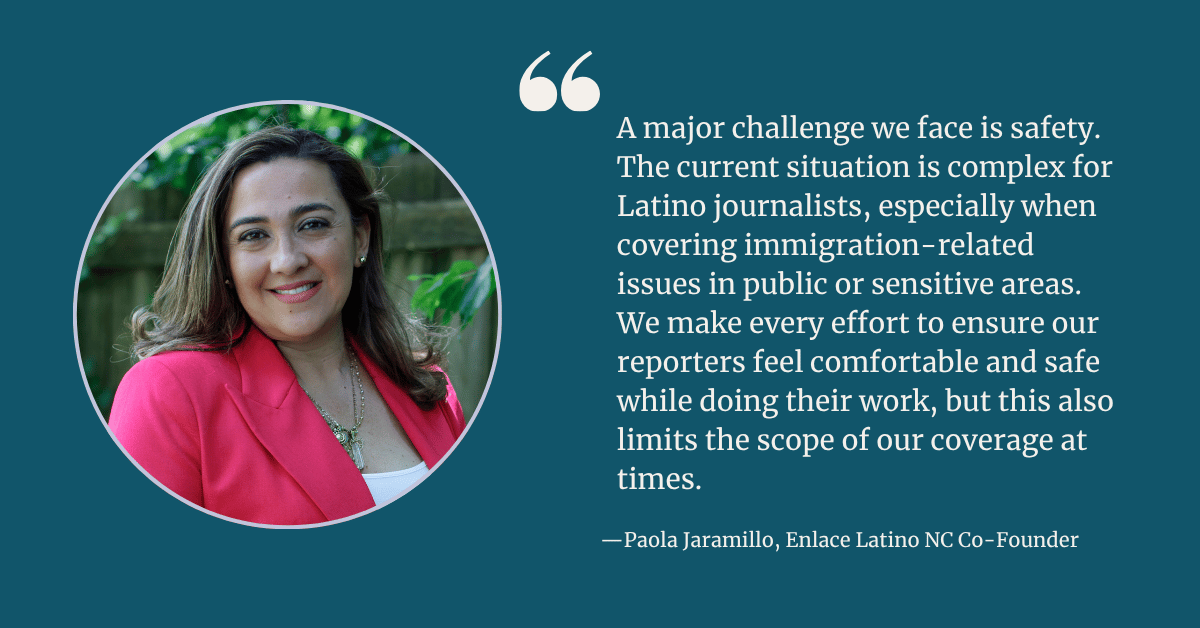
Another major challenge we face is safety. The current situation is complex for Latino journalists, especially when covering immigration-related issues in public or sensitive areas. We make every effort to ensure our reporters feel comfortable and safe while doing their work, but this also limits the scope of our coverage at times.


We also struggle to find bilingual freelance reporters who can support our field coverage. The lack of available collaborators limits our responsiveness and increases the workload on our current staff.


In addition, high costs related to photography and visual production present another obstacle to strengthening the visual storytelling component of our coverage.


Finally, we also face the challenge of combating misinformation. While we are not a fact-checking organization, our community relies on us to clarify rumors and provide verified, trustworthy information.


Despite these challenges, we remain committed to delivering journalism that is useful, compassionate, and grounded in the real needs of North Carolina’s immigrant communities.


How can other news organizations and supporters help? 


Many organizations can help us share information. English-language news organizations, especially traditional outlets, often have larger teams and greater logistical capacity, which allows them to reach locations more quickly — and with less safety risk — where immigration authorities are operating. Sharing that kind of verified information, photos, and data with us is essential to broaden coverage and offer a fuller picture of what is happening in our communities.


Other news organizations can also help by sharing our stories and resources on their own websites or newsletters, so the information reaches more people who need it.


Supporters can contribute by donating or helping spread our stories. Every contribution — big or small — helps us stay on the ground and continue providing verified, useful information in Spanish for our community.


Other immigrant-led news & info resources

 Available for republication 


✅ NC Local: How are Border Patrol operations affecting kids and schools in Charlotte?


✅ NC Local: Are ICE or Border Patrol agents in Western North Carolina?


✅ The Assembly: Law and Orders
Even for immigration lawyers, navigating the Border Patrol’s opaque operation in N.C. is nearly impossible. For those detained, it can be life-altering: “You can’t un-ring the bell on the harm.”


✅ NC Newsline: Protests, warnings across the Triangle as federal Border Patrol agents begin immigration crackdown


✅ NC Newsline: Federal immigration raids in Raleigh impact one of the city’s largest projects

Fact-checking the DHS narrative: lessons from Chicago

When we learned that Customs and Border Protection agents were coming to North Carolina, we knew our colleagues in Chicago would have some wisdom to share. Communities there have been dealing with aggressive and hostile tactics for months, even after a lawsuit and court order restricting the use of force.


At the Chicago Sun-Times and WBEZ, most of the journalists doing on-the-ground coverage have been attacked with chemical irritants, rubber bullets and other projectiles even when it was clear they were reporters or photographers. 


They’ve also spent countless hours responding to false and misleading statements and the Hollywood-style videos and graphics (some using CST/WBEZ photographs) put out by the Trump administration and the Department of Homeland Security. 


We spoke with Nader Issa, a Chicago Sun-Times journalist to learn more and round up some of the team's safety and resource tips below. Our conversation has been edited for length and clarity. 


After Border Control and other federal agents came to Chicago, what was your approach to responding to their official statements?


Our approach was to take a look at what they said, take a look at the evidence that we saw from our reporters on the ground, the evidence that we saw from witnesses, the evidence that we saw from court documents, depending on what the case was—just any sources that could either corroborate what DHS was saying, or that told us a different story.


After CPB agents came to Charlotte, DHS released a statement that used phrases like “worst of the worst” and provided numbers and some names and photographs of the people they arrested. How did you decide what to include from these releases?


If we can’t confirm something from a press release, it's really important that we say “XYZ from their statement could not be independently verified,” if that's the case. And that's what we did.


Back in September, two ICE officers shot and killed a man in a suburb here in Chicago and we put a line in the story that said we “have not independently verified ICE’s account.” If we're talking about numbers, you could publish their numbers and then say, we haven't been able to independently verify this.


In terms of “worst of the worst,” that is something you can fact check. If they're putting out names, you could look up their court record to understand whether they have any violent criminal convictions, which is something we did. You could also try to find neighbors or family members or people just to learn who these people are to fact check that claim.


It's tough, it is a dilemma, because this is what the government's saying, and you can't always fact check within an hour or two. If that’s the case, I do think it's important to say this is something we couldn't independently verify. 


Were there any particular things that federal officials put out that raised red flags or things that you were especially careful to scrutinize?


There is a lot of hyperbolic language that they put out. “Worst of the worst” is one example. They keep repeating this line: we're arresting murderers and rapists. They said attacks against ICE officers have increased by 1,000%. They don't publish data on that and we don't know what types of instances are classified as attacks.


Here in Chicago, they've been calling protesters violent, radical extremists or rioters, or in some cases, terrorists. All of that hyperbolic language that we haven't really heard before, you have to take a step back and try to think about: is this something that we actually saw on the ground? Is this something that we actually have heard from witnesses? Is this something that we have seen in our city before they came?


Were there specific claims from federal officials that the team was able to disprove or find evidence or information that countered what they said?


Yes. The shooting in a suburb called Franklin Park. Two ICE officers were following this guy in his car. The narrative that DHS put out is that he hit the two officers with his car and dragged one of the officers who sustained serious injuries and had to be hospitalized and during the course of being dragged, the officer shot and killed the man.


We FOIA'd for body camera footage from the responding local police. When they came up to the scene, you see the two federal officers near the man that was shot and the local officer asks the ICE officers if they’re injured and they said “nothing major.” So, obviously, nothing major deviates a lot from serious injuries in hospitals.


There was a big overnight raid on an apartment building in a neighborhood called South Shore. There were these Black Hawk choppers, and they zip-tied people, kids, U.S. Citizens for hours all under the claim that this was a hotbed for Tren de Aragua, a Venezuelan gang. And there was just no evidence that this Venezuelan gang had overrun the building, or that they had caused bad conditions in the building. Even in court cases, they are not accusing people of being gang members.


What strategies have reporters used to verify what really happened? 


You have to cast a wide net. You have to be on the ground. In some cases, if there’s a big federal presence in a neighborhood or suburb and they're tear gassing people, they're violently arresting people, you have to be on the ground very quick and responsive to incidents, to see things for yourself.


If you don't see things for yourself, you have to be able to quickly gather eyewitness accounts, gather videos from eyewitnesses. There's also court records, looking back at people's backgrounds, monitoring for any new lawsuits, any new criminal charges or indictments.


Have your reporters gotten access to immigration court? Is that a place to learn more about who’s been detained? 


Yes and no. The way it's worked here in Chicago is that a lot of people who were detained were put in a facility in suburban Broadview. From there, they're very, very strongly suggested to sign their deportation papers and if they don't, they're then transported to longer-term detention facilities in the six states surrounding us. That's all to say, it's not like this has all led to a ton of activity at immigration court. They're not getting arrested and then taken to immigration court. A lot of immigration court cases are cases that people already had, they're seeking asylum, a judge is reviewing their case. ICE has gone to immigration court to pick people up.


What are your three biggest tips for reporters and newsrooms down here?


First and foremost always, is keep yourself safe. What we saw here was a very different situation than covering your average protest, where local police are sort of patrolling it, and even here in Chicago, where there have been times when police have gotten into it with protesters—this was just a completely different level. It felt like soldiers on the streets without care for hurting people. So that's number one, just understand that this is a little bit new and different and the safety aspect of how to cover what's going on.


Number two is the skepticism I talked about. Recognize what DHS is saying, and do all that you can through the different avenues that we talked about to fact check and get as accurate of a story as you can. And it's okay not to include parts of the DHS statement sometimes if it's too inflammatory and you can't fact-check it. It's also okay to be explicit in a story and say "we haven't verified this."


And the third thing is try to keep the focus as much as possible on the human impact of all of this. People's lives are really being torn apart. One day they might think they have legal status, the next day their status is revoked. In Chicago, this has affected people and families and communities. In my neighborhood, there’s a huge park and every Saturday, every Sunday, it would just be filled with people and kids and bouncy houses and people selling things in carts on the sidewalk, volleyball games and soccer games, all that. For the past two months, you can’t find a single person out there. Keep your eye on how this is affecting communities and people. That’s the most important thing. Don’t let the theatrics take over.


Additional safety & reporting tips from 

Chicago Sun-Times/WBEZ


Risk assessment and reporter readiness

  • Have a plan for what your organization is going to do if a reporter is arrested.

  • Have a plan to extract reporters if they are attacked or injured.

  • Prepare reporters for what they might encounter: use of force, arrests, being detained.

  • Have conversations with reporters about their comfort level and potential risks, including immigration status, potential to be targeted based on race/ethnicity, health concerns and mental readiness. 

  • Use a buddy system. Pair reporters together and/or with photographers.

  • Have a check-in plan.

  • Debrief with journalists. Regularly let them know they can say “I’m out” and recover and/or do critical coverage from a distance/home/the office. 


On-the-ground safety and communication protocols


Equipment:

  • Consider go kits containing gas masks, bump or ballistic helmets and vests; eye protection, Sudecon wipes & squeezable water bottle; phone battery chargers. 

  • Caution: equipment and/or press vests could make reporters more visible and potentially a target. They can carry items in a backpack until needed for use.

Communication:

  • Sharing location with editors is helpful but drains batteries. Consider AirTags on shoes instead. 

  • Journalists on the ground should be careful about how source information is shared on phones. Consider pseudonyms, use encrypted apps, don’t get on public WiFi, and delete any messages that come in with unrecognizable links.

  • Consider a dedicated Slack channel for real-time communication with reporters, who can also upload updates/visuals for editors to compile, verify. Invite newsroom staff to use the channel to drop in tips, even if coverage doesn’t fall squarely within their beats.

Thank you to the Chicago Sun-Times journalists who have answered our calls, texts and emails over the last six days and provided us with valuable information to help us here in NC. We appreciate you!  🫶

Reconnecting Through Hard Times & Listening Circle for WNC Reporters

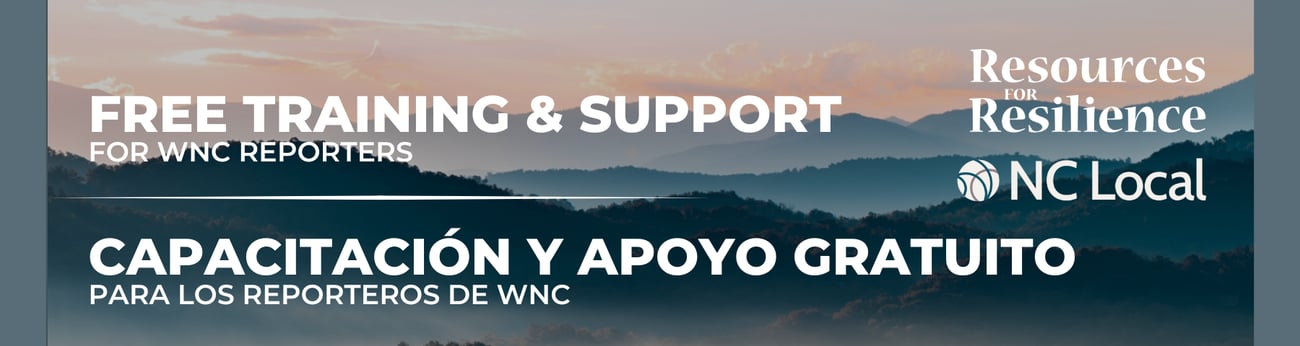
NC Local is pleased to be teaming up with Resources for Resilience to provide an event offering learning and connection for WNC reporters. This three-hour, bilingual gathering will help participants learn simple, powerful strategies for managing stress during difficult times and how to support others after a crisis.


Cenzotle will be providing interpretation for Spanish-speaking reporters and community information providers. 


📆 Thu, Dec 11, 2025 10:00 AM - 1:00 PM

📍Haw Creek Commons, 315 Old Haw Creek Rd, Asheville, NC 28805

Lunch provided. Register here

Questions? Reach out to Catherine at catherine@nclocal.org or to Claire Burnet, who is organizing the workshop, at claire.burnet@resourcesforresilience.com


The NC News & Information Summit returns Friday, March 27, 2026, at NC State's McKimmon Center, hosted by NC Local  and North Carolina Open Government Coalition. Early bird registration is now open!


We're seeking your ideas for sessions on topics and your nominations for the Sunshine Awards.


💡Have a session idea you'd like to lead? Have a suggestion for a topic or presenters? Fill out this form  by Tuesday, December 31. 


❓Want to talk through your idea with NC Local Summit Program Manager Diara J. Townes? Sign up for office hours, December 4 at Noon.


🏆 Nominate yourself or others for the Sunshine Awards. Learn more here about categories and deadlines. 


Also, early bird registration is now open! 

Bulletin Board

Jobs

📌 Editor in Chief, CityView, Fayetteville 💰

📌 Higher Education Reporter, The News & Observer, Raleigh 💰

📌 News Director, Blue Ridge Public Radio, Asheville 💰

📌 Development Communications Specialist, Blue Ridge Public Radio, Asheville 💰

📌 Senior Programs Manager, News Product Alliance (Remote) 💰

📌 Radio and Advertising Strategy Contract, Beacon Media (Remote in NC, WNC Preferred) 💰

📌 Investigations Editor, Data Editor & Investigative editor/reporter, Open Campus (Remote) 💰

📌 Community Engagement Coordinator, ONA (Remote) 💰

📌 Weekend Editor, Weather and Climate, Apple News (Remote) 💰

📌 Curation Editor, Food, Apple News (Remote) 💰


Internships:


📌 Audio & Social Media Intern, Beacon Media (Remote in NC, WNC Preferred)

📌 Summer 2026 News Interns, News & Observer & Charlotte Observer

Opportunities & trainings

📅 Staying Safe on Assignment: Navigating Law Enforcement and Digital Risks. Reporting in the field increasingly exposes journalists to complex safety, legal, and digital challenges — from covering ICE operations and protests to navigating surveillance tools and law enforcement encounters. Join Jeff Belzil, Security Director, and Tat Bellamy-Walker, Program Coordinator at the IWMF for a practical session on assessing and managing these risks. Organized with ONA. November 20, 2:00 pm.


📅 Reporting on Immigration in North Carolina: Legal Rights & Practical Protections for Journalists. RCFP and Ballard Spahr offer this training to equip journalists in North Carolina with a clear understanding of their legal rights and responsibilities when covering immigration issues and encounters involving federal immigration enforcement agencies, including Immigration and Customs Enforcement (ICE) and U.S. Customs and Border Protection (CBP). The session will cover what journalists can lawfully record, how to interact with enforcement officers when stopped while reporting, what to do if ordered to stop documenting, and how to navigate reporting at courthouses, detention centers, workplaces, and community locations where immigration enforcement actions may occur. November 21, 1:00 pm.


🌱 2026 RJI Fellowships: RJI invites proposals from individuals and organizations to build practical and innovative resources for community-centered news, journalists and the communities they serve. Past fellows have built a slack based SEO tool, a bilingual guide to misinformation, a Quick-Start Guide to Freelancing and other amazing resources for journalists. This year, RJI is adding a fellowship devoted to emerging technology at $100K and increasing the amount for all of the fellowships from $30K to $75K. Applications open on Dec. 1. Attend a Q&A December 3 at Noon.


🌱 National Press Club Student Scholarships: Six scholarships are available providing stipends of $5,000 (some renewable) to help high school & college students defray the costs of tuition and other expenses. Programs include the Scholarship for Journalism Diversity Honoring Julie Schoo and the The Wes Vernon Broadcast Scholarship, which is open to students at any stage of their career and prioritizes applicants from community colleges. Application deadline: March 1, 2026.


That's it for today. Thank you to all the journalists, newsrooms and civic information organizations for your nonstop work this last week. Pace yourselves, take breaks and know that you are appreciated for all you do.  —Catherine 


Email Marketing by ActiveCampaign