|
Greetings all, it’s Wednesday April 27. Many weeks we kick off The Hub with something worth celebrating like milestones and anniversaries. Often we round-up all the ways you’re getting news and information out to communities. And sometimes we start with opportunities for you all to plug into the collaborative work of NC Local.
Today, we’re acknowledging some of the hard stuff. Colleagues across the state have been dealing with ownership changes, cost-cutting measures, layoffs and abrupt resignations. Many are concerned about what the future holds, personally and for the news and information organizations they work for. And not having clarity or answers can add to the general stresses of the larger environment we’re in, whether that’s attacks on the press, layoffs at major news organizations or the state of our democracy.
Recently, Resources for Resilience facilitated a free training for the Women in Journalism NC group to share proven ways to help your body and mind cope with hard times. I’ll share a few of the recommendations you can practice when you see one of your colleagues going through something difficult. And for those in WNC, you can sign up for their free workshops and listening circles here.
-
Connect through questions: Hold space by asking “What’s going on?” Asking this first allows people to share whatever is coming up. You can follow up with: “What’s the hardest part?” This helps people zero in on what’s difficult and lets them know you’re listening.
-
Connect through your responses: Mirror words and expressions as you listen and use phrases like “that makes sense” or “I get that,” to validate experiences.
-
Connect through solutions: Ask “What’s getting you through?” so the conversation isn’t just about what’s wrong, but what is helping.
I regularly see all the ways people in the NC news and information ecosystem lift each other up, during good times and bad. Keep doing that and the good work, and we’ll get through these uncertain days together.
Glad you’re here, let’s get started. |
|
|
|
|
Mapping Charlotte: Using AI and an expanded
definition of local news to better understand the civic information landscape |
 |
|
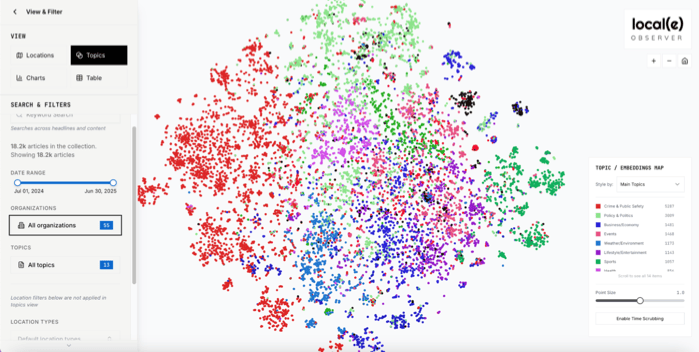
A semantic map showing 18,000+ pieces of content analyzed for the new report on Charlotte's news and information ecosystem. |
|
|
|
A new study led by longtime local news researcher and Tow Center Senior Research Fellow Sarah Stonbely uses new tools and a new methodology for mapping what is being covered and how people are getting news and information.
“Although the concept of a news desert has rightly generated many studies and commanded industry and academic attention, it has begun to feel dated,” writes Stonbely in the study. “While communities not covered by local news outlets are surely at a disadvantage, neighbors and local organizations have adapted by finding new ways to produce and share news and information—whether via a Facebook group, the Nextdoor app, or a WhatsApp chat.”
Stonbely and fellow researchers used Charlotte as a test case as they apply a more inclusive approach to mapping news and information, including the role of civil society organizations or CSOs. Using AI-driven methods, they analyzed more than 18,000 pieces of content from 66 local news providers. Content providers include “local journalism originators” like Queen City Nerve, Axios Charlotte, WFAE and WCNC and other trusted sources of information, like Charlotte Jewish News, Catholic News Herald, Soccer Sheet and the Tiny Money newsletter. Using a semantic mapping tool, the research uncovered a number of findings:
-
The amount of coverage varies significantly by neighborhood, with Center City and other areas that are home to large event venues, hospitals, and the airport receiving a disproportionate amount of coverage while many other parts of the city receive very little.
-
When the least-covered neighborhoods are mentioned in local news, it is often in the context of crime stories.
-
Neighborhoods with a higher proportion of Black residents are more likely to be covered in the context of crime, while neighborhoods with a higher proportion of white residents are more likely to be covered in the context of entertainment stories.
-
An analysis of 500 Charlotte-serving CSOs found that they are covering some topics—especially in schools and public institutions, such as firehouses—that local news outlets are not, suggesting opportunities for collaboration or content sharing.
The research was commissioned by the North Carolina Local News Lab Fund.
The report says the tools give funders “visibility into exactly which neighborhoods are being covered and precisely which topics are being written about.” Additionally, it’s useful for publishers who can use them for insights into their own coverage, allowing them to find and fill reporting gaps and to see if there’s potential for collaboration.
➡️ Find an interactive version of the research here.
📆 To learn more, join Stonbely and co-authors of the study on Monday, May 4 at 1:00 pm for a discussion of the research. |
|
|
|
|
📰 News about the news 📰 |
McClatchy makes no public announcement as Charlotte Observer editorial leadership leaves company
|
|
The Charlotte Observer lost its two top newsroom leaders last week, as first reported by QCity Metro. Executive Editor Rana Cash is resigning and parent company McClatchy eliminated Managing Editor Taylor Batten’s position.
Cash has led the newsroom since 2021 and Batten worked for The Observer for 31 years.
Pointing out Cash’s many accomplishments, the CLT Association of Black Journalists urged media organizations to pay attention to a “troubling pattern of diverse talent — particularly Black women in leadership — being displaced from Charlotte’s media institutions at a time when their presence is most needed.”
“Rana Cash is exactly the kind of leader our industry and our city needed, and her presence here has made Charlotte journalism better,” said Tonya Rivens, President of CAABJ. “She led with integrity, she championed diversity in the newsroom, and she never stopped believing in the power of local journalism to transform communities.”
Cash was The Observer’s first Black Executive Editor in the paper’s nearly 140-year history. In her role there, she put a focus on making sure content was inclusive, launching a mobile newsroom initiative to reach and engage more parts of Charlotte and hiring a race, culture and community engagement editor. “We're not writing about people; we're writing for a broader audience and being intentional in the coverage that we offer,” Cash told WFAE after her first year at the news outlet.
The Observer is also losing three decades of institutional memory with the elimination of Taylor Batten’s Managing Editor position. Batten also served as front-page editor, opinion editor and for many years a reporter covering government, politics and business. Batten also stepped down from the board of the NC Open Government Coalition
Both Batten and Cash led the team during Hurricane Helene, which along with the newsroom at the News & Observer, were recognized for their work as a Pulitzer finalist.
According to The Charlotte Ledger, there are fewer than 40 people in The Observer’s newsroom, down more than 80% from its peak 20 years ago. McClatchy, which is owned by the hedge fund Chatham Asset Management, has continued to make cuts and eliminate staff at the local and national level. Last Fall, it closed its Washington bureau and shut down its real-time national news operation.
McClatchy didn’t respond to questions from QCity Metro or The Charlotte Ledger and has made no announcements about who is currently leading the newsroom. Last Friday, McClatchy posted a new position for a Charlotte Editor that appears to combine Executive and Managing Editor roles.
"The Charlotte Editor must be an audience-obsessed leader who can dramatically accelerate the newsroom’s transformation, with a mandate to urgently, endlessly and fearlessly experiment with content and approaches that grow readership," begins the job posting. "This role requires a leader who thinks strategically like an executive editor and directs day-to-day operations like a managing editor. They must set and enforce clear performance expectations, hire and coach the staff and hold every team member accountable for results."
The news comes following McClatchy journalists across the country raising alarms over an AI “content scaling agent” that repackages their work into new pieces. While the new content is intended to be reviewed by an editor, journalists are concerned about the integrity of what it produces. The Wrap reports that unions representing staff at the Miami Herald, Sacramento Bee and Kansas City Star filed grievances against McClatchy for allegedly violating contract provisions that require advanced notice for any “major technological change.”
In North Carolina, The Wrap reports that members of the Charlotte Observer’s union met with newsroom leaders in March to address concerns with the tool and came to an agreement that its use is optional. It’s not clear if this played any role in Cash and Batten’s departures. |
Mountain Xpress shifting to a new business model |
|
Mountain Xpress Publisher Jeff Fobes announced that the news outlet will be transferring the paper’s corporate stock to a nonprofit: the Fund for Investigative Reporting and Editing (FIRE). In a letter to readers, Fobes said “this transfer, essentially a succession plan, will put Xpress into the hands of a board of directors who won’t personally benefit from any profits it might generate or from it being sold.”
Approaching his 80th birthday, Fobes has led the locally-owned news organization for more than three decades, launching in 1994 with “a scrappy band of journalists, artists and jacks-of-all-trades [who] decided to swap sleep for the Spartan world of newspaper publishing on a shoestring.” (Read more about Jeff’s early and formative years in this piece by Jessica Wakeman.)
While Fobes plans to remain active as publisher, he has been researching various succession pathways to ensure the Western North Carolina news organization could continue for decades to come.
“Developing a succession plan is tough,” Fobes told The Hub. “Particularly when you want to protect the business from the forces of the commercial market, which has been dealing mortal blows to journalism across the country.”
Fobes says the path they’ve settled on removes Mountain Xpress from the danger of bottom-line driven shareholders.
“While the nonprofit option was always available, its restrictions on ad revenue was a deal breaker. The breakthrough came when we figured out that nonprofits can own for-profits. The earliest tip-off was Mother Jones, which has been doing something similar for decades,” said Fobes.
Mountain Xpress will remain a for-profit business, continuing to sell advertisements which is their main source of revenue. Any profits will be routed to the nonprofit FIRE to reinvest in community journalism.
Although not active in recent years, Fobes says the Asheville-based FIRE has been around since the 1990s.
“Having served on FIRE’s board since its inception, I knew and trusted its commitment to community-based journalism in Western North Carolina, making it a natural owner of a media outlet like Mountain Xpress,” said Fobes. |
|
|
|
|
Updates from NC Local |
|
NC Local is thrilled to share that we've been selected by Open Campus as one of three newsrooms launching a new community-college accountability initiative.
The national nonprofit embeds higher-ed reporters in local newsrooms across the country. This new initiative aims to expand news and information on one of the least-covered part of higher education. According to Open Campus, community colleges enroll 8.5 million students and a play a major role in local economies but operate with little public scrutiny. The organization found only 3% of
higher ed stories across 50 major news outlets in 2024 focused on community colleges.
“Our goal is to empower communities, helping people better understand and influence the institutions that shape their futures,” said Sara Hebel, co-founder and editor-in-chief at Open Campus. “We’re thrilled to be partnering with these first three newsrooms to produce meaningful, in-depth journalism for their cities and states.”
The Arizona Center for Investigative Reporting and MinnPost were also selected as part of the inaugural cohort. Open Campus plans to add dozens more newsrooms over the next four years.
In North Carolina, 58 community colleges serve more than 600,000 North Carolinians. "[That's] more than 5% of our total population,” said NC Local Editorial Director Laura Lee. “Applying an accountability lens to better understand how these organizations function is an important effort for our audience.”
Open Campus is providing $75,000 in funding to NC Local and other selected newsrooms to help cover costs as well as editorial support. Find a link to NC Local's job posting for this new reporting role here and in today's bulletin board. |
|
|
|
|
|
Bulletin Board |
Jobs |
|
📌 Investigative Reporter, Open Campus/NC Local (Remote in NC) 💰
📌 Executive Director, NC Health News (Remote in NC) 💰
📌 Public Programming Director, The Assembly (Remote in NC, Triangle preferred)
📌 Deputy Director, Audience and Growth, The Assembly (Remote in NC, Triangle preferred)
📌 Local Government Reporter, INDY/The Assembly, Durham 💰
📌 Charlotte Editor, The Charlotte Observer
📌 Sports Editor, The Courier-Times, Person County
📌 Reporter/multimedia journalist, The Enterprise, Spring Hope
📌 Freelance Bilingual Journalist, Enlace Latino NC, Jackson and Macon Counties 💰
📌 Freelance Bilingual Journalist, Enlace Latino NC, Burke County 💰
📌 Environmental Reporter, News & Observer, Raleigh 💰
📌 News & Public Affairs Director, WNCU, Durham 💰
📌 News Director, WFDD, Winston-Salem
📌 Morning Edition Producer, WFDD, Winston-Salem
📌 AM Reporter, WUNC, Chapel Hill-Durham 💰
📌 Editor-in-Chief, Asheville Watchdog, Asheville 💰
📌 Contract LGBTQ+ Reporter, The 19th (Remote) 💰
📌 Senior Reporter, Political Influence, The Chronicle of Higher Education (Remote) 💰
📌 Politics Team Senior Correspondent, USA Today (Remote) 💰 |
Opportunities & events |
|
🌱 Impact Fund for Reporting on Equity in Health and Health Care: USC Annenberg’s Center for Health Journalism offers $2,000-$10,000 in reporting grants for ambitious investigative and explanatory projects. Applications investigating the barriers to high-quality care and the policies and conditions in health systems that perpetuate unequal outcomes are encouraged. Reporters and freelancers working across beats are welcome to apply. Fellows also receive five months of professional mentorship from a veteran journalist and monthly online development and brainstorming sessions with other reporters in their cohort. Application deadline: May 12.
📅 Leveraging analytics, CRM and moves management to grow and diversify direct funding: Join BlueLena’s monthly roundtable to learn how to leverage a powerful but underutilized asset: audience data that can reveal which readers who have the means and willingness to support journalism financially. Leaders from Montclair Local, Fort Worth Report, and Montana Free Press to learn how they moved beyond one-size-fits-all appeals to identify high-potential supporters, prioritize development staff time, and build disciplined cultivation strategies that increased major gifts, year-end revenue, and donor retention. May 13, 1:00 pm.
📅 2026 Election Security Briefing--Keeping Voters and Ballots Safe: What are the real risks of political violence in North Carolina—and how are they being managed? Join the NC Center for Politics and Public Service and Tom Baker IV, a leading expert working within the state’s election safety and threat monitoring infrastructure. Get a grounded, behind-the-scenes look at how North Carolina is responding in a time of heightened tension and learn how threats are identified and defused, what trends are emerging, and why our voting systems remain secure in North Carolina. May 13 at Noon.
|
|
|
|
|
That's it for this week. Look for the glimmers in everyday life and, as always know you are appreciated for all you contribute to the NC news and information ecosystem! —Catherine |
|
|
|
|
|
|