Greetings all, it’s Wednesday March 18. Happy Sunshine Week! 🌞 Today we’re celebrating all the North Carolina journalists, media lawyers, citizens, open government advocates and civil servants who work to keep public records and data accessible to all. Whether you’ve filed (or filled) one public records request or hundreds, your efforts contribute to the larger movement of holding local, state and federal governments accountable to the public it serves.
But we also know there’s a widening gap between what public records laws define and what happens in practice. Here in the Tar Heel state, our public records law, which dates back to 1935, stipulates that custodians must respond to and furnish records “as promptly as possible.”
But what does that really mean?
NC Local and a group of partners collaborated to find out, submitting 20+ simple records requests to the state’s largest cities. Today, we chat with lead reporter Daniel Walton on which localities have been responsive, which ones haven’t (spoiler: too many! Including one that ironically celebrates Sunshine Week each year) and what this experiment can show your audiences about the
need for more advocacy around the “people’s records.”
Keeping with the theme, we have some other exciting government transparency and accountability developments to share:
The Tar Heel state is getting its first Documenters program! Led by Charlotte Journalism Collaborative, the program will train (and pay!) local residents to document government meetings.
Announcing the 2026 NC Justice Fellows! Five NC journalists will tackle year-long investigative projects with mentors from the Law & Justice Journalism Project.
And, we have just a handful of tickets left for the 2026 NC News & Info Summit happening 3/27 in Raleigh. Get them now (or sign up for the wait list).
Glad you’re here, let’s get started.
|
|
|
|
|
Sunshine Week experiment exposes gaps in NC transparency
The 'property of the people' is often not promptly furnished |
|
|
|
|
On the last Friday of February, NC Local and our media partners asked 22 North Carolina cities for the same set of records: all emails sent to or from the city’s clerk between 9 a.m. and noon on February 24.
Journalists with NC Local, The Assembly, WFAE in Charlotte, and WUNC in Chapel Hill used identical language and sent the requests around the same time. The experiment covered North Carolina’s 20 largest cities by population, from Charlotte through Wake Forest. The Border Belt Independent, part of The Assembly network, also submitted requests to Lumberton and Pembroke.
The collaboration set out to measure an element of NC General Statute 132 that requires all public records be responded to and furnished as “promptly as possible.” But that’s as far as the state goes in defining what that length of time means. How do localities interpret it? And what did we learn about transparency and open government through this process? Today we chat with Asheville-based journalist and NC Local contributor Daniel Walton to find out. Before we jump in, here’s a link to the article about the project, which is available for republication.
State law says public records have to be provided ‘as promptly as possible.’ What does that actually mean?
While local government communications are public, cities vary widely in how they fulfill the legal obligation to make them available.
What were you trying to learn with these public requests?
Daniel Walton: Honestly, the content of the records requests was less important to us than observing the process. We wanted to create the fairest possible conditions for comparing how different cities would fulfil a simple inquiry for public communications records. So we asked for a small, discrete, easily searchable slice of correspondence from an employee that every city must have. Our goal was to see how quickly, and in what form, each government would process our request.
How responsive have localities been?
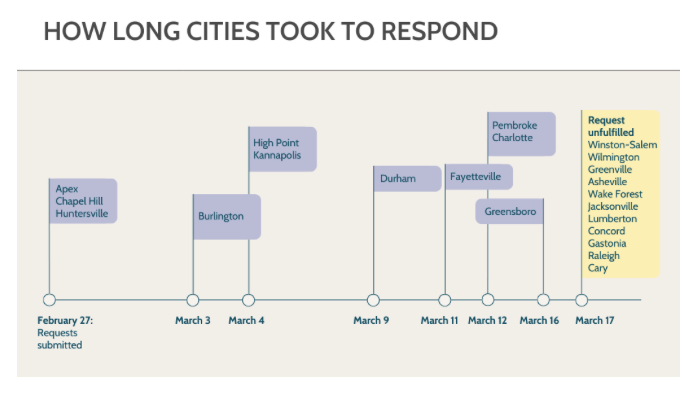
Daniel Walton: It’s been a mixed bag. Three cities gave us the records on the same day we asked for them, with eight others trickling in over the next two-and-a-half weeks. But that still leaves half the cities in our experiment. Some just provided automated responses, while others didn’t acknowledge our request at all.
If/when you get these records back, what might the public learn?
Daniel Walton: The biggest takeaway for me is a sense of how responsive each city is to the public’s requests. One might expect bigger cities to have the resources for quicker turnaround times, but that’s definitely not always the case. Charlotte, for example, didn’t get back to us until March 12. Raleigh wrote back on March 10, saying it hadn’t begun searching for the records and asking if we’d narrow the request with keywords. Given that we’d already narrowed the scope pretty extensively in time, that response surprised me.
On a content level, skimming the emails also might give the public a new appreciation for just how much city clerks do! For example, Durham’s clerk sent or received 25 emails on the morning of Feb. 24, with tasks like coordinating city committees, processing other public records requests, and approving a purchase order for Chai Latte K-Cups.
By NC law, records must be made available "as promptly as possible." Is "promptly" more clearly defined?
Daniel Walton: Not at all. State law provides no guidance on the meaning of the word, and the relevant case law really hasn’t narrowed it down either. North Carolina isn’t alone in that ambiguity: 10 other states also don’t specify any response time for records requests. However, all of our state’s neighbors do give a timeline. Government officials in Georgia, for example, must respond to records requests within three working days.
In your experience, how long is "promptly" for simple requests like this?
Daniel Walton: It really depends on who’s processing the request. Chapel Hill, for example, turned around our ask for the city clerk emails in less than 30 minutes.
Asheville, where I’m based, tends to be much slower. For example, I just got back a response to a request I’d filed at the start of August for communications between a resident and a specific Asheville City Council member. It took the city more than seven months to turn over a grand total of three emails.
To be fair, Asheville has what its officials call an “active and engaged” — that’s PR speak for “annoyingly nosy” — community. In 2025, the city got 970 records requests, and this year’s volume is already on pace to exceed that number. But seven months for three emails seems pretty clearly out of step with what the law expects.
Have there been any efforts to clarify this through legislation? Or other bills that might regain some of the public's access to records that have been rolled back over the last few years?
Daniel Walton: Lawmakers haven’t addressed the “as promptly as possible” issue, but there have been some efforts to expand records access more generally. In 2024, Democratic lawmakers introduced a constitutional amendment that would have revoked the legislature’s earlier decision to exempt itself from public records law. The Government Transparency Act, would have shared the general reasons why state employees are disciplined or dismissed, while the H.A.L.L. Accountability Act would have opened records related to redistricting. Every single one of those bills died in committee.
What tips do you have for other journalists or citizens when making public records requests?
Daniel Walton: First, be sure that you’re asking for specific documents, not information. The law doesn’t require officials to create new documents, so you can only get things that already exist. Try to narrow your request as much as possible; for city council emails, that might look like limiting the timeframe, adding keywords, or naming specific recipients. And consider asking for “serial production,” where you get each record as it’s cleared for release, rather than waiting for an entire batch to be ready.
The NC Open Government Coalition’s website is a great resource for more advice. And if you’re having issues with a request, be sure to ask the coalition for help through its contact form or hotline at 336-278-5506
Anything else to add?
Daniel Walton: I just want to share something from Mike Tadych, a lawyer who helps operate the N.C. Press Association’s legal hotline, that has really colored my attitude toward public records: “The law asserts that the records of the government of North Carolina are the property of the people. So it’s not like you’re asking for something that isn’t already yours.”
Thank you Daniel, The Assembly, Border Belt Independent, WFAE and WUNC for your partnership on this project! Seeking other public records resources? Here are a few:
|
|
|
|
|
Transparency, open government featured at the 2026 NC News & Information Summit |
|
|
This year's NC News & Information Summit offers 28 different panels, discussions and workshops, including a number focusing on public records and transparency led by journalists from across the state. Here's a sampling:
🏫 Fighting for Public Records on the Education Beat with Korie Dean, The Assembly; Rachel Keith, WHQR Public Media; Corinne Saunders, Outer Banks Insider; and Beth Soja, RCFP.
⚖️ How to use eCourts, public records to investigate court cases, sources and jail deaths with Virginia Bridges, Lexi Solomon, Dan Kane, The News & Observer.
💡 From Filings to Stories: Turning Ethics Disclosures Into Local Coverage with Audrey Nielsen, Independent Journalist; Diara J. Townes, NC Local.
🌎 Bring the Receipts: Using Public Data to Find and Report Environmental Stories with Lisa Sorg, Inside Climate News.
📞 Prepublication Legal Review: Best Practices, Pitfalls & When to Call a Lawyer with Beth Soja, Reporters Committee for Freedom of the Press; Ellen Goodrich and Kloee Placke, Duke Law First Amendment Clinic; Brad Kutrow, McGuire Woods.
And we begin the day with the keynote "NC's AI Crossroads: Innovation, Investigation & the Public Interest" and the NC Open Government Coalition's annual Sunshine Awards.
We can’t wait to see you in Raleigh next week! Grab those few remaining tickets (as of 1:00 pm today) by using the button below.
|
| Register for the 2026 NC News & Info Summit
|
|
|
Announcing the 2026-2027 NC Justice Fellows |
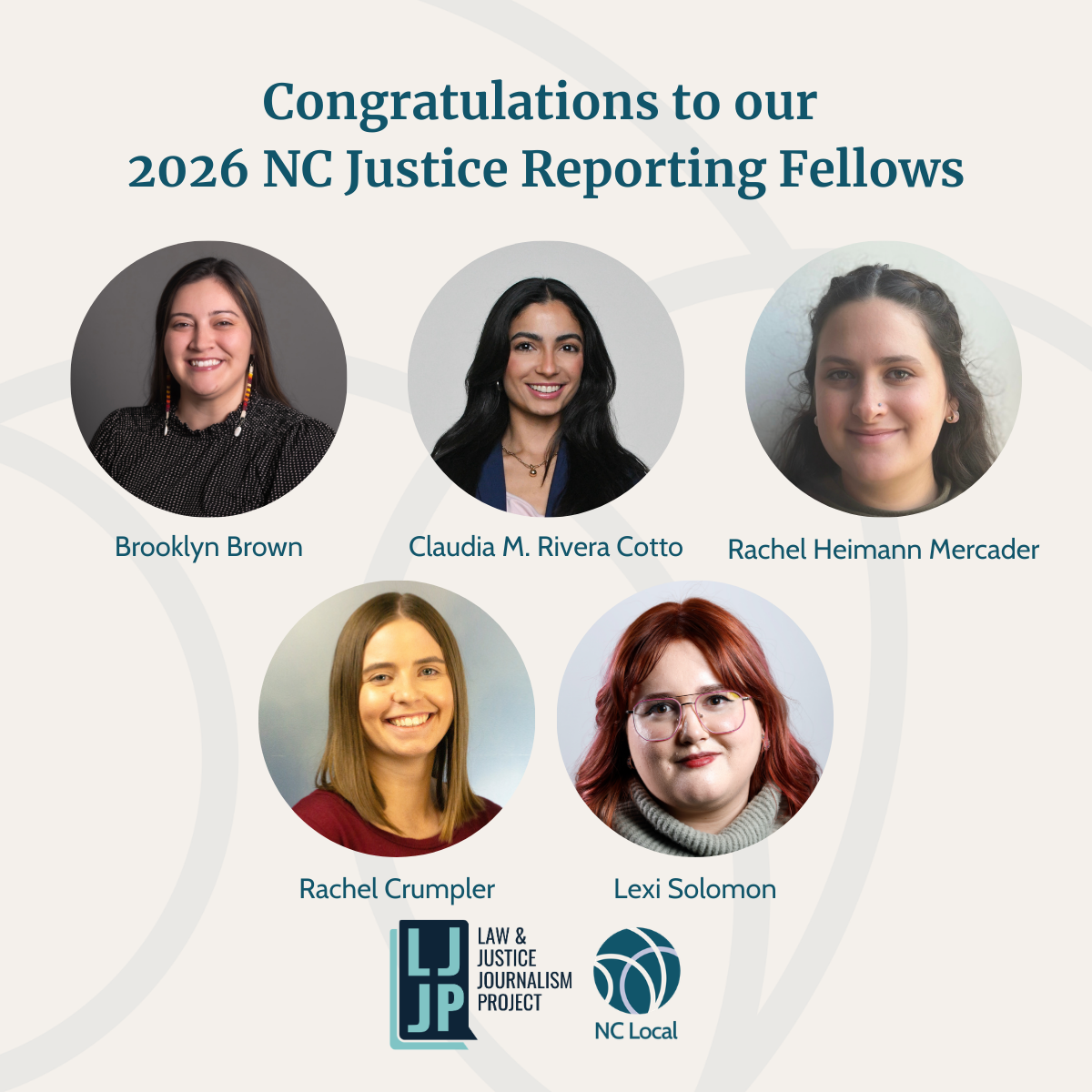
Five journalists from across North Carolina have been selected for The Law & Justice Journalism Project (LJJP) fellowship program. The initiative provides early-career journalists with $5,000 in funding and a year of mentoring and coaching as they pursue ambitious projects. Fellows will receive advising on story development, investigating cases, finding sources, and navigating complex topics.
"We are so excited about these fellows and their projects. We hope they'll shine a light on policies that affect vulnerable people in ways most people don't see firsthand," said Emily Bazelon, LJJP Board Member.
Fellows include:
👏 Brooklyn Brown, Cherokee One Feather , who will report on sex trafficking and familial sex trafficking on the Qualla Boundary of the EBCI.
👏 Claudia Rivera Cotto, Enlace Latino NC, who will investigate the hidden pipeline between traffic enforcement and immigration enforcement in North Carolina.
👏 Rachel Crumpler, NC Health News, who will examine the systemic denial of MOUD treatments — medications for opioid use disorder — in North Carolina jails and prisons.
👏 Rachel Heimann Mercader, CityView, who will report on the systemic failures that allow dangerous domestic violence offenders in Fayetteville to evade justice.
👏 Lexi Solomon, The News & Observer, who will delve into claims made to the North Carolina Victim Compensation Program by Durham County victims, for its practice of denying compensation to victims who were “engaged in a crime” at the time of the offense.
LJJP pairs fellows with experienced criminal justice system reporters during the program and one of this year's mentors is NC-based investigative journalist Kate Martin. The North Carolina fellowship kicks off next week at the 2026 NC News & Information Summit in Raleigh.
Congrats to all the fellows and thank you LJJP for bringing this program to North Carolina!
|
 |
|
|
|
|
|
Círculo de práctica de periodistas latinos y bilingües
Latino and bilingual journalists circle of practice |
|
|
NC Local is relaunching a Circle of Practice for Latino journalists with diverse trajectories: migrants and those born in the U.S.; those who work in Spanish, English, or both languages; and those who work in Latino media, bilingual spaces, or in newsrooms where they are sometimes the only Latino voice. Our Circles of Practice are a space for community and reflection about your work in local news and information here in North Carolina.
The circle will meet once a month and will be facilitated by Patricia Serrano, a bilingual journalist and audio producer, currently the Western North Carolina reporter for Enlace Latino NC.
Please fill out this form by Friday March 20 if you'd like to participate. Our first gathering will be in person during lunch at the March 27 NC News and Information Summit in Raleigh. After that, we'll meet virtually from April-July.
NC Local está relanzando el Circle of Practice, un espacio de comunidad y reflexión para periodistas latinos con trayectorias diversas: migrantes y nacidos en EE.UU.; quienes trabajan en español, en inglés o en ambos idiomas; y quienes se desempeñan en medios latinos, en espacios bilingües o en redacciones donde a veces son la única voz latina.
El círculo se reunirá una vez al mes y será facilitado por Patricia Serrano, periodista bilingüe y productora de audio, actualmente reportera del área oeste para Enlace Latino NC.
Por favor completa este formulario antes del viernes 20 de marzo si te gustaría participar en el Círculo de Práctica. Nuestro primer encuentro será presencial durante el almuerzo en el NC News and Information Summit el 27 de marzo en Raleigh. Después de ese encuentro, nos reuniremos de manera virtual de abril a julio.
|
|
|
|
|
|
📰 News about the news 📰
|
CJC announces first Documenters program in NC |
The Charlotte Journalism Collaborative will be home to the very first Documenters program in North Carolina, helping expand coverage of local government meetings and engaging Mecklenburg County residents in the process.
“In an era of profound disconnection, stronger community relationships are essential for democracy to thrive,” wrote CJC in its announcement. “Public meetings represent a powerful opportunity for residents to understand and participate in the decisions shaping their communities.”
Documenters is a national initiative that operates in about 22 cities across the country. Residents are trained and paid to attend public meetings and document what happens there. Local journalists, nonprofits, academics, researchers and everyday people can then access meeting summaries that surface more information about government decision-making that impacts the community.
In Mecklenburg County, there are about 50 local government meetings each month and many receive little or no media coverage. Charlotte Documenters aims to fill those gaps, including proceedings in immigration court. Charlotte would be the first site in the national network piloting the program for immigration court.
Charlotte Documenters is getting off the ground with a $150,000 grant from The Knight Foundation and $25,000 from The Robinson Center for Civic Leadership at Foundation For The Carolinas. CJC is continuing to raise matching funds to meet the program’s full two-year budget.
“We are thrilled with the early support of this program and the excitement that it is already garnering across the city,” said Chris Rudisill, CJC Director. “Support from Knight Foundation and Foundation For The Carolinas shows a shared commitment to building informed and engaged communities.”
To get updates or participate as a Documenter, please fill out this form. If you'd like to support the project, learn more here.
|
Icon of NC journalism wraps up 40 years at the N&O |
Longtime journalist Martha Quillin will be leaving the News & Observer after four decades, countless miles traveled and a vast and wide-ranging archive that spanned beats and artfully documented the experiences of everyday people and the diverse culture of North Carolina, from the mountains to the coast.
Quillin originally wanted to pursue a career in education, but while working at a Greensboro grocery store in the ‘70s, a customer who had retired from the News & Record suggested she consider the newspaper business. Her first gig? The night shift writing obits for the Greensboro paper, while also working at Kroger and eventually studying journalism at UNC Chapel Hill.
Quillin started at the N&O in 1987 and over the decades covered a bit of everything, from local government, courts and the military to the environment, natural disasters and climate change.
In a tribute carefully crafted to honor Quillin’s contributions (and her powerful writing), the N&O’s Josh Shaffer said the prolific journalist “carried a tent with extra stakes in the trunk, and at least one sewing machine, along with whatever it took to see North Carolina up-close, sit it down in a Waffle House booth and coax out its deepest, tenderest stories — the
kind that make teardrops fall on a newspaper page and blur the ink.”
“I was born to tell stories,” Quillin told Shaffer. “There’s something about me, something about you, that people just want to talk to us. I didn’t even have to work at it. You sit down with people and they just tell you everything.”
Describing Quillin as “equal parts sweetheart and badass,” Shaffer emphasized the many ways she showed up for colleagues and community members alike.
In all the towns she visited, “Martha stopped at a thrift store to find clothes for the homeless served by her church, or a fabric store to finish sewing something for somebody in her community. While she documented murder and destruction, sadness and loss, she found time to bake cookies for the newsroom,” wrote Shaffer.
As Martha begins her next chapter, we congratulate all she’s contributed to the North Carolina news ecosystem throughout her impressive career. Thank you Martha for helping document North Carolina and inspire generations of women journalists!
Have something to share about your news and information organization? Send a note to catherine@nclocal.org.
|
|
|
|
|
|
Well DoneThe Sunshine Week Edition
👏 For this year's primary coverage, Outer Banks Insider Publisher and lead journalist Corinne Sanders produced a four-part series on local sheriff candidates. Her research included North Carolina records requests and for one candidate, out-of-state records that required months of work. The records shed light on candidate Theodore “Teddy” Daniels experience and background, including being suspended without pay from a police department and a domestic violence accusation.
Saunders' coverage of Daniels relies primarily on public records as the candidate would not answer many of her questions. Instead, he threatened a lawsuit.
“I forwarded your questions to my legal team and we are preparing civil litigation against you…for targeted harassment and defamation,” Daniels said in a Feb. 7 email. “Your ‘questions’ are masquerading as ‘reporting’ and is being done to only harass and defame.”
Eventually Daniels did respond to some questions, through his lawyer. Saunders sought assistance with pro bono lawyers who also provided prepublication review of her coverage.
👏 Several news organizations, including NC Local, continue to pursue public records that shed light on the federal immigration actions in Charlotte and the Triangle that led to the arrest and detention of 400+ people last Fall. WFAE's Julian Berger continues to seek answers about who was arrested, why and where they're being held. NC Local's Jacob Biba used data and maps to track
where ICE has been holding people and where they may be expanding detention facilities across the state. The Charlotte Observer's Ryan Oehrli looked at the recent lawsuit filed by US citizens who were aggressively arrested without warrants or probable cause. And The Observer's Julia Coin is also continuing to document ICE activity at immigration court and the cases against protesters and those documenting ICE activity weaving their way through the judicial system.
👏 Following AVL Watchdog's 2021 investigative series, Equity Erased, Asheville attorney Robert Perry Tucker II was found guilty and sentenced to 4-6 years in prison. Sally Kestin's investigation found that numerous Buncombe County homeowners, many Black and economically disadvantaged, lost their homes and the equity they’d built due to fraud and forgery from a group of lawyers,
realtors and investors.
“This fraud was perpetrated on all of us, because the public, not just lawyers and judges, but the public should have a right to trust what’s in our records,” Judge Trosch said. “When we start hiding things and we start fraudulently reporting things that aren’t true on legal documents, then all of us are in trouble, and then we get to a place where nobody trusts anything that anybody says.”
Others charged will have separate trials.
See something noteworthy we should feature in the well-done section of The Hub? Forward it to catherine@nclocal.org or drop her a note in the NC Local Slack Community.
|
|
|
|
|
Bulletin Board
|
Jobs |
📌 Chief Development Officer, PBS NC, Durham 💰
📌 Production Director, Cherokee Scout, Murphy
📌 Western Wake County Reporter, The News & Observer, Wake County
📌 Transportation Reporter, The Charlotte Observer, Charlotte
📌 Reporter, The Mountaineer, Waynesville
📌 WUNC Listener Services Associate, WUNC, Chapel Hill & Durham 💰
📌 Director of Marketing + Audience Development, City Cast (Remote) 💰
📌 Managing Editor, The War Horse (Remote) 💰
📌 Deputy Research Editor, ProPublica (Remote, deadline today!) 💰
📌 Director of Programs, The Pivot Fund (Remote) 💰
📌 Program and Development Coordinator, Public Media Company (Remote) 💰
📌 Platform Success & Training Manager, BlueLena (Remote) 💰
|
Opportunities, events & resources |
🌱 Rosalynn Carter Fellowships for Mental Health Journalism: This year-long, non-residential fellowships supports journalists working on a mental health topic of their choice. Fellows receive a $10,000 stipend, training, networking opportunities, and access to top experts and resources in mental health and journalism. Fellows are encouraged to select topics that are unique and creative. Projects may educate the public, raise awareness
and inform other journalists in the field. Application deadline: April 3.
📅 Local News Day Trainings: The national team behind Local New Days has organized a series of trainings to help you maximize audience growth for the day of action and beyond. Sign up for Local News Day here to get updates, invites to weekly info sessions and access other resources.
📅 AI Series + 1:1 Coaching from Trusting News and the Lenfest Institute. Led by Lynn Walsh, you’ll have the opportunity to sign up for one-on-one coaching after the trainings to help you move from brainstorm to implementation.
How to create a trustworthy AI use policy
March 26, 1 pm ET
Develop or refine clear, values-driven policies that guide how your newsroom uses AI tools responsibly. Register here
How to create trustworthy AI use disclosures
April 8, 1 pm ET
Explore when and how to disclose AI use in ways that build credibility and audience trust. Register here
Use AI literacy to build trust with your audience
April 29, 1 pm ET
Learn how to educate the public about AI - not just how you are using it - but what it is, how it works and how it's being used in the community. Why? People say they want this. Register here
|
|
|
|
That's it for today, thank you for reading. As always, know you are appreciated for all you do to support the North Carolina local news and information ecosystem. —Catherine
|
|
|
|
|