|
Greetings all, it’s Wednesday August 19th. Sometimes innovation comes from simplicity, abandoning the noise of new technology and elevating something tried and true. That’s the recipe The Food Section’s Hannah Raskin used in developing changes to their pitch policy. Instead of the now ubiquitous forms and emails, Raskin is switching to the phone.
“Having been deluged by AI-generated and enhanced story ideas this summer, we're re-humanizing the process with a dedicated hotline,” wrote Raskin on LinkedIn, adding the upcoming change has “the added benefit of weeding out supposed reporters who aren't in the habit of ringing up strangers.”
Apparently, many others miss the immediacy of the telephone as well. A few of the comments:
“Love this”
“Love love this”
“This is brilliant.”
Raskin also elaborated on the problems that led her to this old-meets-new innovation, sharing with Neiman Lab that a quarter of the pitches they’ve been getting were AI generated.
“Like most editors on the receiving end of slop — some of which was disturbingly calculated to appeal to a publication that prides itself on exposing social injustice — I found the situation incredibly depressing,” Raskin said. “What was especially worrisome was I felt myself becoming more inclined to dismiss pitches from writers without sterling portfolios or connections to journalists in my professional circle. That’s hardly compatible with cultivating new voices or encouraging young reporters.”
These days, we use our phones more to scroll than to actually talk with people. Meeting people where they are, a growing number of news organizations are experimenting with SMS (see today’s bulletin board for a new training on that). But beyond the daily 1:1 exchanges between reporters and sources, how else could we use the actual telephone to engage our communities? Even if you don’t have a radio station, could you do a call-in line? What about a CTA for voice memo questions or experiences on a topic? Maybe you have a number listed on your site and a real person picks up! Let us know how you’re using the telephone - I’d love to round up these old-school ways of connecting for a future edition.
Jumping into today’s line-up:
-
“We were unapologetic because meaningful community journalism requires it.” After eight years of feisty local journalism, Queen City Nerve shuts down.
-
Want to connect with other NC journalists covering environmental stories? Covering Climate Now is hosting a series of happy hours as it kicks off its new South Atlantic Climate Journalism Hub
-
Time for a new chapter? Check out new podcasting opps at WUNC & WFDD, along with reporting openings here at NC Local, WRAL, The Gaston Gazette and more!
Glad you’re here, let’s get started. |
|
|
|
|
‘So damn sad.’ Charlotte alt-weekly shuts down
|
 |
|
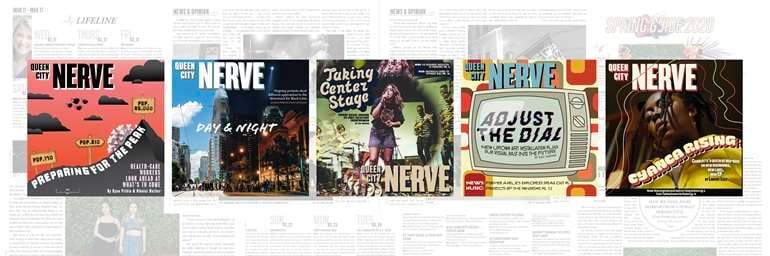
Earlier this month, Queen City Nerve announced the end to print amid financial hardships. |
|
|
|
Queen City Nerve Co-founders Ryan Pitkin and Justin LaFrancois announced Monday the immediate closure of Charlotte’s eight-year-old alternative newspaper. Coming just weeks after announcing an end to the print publication, the founders said financial hardships and the inability to find a buyer for the news organization led them to this decision.
In a personal post on LinkedIn, LaFrancois elaborated on the challenges, pointing out that their for-profit model was intentional because they wanted editorial independence.
“We did not want our coverage shaped by the priorities of funders, foundations, or institutions,” wrote LaFrancois. “That choice did not make us popular in the journalism world. It meant we did the work without the relationships, access, or support that other outlets may have had. We were not in this business to make friends, but to be a benefit to the community.”
LaFrancois and Pitkin launched Queen City Nerve in 2018 after their former employer, Creative Loafing, abruptly shut down. It was a labor of love. They used their personal finances and went unpaid for five years. But along the way they had many successes, publishing about 200 print editions and carrying on the tradition of bold and visually captivating covers lining racks at grocery stores, breweries, coffee and barber shops, bookstores and other community hubs.
Like many alt weeklies, Queen City Nerve provided locals and newcomers alike with a guide to their city, covering local government, arts and culture, nonprofits and small businesses. The news outlet was recognized for its coverage of the 2020 George Floyd protests, a deep-dive series on segregation in Charlotte-Mecklenburg Schools, a tribute to “Moses the Street Preacher” and other unique and in-depth stories.
“Countless people over the years have told us that Queen City Nerve was how they found their community after moving to Charlotte, or that our weekly coverage of Charlotte City Council inspired them to engage with local government for the first time,” said Pitkin and LaFrancois in their announcement. “While some of our most viral stories may have been the ones that called people out or held them accountable, our regular readers know that on a daily basis we highlighted businesses that often didn’t get a voice otherwise and told stories that were not likely to be told elsewhere.”
Readers, contributors and fellow publishers in Charlotte mourned Monday’s announcement. Charlotte Ledger Founder Tony Mecia was one of many posting about the paper’s closure.
“I’m sad to see it go, especially because Nerve was locally owned, feisty and had a dedicated following,” wrote Charlotte Ledger Founder Tony Mecia on LinkedIn. “Having plenty of choices is a good thing for Charlotte, and Charlotte is diminished when it has fewer voices working to provide independent and original information about our city.”
There are just a handful of alternative newspapers in North Carolina. Last year, Triad City Beat shut down. But Mountain Xpress continues in Western North Carolina (and recently announced the paper’s stock would be transferred to a nonprofit), INDY Week distributes its weekly print paper across the Triangle, Sanford’s The Rant is coming up on its 100th monthly print edition and Wilmington’s alternative paper Encore was revived earlier this year. |
|
|
|
|
|
NC Local Opportunity!
Help us cover & connect Alamance County |
|
|
|
The Alamance Fabric is a weekly news initiative for Alamance County, a diverse and growing county in the central Piedmont region of North Carolina.
The Fabric is powered by NC Local, a statewide nonprofit newsroom. NC Local operates as a hub of development for new initiatives, journalism and services that shed light on issues shaping North Carolina.
We’re seeking a full time Alamance Community Reporter to report, write and publish our weekly newsletter, manage the Alamance Fabric website and social accounts, and convene community members to learn about their information needs.
Learn more about the position and find details on submitting an application. Priority deadline for applications is September 10. |
|
|
|
|
|
|
|
👏 Well done 👏
👏 Asheville Citizen Times Reporter Will Hofmann selected for Allbritton Journalism Institute fellowship
Will Hofmann is wrapping up his time with the Asheville Citizen Times and getting ready to relocate to DC where he’ll report for NOTUS. Hofmann is one of a dozen fellows selected out of a pool of 600 candidates. The two year fellowship was launched several years ago by the Allbritton Journalism Institute and combines immersion courses and mentorship with hands-on experience reporting for NOTUS.
Hofmann covered growth and development for ACT and contributed to the team’s award-winning coverage of Helene and its aftermath. During his time there, Hofmann covered evictions and poor housing conditions for Helene survivors and broke a story about a senior living facility that stopped paying its staff. He also regularly reported on little-watched government entities, like the Buncombe County Board of Adjustment.
As Hofmann finishes up his work at ACT this week, Daniel Walton has joined the team as City Government Watchdog Reporter. Walton, who previously contributed freelance reporting to NC Local and BPR, kicked off his new role with coverage of the city’s controversial changes to public transit and the county’s first pedestrian plan .
👏 Two NC news orgs honored with national Murrow awards
The Assembly was recognized with a national Edward R. Murrow award in the Small Digital Organization, Breaking News category for its coverage of the federal immigration operations in Charlotte last November. The piece submitted , by then freelance journalist and now WFAE Senior Editor Greg Lacour and photojournalist A.M. Stewart, looks at the initial hours and days of the city's response to the Department of Homeland Security and ICE surge, including first-time protesters, the experiences of long-time residents and the impact on families, businesses and the larger community.
In the Student category, UNC's Carolina Connection won for excellence in podcasts for this episode by Sarah Ellis. Ellis examines the growing trend of people consuming raw milk using a range of voices, experiences and expertise. Ellis's piece grabs you from the first seconds and uses strong scene setting to help people understand the popularity, policies and health concerns related to raw milk.
👏 QnotesCarolinas launches podcast
Ahead of last week's Pride celebrations in Charlotte, longtime LGBTQ+ news outlet QnotesCarolinas launched a new product: The Q. The video and audio podcast is hosted by Liz Schob, Chann Daily and Vanna Vanity and produced in partnership with Bobby Kerns Productions.
With the tag line "Three hosts. Three perspectives. One conversation," the hosts bring their varied backgrounds and experiences to "create conversations that are informative, welcoming and never boring."
The debut episode features a discussion with Board President of Charlotte Pride Will Martin, a "What's happening about town" segment, a round-up of LGBTG+ news from across the state and country, and a "Good News Corner," highlighting solutions-focused events, initiatives and programs.
While Qnotes has provided news, connection and amplification for the LGBTQ+ community for more than four decades, the new show provides a new level of visibility, especially as anti-LGBTQ policies and rhetoric continues across the country. Qnotes is also expanding their reach producing original content for Youtube Shorts and TikTok. |
|
|
|
|
|
|
|
|
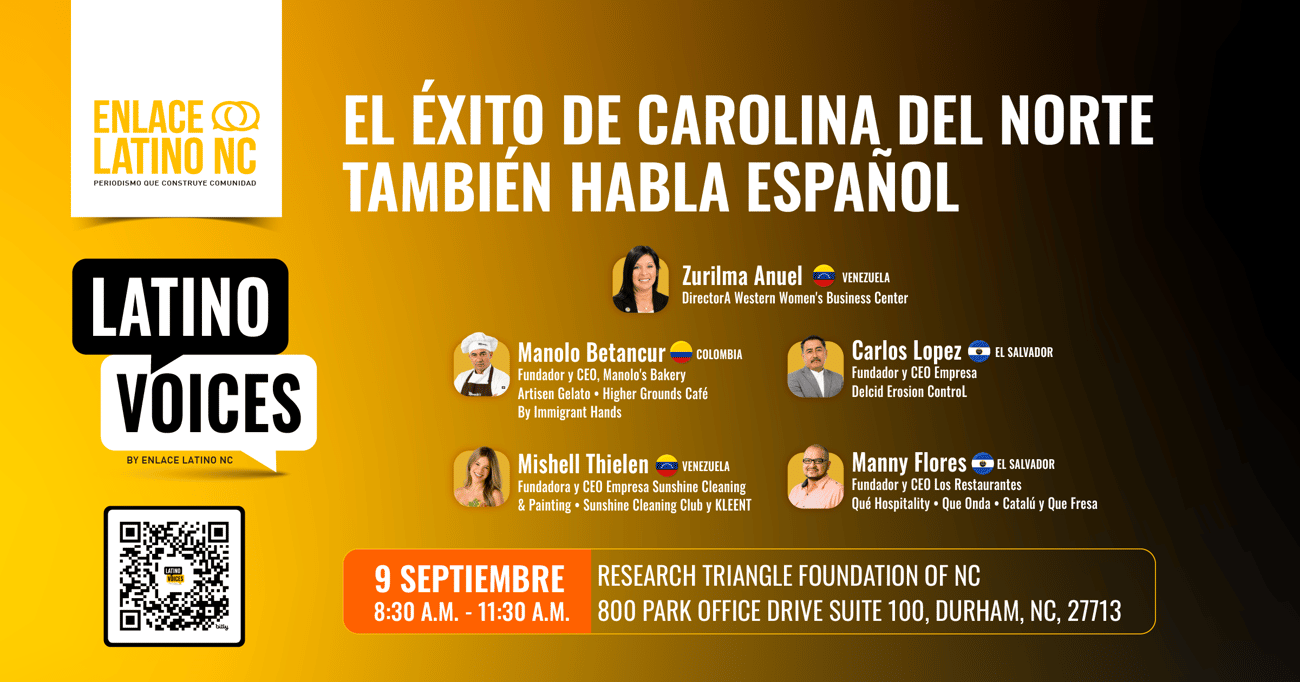
The inaugural “Latino Voices” event kicks off September 9 in Durham with a theme of “North Carolina's Success Also Speaks Spanish.” Enlace Latino NC’s series aims to “create spaces for live conversation to highlight the role of journalism in telling the stories of Latino communities in North Carolina.”
Western Women's Business Center Director Zurilma Anuel kicks off the opening conversation, followed by a panel that includes:
-
Manolo Betancur (Colombia): Founder and CEO of Manolo's Bakery, Artisen Gelato, Higher Grounds Café, and the By Immigrant Hands Foundation. Charlotte, NC.
-
Mishell Thielen (Venezuela): Founder and CEO of Sunshine Cleaning & Painting, Sunshine Cleaning Club, and KLEENT. Raleigh, NC.
-
Carlos Lopez (El Salvador): Founder and CEO of Delcid Erosion Control. Zebulon, NC.
-
Manny Flores (El Salvador): Founder and CEO of Qué Hospitality, the restaurant group behind Que Onda, Catalú, and Que Fresa. Charlotte, NC.
The free event runs 8:30-11:00 am Wednesday September 9 and includes networking and breakfast, a featured interview, a panel discussion and wraps up with more space for making community connections.
The event will be held in Spanish, with simultaneous English interpretation available. Space is limited, register here.
|
|
|
Bulletin Board |
Jobs |
|
📌 Alamance County Community Reporter, NC Local, Alamance County 💰
📌 Senior Enterprise Editor, The Assembly (Remote in NC)
📌 Due South Producer, WUNC, Chapel Hill & Durham 💰
📌 Podcast Producer, WFDD, Winston-Salem
📌 News Reporter/Host, WHQR, Wilmington
📌 Fill-in Announcer, WHQR, Wilmington
📌 Reporter, The Mountaineer, Waynesville 💰
📌 Sports Editor, The Franklin Press
📌 Editor, The Sylva Herald
📌 Assistant Editor, Mount Airy News
📌 News Editor, The Graham Star, Robbinsville
📌 Reporter, The Gaston Gazette, USA Today, Gastonia
📌 Investigative Reporter, WRAL, Raleigh
📌 Story Desk Editor , WFMY News 2, Greensboro
📌 Audience analytics manager, The 19th (Remote) 💰
📌 Designer, visual storytelling, The 19th (Remote) 💰
📌 Product Manager, Membership Growth and Development, ProPublica (Remote)💰
|
Resources, opportunities & events |
|
🧰 Audio pitches database: Audio producers Will Coley and Amanda McHugh are maintaining a crowdsourced spreadsheet of media organizations and production companies that accept audio freelance pitches, including deadlines and rates. Scroll to the bottom for resources on helping you pitch.
🧰 C-SPAN's Road to the Capitol: If you missed last week's Hub newsletter, check out our Q&A with C-SPAN's Rachel Katz about a new partnership they have with NC Local and local news organizations across the state. They're offering free video coverage of US House, Senate and the gubernatorial races to local newsrooms. Use for your reporting, publish on your sites and take advantage of transcripts and pre-produced video clips. If you're interested, send a note to Rachel at rkatz@c-span.org. She'll schedule a short conversation with you to learn about your news organization, answer any questions and get you set up with their portal.
📅 Solutions Journalism Network: Train-the-Trainers: SJN is recruiting journalism trainers, editors, reporters, and educators to build their skills in leading solutions journalism trainings, over five 3-hour sessions (Sept 16, 18, 21, 23, 25, 7–10 a.m. ET). Full attendance at all five sessions is mandatory — no partial participation accepted. Application deadline: August 23.
📅 Launch Events for Covering Climate Now: South Atlantic Climate Journalism Hub: Covering Climate Now is hosting a series of happy hours for journalists across the region as it kicks off its new South Atlantic Climate Journalism Hub. Join local environmental and climate journalists and experts for free drinks, conversation and networking: NC stops:
-
Raleigh: Natural Science Bar, Tue Aug 25, 5:30–8 p.m. (Liz McLaughlin & Harrison Fell on NC data centers and where our power comes from)
-
Charlotte: Protagonist Beer–LoSo, Wed Aug 26, 5:30–8 p.m. (open networking with CCNow staff)
-
Asheville: Riverside Rhapsody, Thu Aug 27, 5:30–8 p.m. (Katie Myers & Adam Smith on the cost of climate disasters and the Helene anniversary)
🌱 Call for Applications for U.S. Democracy Reporting Grants: The Pulitzer Center is offering special grants for reporting on U.S. democracy. They’re open to ambitious story ideas from a big-picture story or a series of stories. Top themes include voting rights, civil and free-speech rights, election transparency, and investigations into how federal and state government agencies are carrying out their work. The application is open to newsroom staff reporters and editors, and freelancers who would work closely with a newsroom committed to editing and publishing a text, multimedia, or broadcast project. Application deadline: August 31.
🌱 IRE Journalist of Color Investigative Reporting Fellowship: IRE is accepting applications for this fellowship supporting journalists of color pursuing investigative reporting projects. Over the course of the year, fellows receive IRE training, mentorship, data services and support, with the goal of producing an investigative reporting project to help their community. Application deadline: September 1.
🌱IRE Freelance Fellowship: IRE's fellowship for freelance investigative journalists are awarded for nonfiction project proposals which demonstrate impact, breadth and significance. Proposals for books, documentaries, cable series and other long-form projects are eligible. Application deadline: September 1.
📅 The Rise of Private News: Using SMS and Messaging for Deeper Engagement in Journalism. Looking for new ways to connect with your audience? Join the Knight Center’s free asynchronous court to learn how messaging platforms can help you build stronger, more direct relationships with the people you serve. No technical experience required. The course will review platforms, content strategy and legal, ethical, safety, and operational risks. September 14–27, 2026. |
|
|
|
|
That's it for this week. Diara Townes assisted with this week's bulletin board. Got something you'd like to share in The Hub? Get in touch anytime by replying to this newsletter or send me a note to catherine@nclocal.org. Thank you all for supporting each other (through the good, the bad and all the in-between) & know you are appreciated for all you contribute to the NC news and information ecosystem. — Catherine |
|
|
|
|
|
|