|
Greetings all, it’s Wednesday August 5th. We have had quite the week of intense weather. Flash flooding in Surry County overnight Saturday caused extensive damage, washed out roads, and led to a number of swift water rescues, with some calling it the worst flood since 1979. In Watauga County, 10 inches of rain turned streets into muddy rivers and also prompted water rescues. A few days before that, a tornado hit Madison County.
Thankfully, there were no deaths but the events happening here in NC (as well as devastating fires out west) are a reminder of the urgency for news organizations to be prepared. Also thankfully, there are resources to help!
As a partner on the Emergency Mode for News project, NC Local worked with journalists across the country who have first-hand experience covering climate emergencies to develop a collection of resources, including disaster checklists. BPR & Grist’s Katie Myers created this Flooding Checklist. It’s a Google doc you can copy and adapt to fit the needs of your newsroom. Here are a few of Katie’s tips from that resource:
✔️ Keep these basic emergency supplies somewhere in your newsroom.
✔️ Establish connections with other newsrooms in the event communications or electricity goes down for your building or your staff, who may need remote options.
✔️ Know high-risk flood areas and monitor them during inclement weather, including those in vulnerable communities.
✔️ Have ways to collect and quickly answer questions from your audience
✔️ Send team members out in pairs and make them take breaks! Allow them to spend time in their community that isn’t just on the job or at home with their family. For a local news team, this is home too.
Emergency Mode for News also includes month-long peer learning cohorts to help you put emergency preparedness plans into place. There’s a pilot taking place now & future cohorts will be announced soon.
Additionally, two free tech tools will be released soon for anyone using Wordpress: a “lite site” plugin that helps community members access your reporting when power outages affect connectivity and a “rolling coverage” plugin that lets you embed all your team's reporting in one place, making it easier for your audience to find essential info whatever emergency you’re facing.
Sign up for the Emergency Mode newsletter here to stay up to date on when the next cohorts and tech tools launch.
Coming up today:
-
Some investigative stories start with a tip. Others with a gut feeling. My colleague Diara J. Townes chats with WBTV’s Naomi Kowles about her reporting on the death of 6-year-old Dominique Moody & the legislative action that followed.
-
News organizations continue their legal fight to get UNC Chapel Hill to release a $1.2 million investigation into the School of Civic Life and Leadership.
-
And, let’s celebrate! 👏 30 NC news orgs and journalists are recognized in this year’s Green Eyeshade Awards, including top honors.
Glad you’re here, let’s get started. |
|
|
|
|
Covering the 'lost kids in Mecklenburg County' |
|
WBTV’s Naomi Kowles on the instinct, the records fight and the sourcing behind a months-long investigation into 6-year-old Dominique Moody's death. |
|
By Diara J. Townes |
 |
|
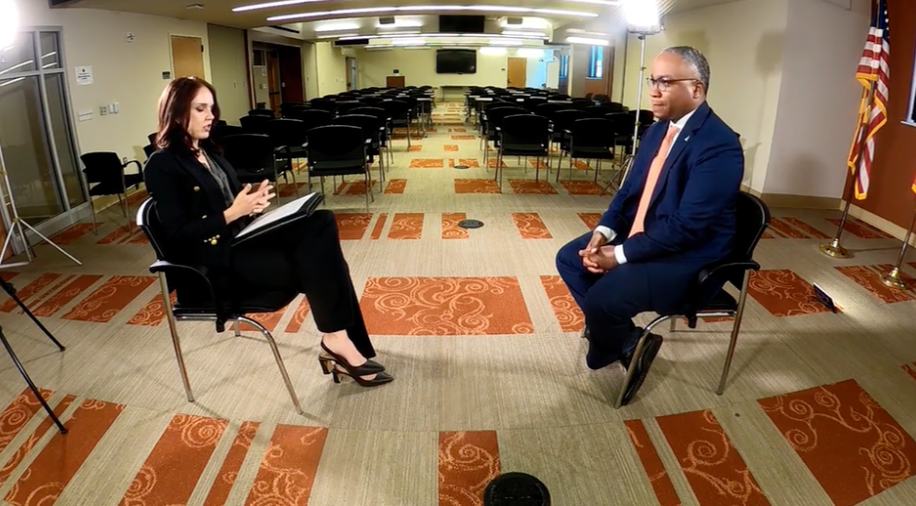
WBTV's Naomi Kowles interviews Mecklenburg County District Attorney Spencer Merriweather. |
|
|
|
For nearly a decade, Naomi Kowles has investigated government accountability, child abuse and domestic violence. And for the last three, she’s been digging into these stories in North Carolina at WBTV in Charlotte.
Last December, working through the slow week between Christmas and New Year's, Naomi started reading through initial coverage of six-year-old Dominique Moody's death in the Queen City. Three women had been charged. But something about the case didn't sit right with her. Naomi started asking systemic questions: Who else knew about Dominique before she died? Who should have known?
What followed was a seven-month investigation that involved numerous public records requests but also a nuanced approach to reporting. Naomi considered the impact of her work on Dominique’s family: Would they take her call? Would they be suspicious of her intentions? How could she build trust before asking these very tragic questions?
Naomi’s reporting eventually forced Mecklenburg County to release information it fought for months to keep sealed, prompted a state legislative hearing, and led to the "Dominique Moody Safety Act," a new law creating state oversight for complex child-welfare cases.
We had the opportunity to chat with Naomi recently about how she built the story and fought for answers. Our conversation has been edited for length and clarity.
What was your original approach to looking into the death of Dominique Moody? Did you initially see evidence of neglect or malfeasance by Mecklenburg County?
Naomi Kowles: I think it's really important as a reporter to start with an open mind. I'm not sure what I thought — I really didn't know what I would find at first. I suspected I was going to find some level of police and social services involvement, but I didn't know the nature of it. Pretty shortly into the process, before I published my first story, I heard from a source close to the situation about what had really happened — stuff that didn't come out publicly, that I wasn't able to confirm for even months afterward. That confirmed to me I was on the right track. But I don't know that I really knew what to expect, and I think I start a lot of stories that way. Some stories, you get a tip — a version of events someone believes happened, and you go in to prove or disprove it.
This one started in a much more open-ended fashion. A good number of my stories start that way, more from a question or a heavy suspicion of what I might find. Stories die all the time in investigative journalism — you go in, you ask questions, the evidence isn't there, and there's other stories waiting.
You mentioned this one started differently than a story that begins with a tip. What's different about the process, and what was that first records request?
Naomi Kowles: A story like this, which started more from a gut feeling and a sense as a long-time journalist that there was something there, is a little bit of a different process than starting out with a tip, where you might know exactly what records to pull. My first records request in this case was for Computer-Aided Dispatch or CAD reports. These are dispatch notes for calls for service. I really did not know if I would find anything in those. It was just awareness that this was the only public record I could ask for in this case, and if there was something to look at, it might give me an indication of what road to go down. And it did.
You've talked about finding Dominique's family through a funeral home. What's your approach to reaching people in the middle of grief and anger, without it feeling extractive?
Naomi Kowles: The records were only ever a starting point — there's no way I could have published a complete story without finding the people who lived it. The CAD reports were redacted for names, but I could tell from context that a family member had made some of the welfare calls. So I went down a social media rabbit trail: who's sharing this story, who's commenting, who's talking about it — then cross-referencing with tools like LexisNexis to figure out who might be family. That's how I found J. Vernon Peterson, who ran the funeral home and became the key to the rest of the story. He was standoffish at first, like most people are with a cold call from a reporter. I explained what I was working on and why it mattered, and he invited me out. There's no script for those calls — every one is different depending on the person's relationship to the situation. What I do every time is try to sit in the other person's headspace before I dial: why might they be suspicious of me? What do they need to hear first to build any trust at all? Think about the call before you make it, and think hardest about the person receiving it.
You did standalone pieces about Mecklenburg County’s Department of Social Services (DSS) refusing to release records you believed were public. What made you decide the denial itself was newsworthy, rather than just a setback to work around?
Naomi Kowles: I'll say I gave them two to three opportunities first. That story didn't come out with the first denial. I had given the original request for comment, gotten the response that laws prevented them from giving any information. Then I filed a records request — they blocked that. Then we brought in our attorney, who wrote a more formal letter of appeal to them. They also blocked that. But the choice to publish that standalone story is reflective of my training as an investigative reporter, probably something I picked up going to the National Conference for Investigative Reporters pretty much every year throughout my career.
As a personal matter of journalism standards, I think it's really important to make it a story when authorities are persistently blocking the release of information that is in the public interest. We were talking about information about what the agency had done. The decision to publish is rooted in a fundamental belief that when we choose to be silent about roadblocks we face, especially after giving multiple opportunities to overcome them and after conducting the legal analysis to believe those roadblocks shouldn't exist — if we stay silent after that, we are only doing authorities favors in helping keep that information secret. The public needs to know when our officials, who we pay, are blocking that information.
My recommendation, particularly to early-career journalists in that one-to-three-or-four-year space: I wouldn't publish an article like that without consulting a veteran journalist or an accomplished editor. I'm always all about calling out public officials, but if you're not used to the patterns and legal processes for public records, consult with someone more experienced — and I would not consider a week enough time.
You reported five Child Protective Services (CPS) investigations into Dominique's home — then learned during a legislative hearing that there were 13 reports made to Social Services about her welfare. What did that gap tell you about how the county was measuring its own failures?
Naomi Kowles: That gap was really important to me, because I spent a lot of time trying to fill it. By law — and by the read of every media attorney I consulted — the county should have given me that information [the public records] months before it came out. When I first got the court record showing five investigations, none of which found evidence of abuse or neglect, I knew that alone was a serious story. But sources kept telling me, essentially, "you think that's bad? There's more." That's why I kept pushing instead of treating it as a done story. When I finally saw the real number in that legislative hearing, my jaw dropped. Thirteen different times people had called Mecklenburg County CPS about this child or her home. That's what underscored for me how much of an outlier this case was, and how a system built to catch it let it exist anyway.
After seven months, what would you tell a reporter chasing a systemic failure with a fraction of your time and resources — and how did you know when this story was done?
Naomi Kowles: If you've got good reasons and a solid gut telling you the story isn't over, it isn't over. Some stories are done after one or two pieces. This wasn't one of them, because I knew the county wasn't telling me everything, and their reasons for withholding kept changing. For public officials, my message is: stop being so afraid of transparency. I feel for the child welfare workers at that agency who are overworked and underpaid and making impossible calls every day — my reporting was never about putting individuals on blast. It's about the system that enabled failure, and how we get it to a better place. And zooming out further: as a society, our budget choices reflect our priorities, and if we keep underfunding the people who care for our most vulnerable children, that's a reflection of what we actually value.
Thank you Naomi for speaking with us, staying committed to this important story and the impact your reporting has had.
For more details, find some of Naomi's coverage below - but please note, some of these stories discuss extreme child abuse and neglect.
➡️ Police, social workers called to Charlotte home dozens of times before child’s horrific death
➡️ WATCH: Mecklenburg County district attorney speaks out about county’s denial of information in child death case
➡️ ‘Lost kids in Mecklenburg County’: Lawmakers blast county officials in combative hearing about child’s death
➡️ North Carolina House passes ‘Dominique Moody Safety Act’ to boost state oversight of child welfare cases
➡️ Reporter’s Notebook: A new state law comes after a WBTV investigation into a child’s death |
|
|
|
|
|
|
|
📰 News about the news 📰 |
News outlets continue push to release investigation into UNC School of Civic Life and Leadership
|
|
Orange County Superior Court Judge John Morris said Tuesday he’ll personally review a $1.2 million, 400-plus page internal investigation into UNC Chapel Hill’s School of Civic Life and Leadership before deciding on next steps, which include whether the case will go to trial.
A coalition of news outlets, including The Assembly, The Daily Tar Heel, The News & Observer and WRAL-TV sued the university in April to compel the release of the report. According to Carolina Public Press, another plaintiff, UNC’s attorneys say the report is not subject to public records law because the “entire report is governed by trial preparation materials.”
But it’s not clear what trial UNC is preparing for. Attorney Mike Tadych said there is no pending litigation and a justification, required under NC public records law, hasn’t been produced.
The university has also denied requests for a redacted executive summary or an itemized index of the report. Students and faculty have also demanded the release of the investigation.
The School of Civic Life and Leadership has come under fire for political motivations since the Board of Trustees fast-tracked its creation in 2023, using funds approved by the Republican-controlled General Assembly. Classes include “The Christian Story” and “Men and Women,” which requires students to go on a date, plan their own weddings and organize a ball, according to the NYT. It’s also been criticized for recruitment of faculty, resignations and leadership turnover.
The media organizations have asked the court to “determine if defendants have complied with their obligation under the Public Records Act, whether any portions of the report have been permissibly withheld and why, which portions of the report the defendants should be compelled to produce for inspection and copying.”
Judge Morris said he’ll do an intensive, legal review of the report and there likely won’t be a decision this week. |
Rana Cash returns home with new roles at USA TODAY Network-Florida
|
|
Former Charlotte Observer Executive Editor Rana Cash started a new position this week as executive editor of the Daytona Beach News-Journal and Deputy Region Editor for Investigations & Enterprise at the USA TODAY Network-Florida.
“This is a homecoming for me -- returning to the news organization that has been so central in my career, and returning to my home state, having grown up only 30 minutes from this newsroom,” wrote Cash on LinkedIn. “The opportunity to serve a community so special to me while coming home to family means the world to me. This is a great news team with big ambitions, and I'm excited to get started.”
Matt Leclercq stepped into the top editing role at the Charlotte Observer in late May. Leclercq spent two decades at The Fayetteville Observer, before spending a few years out of state, including as senior managing editor at the Fort Worth Star-Telegram. |
WFAE hires Greg Lacour as senior editor |
|
Longtime Charlotte journalist Greg Lacour is joining the team at WFAE, stepping into the role of senior editor. Lacour spent about seven years at Charlotte Magazine (before it shuttered last year), including as editor-in-chief and senior editor. He served as associate editor for The Food Section Charlotte and has freelanced for The Assembly and Our State.
“Lacour brings strong news judgment, creative storytelling, a drive to break news, and a deep knowledge of the people, trends, and forces shaping the Charlotte region,” wrote WFAE in an announcement.
Lacour will work under Executive Editor Ely Portillo, and be responsible for co-producing daily news, long-form stories and special projects.
“It’s a tremendous opportunity to work with a group of top-notch folks at a station I’ve long admired,” said Lacour on LinkedIn.
Lacour begins his new role next week.
Have something to share about your news and information organization? Send a note to catherine@nclocal.org. |
|
|
|
|
|
Bulletin Board |
Jobs |
|
📌 Assistant Editor, Mount Airy News
📌 Staff Writer, The Daily News, Jacksonville
📌 News Editor, The Graham Star, Robbinsville
📌 Sports Editor, The Franklin Press
📌 Editor, The Sylva Herald
📌 News Reporter/Host, WHQR, Wilmington
📌 Fill-in Announcer, WHQR, Wilmington
📌 Programming and Operations Director, WNCW, Spindale
📌 TV Anchor/Reporter, WRAL, Raleigh
📌 Social Media Strategist, States Newsroom (Remote) 💰
📌 Magazine Editor, CityView/The Assembly, Fayetteville 💰
📌 Coalition & Partnerships Coordinator, Rebuild Local News (Remote) 💰
📌 AI & Tech Policy Manager, Rebuild Local News (Remote)
📌 Communications Coordinator, IWMF (PT, Remote) 💰
📌 Chief Technology Officer, News Literacy Project (Remote) 💰
|
Resources, opportunities & events |
|
🌱 ProPublica Emerging Reporters 2026-2027: Undergraduate juniors or seniors can apply for this program, which provides $9,000 stipends, along with mentoring and a trip to a journalism conference, such as the Investigative Reporters & Editors conference, to five students each year. The program is aimed at talented aspiring journalists who find investigative journalism inaccessible for financial reasons. Applicants from underrepresented groups are encouraged to apply. Application deadline: Aug. 17, at 9 am ET.
🌱 NYT Local Investigations Fellowship: Applications are open for the 2027-28 cohort of local investigative fellows, who spend a year on an investigative project focused on their state or region, receiving guidance from Dean Baquet, The Times’s former executive editor, and a group of veteran investigative editors. Open to staff reporters and freelancers, fellows are based in the communities where they are reporting and make periodic trips to The Times’s offices for training and support. Application deadline: August 21.
📅 Beat Academy: Reporting the 2030 Census. Decisions about the 2030 Census are already underway, and their impact goes far beyond redistricting. They will shape political representation, federal funding and how communities plan for schools, housing, transportation, health care and other essential services for the next decade. Join Poynter for this webinar will help you understand what’s changing, why it matters now and how to turn those changes into meaningful local reporting. August 26, Noon-1:15 pm ET.
🌱 2027 Alicia Patterson Fellowships: Alicia Patterson Fellowships support significant, in-depth written reporting on subjects of public interest. Six-month fellowships pay $20,000, and 12-month fellowships pay $40,000. To learn more, the Fund for Investigative Journalism is holding an info session Aug 12 at 12:00 pm ET featuring NC-based journalist and former fellow Melba Newsome. Application deadline: Oct. 1, 2026. |
|
|
|
|
That's it for this week. Thank you for reading and know you are appreciated for all you contribute to the NC news and information ecosystem. —Catherine |
|
|
|
|
|
|