Share
How to fill their resilience banks (and yours too).‌
 ‌ ‌ ‌ ‌ ‌ ‌ ‌ ‌ ‌ ‌ ‌ ‌ ‌ ‌ ‌ ‌ ‌ ‌ ‌ ‌ ‌ ‌ ‌ ‌ ‌ ‌ ‌ ‌ ‌ ‌ ‌ ‌ ‌ ‌ ‌ ‌ ‌ ‌ ‌ ‌ ‌ ‌ ‌ ‌ ‌ ‌ ‌ ‌ ‌ ‌ ‌ ‌ ‌ ‌ ‌ ‌ ‌ ‌ ‌ ‌ ‌ ‌ ‌ ‌ ‌ ‌ ‌ ‌ ‌ ‌ ‌ ‌ ‌ ‌ ‌ ‌ ‌ ‌ ‌ ‌ ‌ ‌ ‌ ‌ ‌ ‌ ‌ ‌ ‌ ‌ ‌ ‌ ‌ ‌ ‌ ‌ ‌ ‌ ‌ ‌ ‌ ‌ ‌ ‌ ‌ ‌ ‌ ‌ ‌ ‌ ‌ ‌ ‌ ‌ ‌ ‌ ‌ ‌ ‌ ‌ ‌ ‌ ‌ ‌ ‌ ‌

Click here to view in your browser

Did someone forward you this email?

👋 Click here to sign up

Greetings all, it’s Wednesday January 28. If you’re feeling off-kilter, that’s to be expected. You made it through Winter Storm Fern, but another looks like it’s on the way. You’re processing the Border Patrol killings in Minneapolis and the collective fear of a major US city that’s spent weeks in the frigid cold, trying to protect their community. You’re thinking of our journalism colleagues, facing those same conditions, and some coming under attack themselves.


Times like these are overwhelming, but there are ways to regain some sense of balance as we continue to navigate lots of uncertainty. 


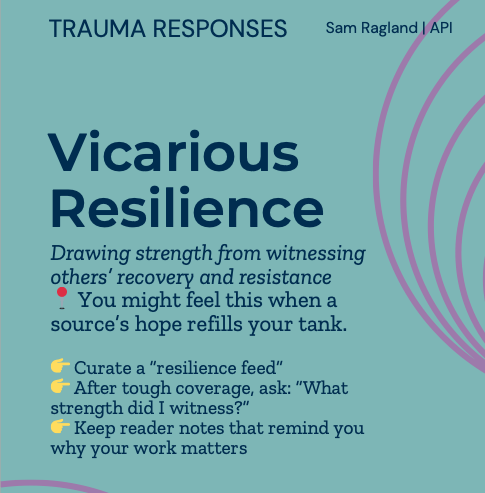
One tremendous resource comes from Sam Ragland, American Press Institute’s Senior Vice President. She created a series of graphics that puts a name to what many journalists are going through, things like traumatic exposure, generational trauma and compassion fatigue. And then she lists interventions, both those that work on deadline and ones news leaders can weave into their operations and culture to build more sustainable organizations. 

I love that Sam also reminds us about vicarious resilience. You can draw strength from others and build a resilience bank by keeping audience notes of appreciation in a folder; curating a feed of hopeful stories, songs or images; and during challenging coverage ask “What strength did I just witness?”


Find more insights and resources from Sam in her piece Trauma-informed leadership: How psychological safety can enhance journalistic well-being.

And, if you want to show some love for our colleagues in MN, Poynter’s Kristen Hare put together this list of local news organizations including links to donate. The local tourism association has this directory of BIPOC/Multicultural media organizations. The Minnesota Journalism Center is supporting newsrooms with safety and legal resources. And here are some photojournalists and independent journalists in the area to follow and check in with. 


Even if you just send a quick note of gratitude, it can go a long way in helping build up the resilience banks of fellow journalists.


Here’s what we have in the mix for today: 

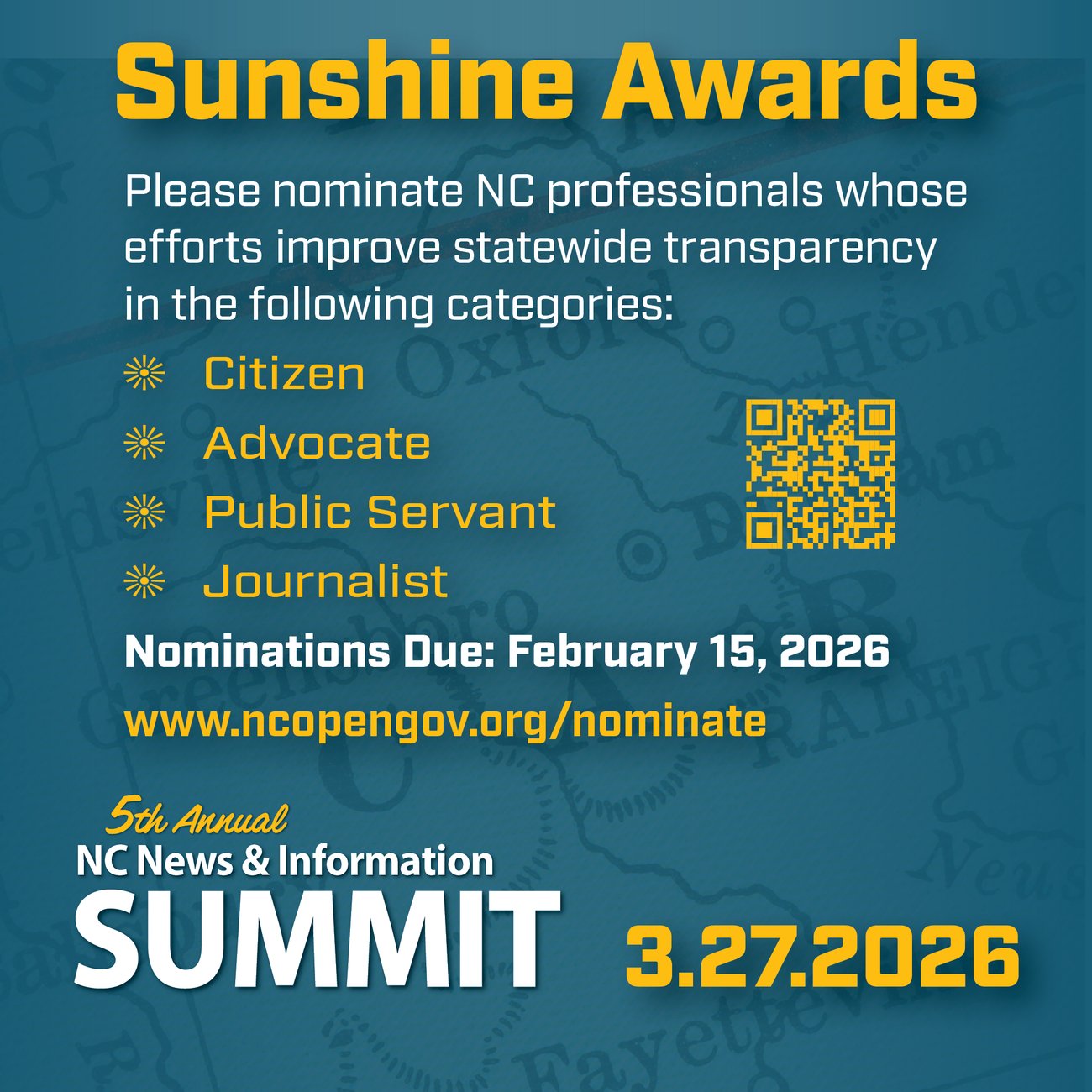
  • The 2026 NC News & Info Summit returns 3/27 at NC State. We’ve extended Early Bird tickets through this Friday & announce our keynote.

  • An NC student journalist pens our feature this week, exploring AI, editing and ethics.

  • And, our bulletin board has opportunities for environmental justice and health reporting fellowships; an accountability reporter position with NC Local; and leading elections and voting coverage at Votebeat.


Glad you’re here, let’s get started.

Keynote announced for the 2026 NC News & Information Summit

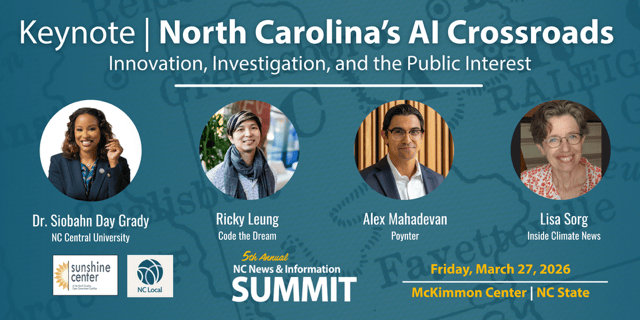
NC Local and the NC Open Government Coalition are pleased to announce the keynote discussion for the 2026 NC News & Information Summit — North Carolina's AI Crossroads: Innovation, Investigation, and the Public Interest.

Artificial intelligence is transforming news and information. For audiences, it’s reshaping how they find and access news. For journalists and civic information developers, it offers unprecedented tools for data analysis, accessibility, and content personalization. But AI also raises urgent questions. 


Join Poynter's Alex Mahadevan, Inside Climate News Reporter Lisa Sorg, NC Central's Dr. Siobahn Day Grady and Code the Dream's Ricky Leung to explore how we harness AI's potential for news and information while addressing accountability challenges facing our profession, our state, and the communities we serve.


This keynote kicks off our annual gathering on March 27, 2026 followed by 25+ sessions and table talks (details coming soon). 


Early bird tickets are just $75 and extended through Friday January 30. Get yours today


We also have several sponsorship opportunities so you and your organization can support access to local, sustainable news coverage and freedom of information for North Carolinians. Sponsors are eligible for free registrations, logo placement and tickets to a special sponsor dinner. 


Contact Pate McMichael at pmcmichael@elon.edu or Shannan Bowen at shannan@nclocal.org to sponsor the Summit.


Are we teaching student journalists enough about AI and ethics?

By Mila Mascenik, Class of 2026 Graduate Student at the UNC Hussman School of Journalism and Media 

“AI,” “Artificial Intelligence,” “Generative AI.” These are some of the terms I searched for in the syllabus of a reporting class I took in fall 2024, when I was a senior in my undergraduate studies at UNC-Chapel Hill. My computer made a pinging sound when I hit enter. 


Nothing. 


It was hard to believe that zero results appeared, given that conversations about AI seemed to be all around me on campus one year later. It presents itself in syllabi, class discussions and assignments and even events. As a graduate student at the UNC Hussman School of Journalism and Media, I experiment with it in my own reporting, primarily to help generate questions. At the same time, I consider some of AI’s ethical implications, particularly for the work of editors. These include which tasks AI is appropriate for, when it should be disclosed and who is involved in these decisions.  


Along with a newsroom’s own policy, guidelines created by nonprofit media institutions, such as the Poynter Institute and Trusting News, offer a roadmap for the responsible use of AI. How and when AI should be disclosed to audiences is a complex issue, yet it is critical in building trust with readers as a growing number of journalists and newsrooms use the technology in different ways. 


As an aspiring news editor, I strive to acquire a comprehensive understanding of AI from both technical and ethical perspectives. It’s also something I know will be helpful to other news organizations. So when my professor asked our class to write a story on an ethical issue facing our profession last semester, I wanted mine to center on AI. My interest in this topic grew after writing the story, and this semester I’m doing an independent study through school focused on how editors are integrating AI into their work. 


For my class assignment last fall, I interviewed three professionals with unique experiences using AI in their work. These interviews have been edited for brevity and clarity.


Erin Servais is the founder of AI for Editors, a primarily online, live editing training program for professional editors who work in fields ranging from education to government. 


What are some of the best basic practices for ethically integrating AI in editing?


Servais: It’s a best practice to follow the AI use policy of your publication, if it has one. If it doesn’t, lobby for one, or if you’re in a situation where you’re a freelancer working directly with clients, with writers, which wouldn’t really be the case for newsrooms. The best policy is to look at your workflow, all of the individual tasks that you do as an editor, and determine at what level AI use is appropriate. I break it down into three main categories: 

  1. Automation, meaning that task is done one hundred percent by AI

  2. Augmentation, meaning a percentage of the work is done by AI, the rest is done by humans

  3. All Human, where it’s one hundred percent done by a human being

What sorts of situations, if any, could you see a disclosure that AI was used in copyediting for a publication, for example? Or is that not needed as much because it’s just copyediting?


Servais: If we’re talking about strictly copyediting, I would lean much more toward a disclosure not being strictly required. I could see that some publications might like their readers to know that a human signed off on all decisions related to the article and its editing. the editing of it. For that reason, maybe they would want to have a disclosure that was more of a catch-all disclosure rather than explicitly stating we used such and such program for copy editing. 


From the editors that you’ve spoken with, because I’m sure they’re from a wide range of disciplines, what do you feel like has been the overall consensus about them incorporating AI into their work? 


Servais: The copyeditors, it depends on the length of text that they typically have to edit at one time, because it doesn’t work yet that you can upload a book manuscript and have it copyedit the whole thing in one go. People who work with very long texts are finding it less useful than people who might be in newsrooms working on shorter texts.

For people where that is the case – they can’t use AI on the entire project at one time – then they’re using it in the way that a line editor may, where they’re putting in that long, convoluted sentence and having AI work on that sentence first, and then hopefully it does it exactly the way they want to the first try. Otherwise, it at least helps them figure out where to get started with it.


Brighton McConnell is the news director at 97.9 The Hill WCHL and Chapelboro, the latter an online news publication based in Chapel Hill. His newsroom experimented with an AI chatbot last year as part of a research project by the UNC Center for Innovation and Sustainability in Local Media. 


Why did Chapelboro decide that it wanted to have this chatbot on its website?


McConnell: When we saw that CISLM, the UNC Center for Innovation and Sustainability in Local Media was doing this research project and looking for small newsrooms to participate, that jumped out to us as a good opportunity… not only was it something that’s like ‘ok, they help build the tool that saves us a bit of time,’ the idea was that it would go pretty easily onto the website, which also sounded attractive. It was in the name of helping a group that’s UNC-affiliated and helping with research. 


I do not use ChatGPT in any form or fashion in my putting together of stories or research. I’ve just been really skeptical of those tools, but we also understand that a lot of outlets are beginning to use them. We thought this could be a potentially good way to dip our toe into what artificial intelligence would either look like or how it would interact on our website.


What are some examples of reader feedback that you received while having the bot up? 


McConnell: In part because of the way we presented it to readers, I think they struggled to understand that it was not like a ChatGPT or [that] something was using search engines to pull in all of this information and spit a response back. Sometimes, it was readers asking it [the bot] non-Chapelboro-related things that were Chapel Hill and Carrboro-specific, to which the bot would sometimes have up and down answers for.

We had people being like, “Tell me the history of Chapel Hill,” and that bot just wasn’t prepared to do that. Some of the feedback we received is a lot of skepticism about seeing something labeled as artificial intelligence around a trusted news source.


What do you think are some of the most important lessons that you learned about AI from this experience?


McConnell: I think this was an example of how not every single AI tool is what we know – ChatGPT and other really established, big AI tools – to be. There is this middle ground and this part of the industry that’s still finding its way. It reaffirmed that it’s [AI] not going to be right every single time.


Jasmine McNealy is a professor in the department of media production, management, and technology at the University of Florida. She researches AI and its impact on communities, people and organizations, and the policies around it.


Since you teach some classes over at the University of Florida, what does your AI policy look like for students? 


McNealy: I usually tell students not to use it. However, if you’re going to use it, you’re responsible for any of the outputs that it gives that you use. One of the things about critically thinking about AI is that hopefully, you get an opportunity to correct AI. 


What do you think young communications professionals should watch out for when using AI?


McNealy: Young professionals need to be able to communicate well, aside from artificial intelligence. It’s ok to make mistakes, it’s ok to grow as a writer, communicator, [and] as a graphic designer; there are tools that are now able to assist you. But it is also imperative that when the system goes down, as it inevitably does, you know how to use the skills and expertise you have.


Are there any news outlets that you think have a solid AI policy or are doing good work with it ethically? And what in your view makes a good AI policy?


McNealy: CBC News, Global Voices and The New York Times. I think one good AI policy is being transparent about whether a news organization will use AI and perhaps how it may or may not use it.


Thank you Mila Mascenik for sharing your piece on AI & ethics for The Hub newsletter! If you'd like to share your newsroom's AI policy and/or experiences using tools, get in touch with her at mmila@email.unc.edu.


NC Local selected as Report for America newsroom

NC Local is thrilled to share that we're joining Report for America as a host newsroom in 2026. The RFA corps member in our newsroom will serve as an accountability Reporter in North Carolina.


The reporter in this beat will take an investigative approach to large, complex statewide issues, such as Hurricane Helene recovery. By tracking funding sources and policy decisions, the position will strengthen accountability reporting in the area. This reporter will collaborate with other news staff and partners to use investigative skills to answer questions from audiences across a range of issues. In addition to investigative reporting and writing, the position will help translate investigative findings into digestible and accessible forms for all audiences.

Learn more about becoming an RFA Corps Member here and apply before Feb. 16.

Women in Journalism NC Virtual Gathering 1/29

Join the Women in Journalism NC group tomorrow/Thursday at 7 pm for our bi-monthly casual conversation. This month's theme is "No Dumb Questions." Submit all of your burning journalism questions in advance. They'll be shared anonymously during the virtual meeting for the group to answer together. This is a great space for collaborating, commiserating and getting inspiration from your fellow journos!


Contact womeninjournalismnc@gmail.com for the link or with questions you'd like to submit!

 NC Local content for republication 


What is habeas corpus? How is it leading to the release of NC residents from ICE detention? 


Parts of the federal government could shut down this weekend. Here’s what you need to know.


How Tropical Storm Chantal redefined flooding risk and resilience in Alamance County


Stories from our partners


NC Health News: Advocates urge safeguards for caregivers under new Medicaid work requirements


Enlace Latino NC: Mapa Electoral de Carolina del Norte (Haz clic en cualquier condado para explorar datos electorales, fechas clave, candidatos y cantidad de votantes latinos para las elecciones primarias del 2026.)


Carolina Public Press: ‘Protect Ours.’ NC A&T students take the wheel on early voting

Bulletin Board

Jobs

📌 Accountability Reporter, NC Local (Remote in NC)💰

📌 Editor, QCity Metro, Charlotte 💰

📌 Director, North Carolina Local News Lab Fund, Remote in NC 💰

📌 Reporter/Newsletter Producer, The News Reporter, northern Brunswick County 💰

📌 Breaking News Reporter, The News & Observer, Raleigh 

📌 Partner Success Manager, URL Media (Remote) 💰

📌 Engagement Reporter, Open Campus (Remote) 💰

📌 Reporter & Investigative Editor, The Examination (Remote) 💰

📌 Senior Editor, Economy and Business, The Conversation (Remote) 💰

📌 Senior National Reporter, Votebeat (Remote)💰

Opportunities, events & resources 

📅 Digging into crime data to inform news coverage across beats. The Journalists Resource offers a training about how to find reliable crime data and use it responsibly. Guests and topics will cover: how to use The Trace’s Gun Violence Data Hub; what journalists sometimes get wrong about crime data, research and policy aimed at improving community safety — and how to get it right; and how to find story ideas in local and national crime data. February 4, Noon-1:00 pm.


📅 2026 IIJ Conference: Solo Together. A conference for independent journalists and creators to find community and build thriving businesses. 12 live, online sessions, plus bonus Q&A videos and editor panels, delivering over 20 hours of learning. March 5-6.


📅 How to work safely with sensitive sources: The Signals Network and RJI are offering an online training program in early 2026 that will focus on the psychological, digital and legal aspects of the journalist–source relationship. It will provide a concrete toolbox and practical advice on how to engage with sources — from the first contact to post-publication to maintain professional and ethical boundaries while managing the anxiety and trauma.


🌱 2026 Environmental and Epistemic Justice Journalism Fellowship: The Wake Forest University Environmental and Epistemic Justice Initiative provides 4-6 early to mid-career journalists with this program to improve coverage of environmental justice issues, while aiding in diversifying the ranks of environmental journalism. Each fellow will receive a $3000 reporting stipend, plus expenses for travel and accommodations to attend the 2026 Summer Institute at INSTEP-WFU London, England. The fellowship encourages proposals that focus on the intersection of environmental and climate justice and health, particularly in the southeast and mid-Atlantic. Application deadline: February 15, 2026.


🌱 2026 Public Health Reporting Fellowship: A six-month, fully-remote opportunity open to newsroom and independent journalists with 10 or more years of professional experience, the fellowship supports ambitious, in-depth reporting on critical community, regional, state, or national public health challenges. Up to five mid-career journalists will be selected to receive fellowship awards of up to $7,500 each to fund substantial reporting projects across formats, including print, digital, audio, visual, and broadcast. Application deadline: February 16.

Before we wrap up, two new newsletters to recommend. My colleagues Lilly Knoepp and Laura Brache are putting together some wonderfully warm, informative and community-connecting newsletters. Sign up for the newly launched Alamance Fabric and The Trailhead here.  As always, know you are appreciated for all you do to support the North Carolina local news and information ecosystem.  —Catherine 


Email Marketing by ActiveCampaign