|
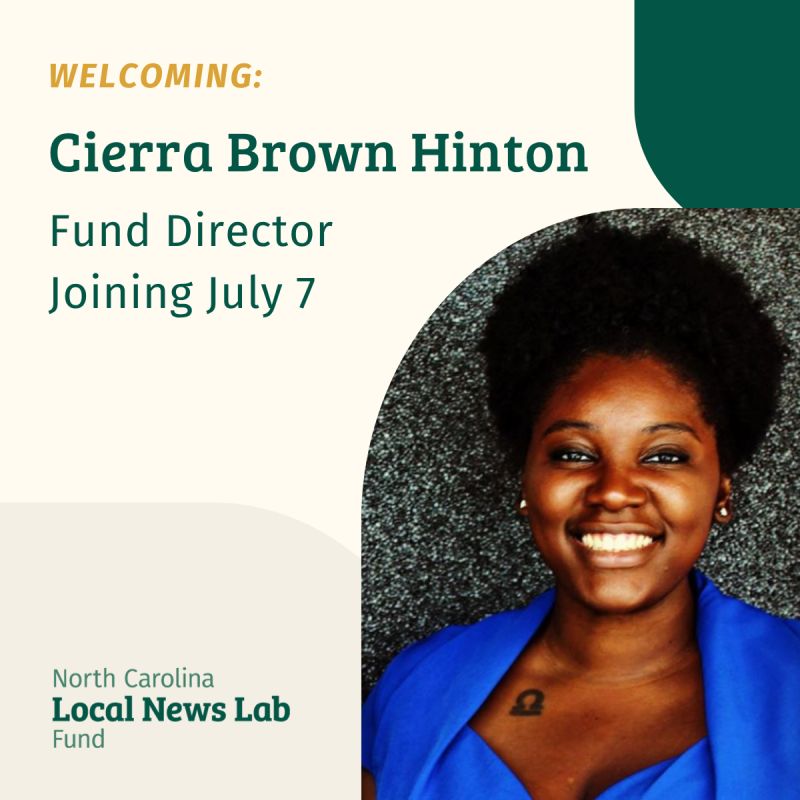
The North Carolina Local News Lab Fund made a major announcement Tuesday: Cierra Brown Hinton will step into the role of the Fund’s next director.
As a Reidsville native who lives in Durham, Cierra is familiar to many of you. She’s coached news leaders on revenue and sustainability through her outgoing role as Development Director with Blue Engine Collaborative. She led trainings for NC Local (when we were the NC Local News Workshop), including the Anti-Racist Table Stakes framework, and facilitated our community engagement and newsroom culture circles of practice. Cierra also previously served as Executive Director-Publisher at Scalawag, the Black-led, abolitionist media organization reporting with communities across the South on race, power, culture and liberation.
“Cierra Brown Hinton is a skilled leader and trusted partner whose work has shaped the North Carolina and national news landscape,” said Teresa Gorman, Board Chair of the NC Local News Lab Fund and Associate Director at Democracy Fund in a statement. “She combines strategic vision with a deep, critical understanding of what this ecosystem needs — and she leads with values that put communities first.”
Cierra is also Board Chair of LION Publishers and a strategist at the Southern Power Fund. She says her experiences working inside newsrooms, coaching organizations and seeing how funding decisions are made has helped build her conviction that “this work is more than journalism.”
“It's about whether communities have the infrastructure they need to understand their world, organize around what matters, and hold power accountable — and whether the people and organizations doing that work can survive and grow,” she said.
NC Local, which is a grantee of the Fund, couldn't be happier to welcome someone we already know and admire into this role. Cierra has been doing quiet but essential work for many years: giving news leaders practical tools and building their confidence; keeping community needs front and center; and always finding ways to connect people and groups to each other to strengthen the ecosystem.
As the Fund prepares to welcome Cierra in July, this week we chat with outgoing Director Lizzy Hazeltine about the news, what she’s learned over the last seven years and what questions she’s continuing to ask as the NC news and information ecosystem adapts and evolves.
The Fund announced Cierra Brown Hinton as its new director. Tell us about why you’re excited for this new chapter for the Fund.
Lizzy Hazeltine: I've had the real privilege to see Cierra's work and admire it, both at close distance and at arm's length distance for a long time now. She brings not just the deep experience of being inside newsrooms and in the funder community, but also the kind of leadership skills and a strategic vision that this work really needs. And she's done it all with her roots here in North Carolina.
All these skills and this track record is also fundamentally based on the fact that she turns all of this ambition and clarity into things that matter and results that happen. And in our particular moment, that is so important for the Fund, for North Carolina, for local news and information providers and organizations, and the ecosystem as a whole. All of these different components really made her stand out in the national search that the Board of Advisors led.
You’ve been in the role of director for seven years. What are some of the biggest changes you’ve seen in the NC news and information ecosystem?
Lizzy Hazeltine: What I have seen really clearly is part of what the Fund has worked to help funders understand: that local news and information is critical infrastructure during crises and on really boring Tuesdays. And that used to be harder to bring people around on.
Now I see that knowledge and that recognition of news and information as an asset, just being more and more a starting point, and more and more a conversation about the many different players that it takes to inform communities. That's the asset frame and it's been a very cool change. From, "Oh, gosh, all the news is dying" and we couldn't possibly save news, to more of a design and asset frame. How might we make sure that farm workers know about an incoming hurricane? How might we make sure that people know about a fun event happening on the weekend? How might we keep an eye on rat finks who might be in public office? But also, how might we reward public servants who are doing their part to bring sunshine into government, too?
I know you’re a big fan of the Table Stakes “From... To...” performance-driven change model. You and Cierra collaborated to build on that with the Anti-Racist Table Stakes framework. When you started at the Fund, were you using that “From... To...” approach as you were setting goals for what you wanted to do?
Lizzy Hazeltine: Yes. I came to the Fund to answer some really clear questions about what the role of the Fund could be in an ecosystem that already had a wide and deep bench of leaders in a lot of different places. And my goal was to understand more about where the assets were, to get a sense of what might be possible, and then to build hand-in-hand with others what those possibilities could be. So with funders, looking at who could see the shared interest in making sure that people can find, trust and use the news and information they need, and what would that do to change their grant-making or make more money flow, especially in places in the state where access to philanthropy has been more difficult.
Similarly, the Fund was founded on a community-centric vision of local news and information, fundamentally a service vision. So how might we make more visible the many different types of service and the many different people who are providing it? Both people who wake up thinking of themselves as journalists and people who don't — and help them see each other as allies, friends and fellow travelers.
What did it take to help funders make that connection that there is a diversity of information providers in a community, and they all should be looked at as important trusted messengers?
It really depended on the funder. What I have seen is that when we start with the people and places we have in common, we get questions of what could we try more quickly, or what do you already know that I can help you connect with. Kate B. Reynolds Charitable Trust was an early partner, along with the Z. Smith Reynolds Foundation, and seeing the connection between their existing portfolios of work and the necessity of making sure that local news and information was a part of how they made sure that people could understand Medicaid expansion, or understand changes to voting eligibility, or all these different dimensions that fundamentally are about people getting their questions answered about a topic that matters to a funder.
You've substantially grown philanthropic support in North Carolina. Meanwhile, nationally that's been happening, too, with Press Forward and of course, the Fund is home to Press Forward North Carolina and Press Forward Charlotte. Do you see momentum building for more philanthropic support for local news, or is it plateauing or something else?
When I think about Press Forward's launch, it was like, this is so great. Now there's national momentum that matches the momentum that we see here in the state. I think one of the real benefits of what Press Forward is doing is they're giving local leaders a space to step into their own leadership and to invite other people to contribute, much in the way that the Fund has done that work here. And so you can't read that as anything other than growing, from my perspective.
In another way, I think there's this deepening of support among North Carolina's funders that I'm just so encouraged by. We've gone from two funders in the state who said they’d fund local news or just media or journalism, and it wasn't even local news and information at that point, to now in our coalition more than 18. And that's just in the Fund. There's plenty more of aligned funding that we advise on, that we slingshot directly to other organizations across the state. And that really says to me that this is not just a flash in the pan, but it's a coalition that's built around the reality that this is useful to these other partners for the community level outcomes that they want to achieve.
What advice do you have for newsrooms right now in terms of seeking philanthropic support?
A powerful starting point for newsrooms is: who are you serving and who do you have in common with those folks? Who else cares about your part of the state, the audience you serve and how can you start a conversation about that and being really clear about the service you provide. And again, I want to highlight this idea, that philanthropic support is at its base about relationships.
How did you grow — personally and/or professionally — during your time at the Fund?
Oh my gosh, I've learned so much in the last seven years. One thing that I learned early on was, as much as people have generously said that I started this thing from scratch, I really learned that the power of this work has been that it's always been the work of many hands, and that really truly, people want to make meaningful contributions together that actually mean something.
I saw people respond so generously when I needed help or didn't understand something, and that’s made a huge difference. That kind of generosity of people, both in the field and in the funder community, is something I learned about in very real concrete terms.
One of the other big things that I've learned in the last seven years is just how powerful it is to stay really anchored in the value of a story of success. The power of a story in general, the story of what it means when this particular thing happens, what it means when people are funded in advance of an election or a hurricane or any other thing that we can't anticipate. What it means, in the best ways, for increased safety, for more of a sense of what's possible, for less danger, just these very real senses.
I've seen that those stories and the work of the Fund's partners just clearly helps people understand what it looks and feels like when this works — and gets us back into that asset frame of building possibilities; that we can, it's already happening, and you can do it too framework, which has been the real momentum that continues with the Fund.
You recently announced that you'll be doing a fellowship with the Futures Lab at Brown University looking at place-based systemic investment models. Looking a little bit further ahead, what's your next dream role?
I have next dream questions, and they're a lot about what we've discussed today about this interconnection and how much democracy is connected with whether people can get information, which is also connected with health, but is also connected with digital access. There's no actual silos that exist because everybody in their own life, in their own town, on their own street, in their own house, experiences lots of these different forces at work. So I'm deeply grounded in this idea that all of us deserve to thrive and that we're gonna need to change some things in order for all of us to thrive.
I'm really excited to look for places where I might pursue these questions about how we might see these interconnections as an asset. How can coalitions be a decentralized force for good for what change needs to happen? How can philanthropy be a powerful lever for accelerating the change we need? And also thinking about local to local networks as a powerful force for continuing to learn from each other and to break up the sense of being alone or powerless or isolated.
Cierra is starting as Director in July. Could you share a little more about the transition and any other highlights from the Fund for the rest of the year?
What I want everybody to know is that the Fund’s grant making continues uninterrupted. We're not doing an open round this year, but existing grant making continues as scheduled. In terms of transition, in July, I'll start working for Cierra as a senior advisor and support her as she takes the helm.
I’m so thrilled about Cierra being hired. I'm really excited to support her with some organizational continuity in her first few months leading the Fund. The Fund is in such a great place with our grant-making continuing, we have this excellent team, a proven theory of change that's a national model. I'm so excited and really grounded in how steady the Fund is, and that this is a point of acceleration on the momentum we already have.
Congrats to both Lizzy on all she's accomplished during her seven years at the Fund and to Cierra as she steps into the role of Director!
|