|
In 2024, Beacon Media's Jeremy Borden commiserated with Todd Zimmer, co-executive director of Down Home NC, a rural and small town community organizing nonprofit. They shared a familiar frustration: getting reliable information to marginalized communities.
Beacon Media, which was founded by former Senator Graig Meyer in 2024, had worked informally with Down Home NC for a while, uplifting its grassroots leaders through Beacon Voices. But Hurricane Helene made the gap impossible to ignore. As Bri Brough, Beacon's Community Media Liaison, watched disinformation spread through western NC in real time, it confirmed what Todd Zimmer had been saying all along: communities needed their own trustworthy local news infrastructure, not just syndicated coverage from the outside.
That conversation became County Beacon, a new hyperlocal news initiative serving Franklin and Granville counties, built in direct partnership with Down Home NC. And from the beginning, one thing was non-negotiable: whoever reported it had to already be from there.
This is where Tykayla Livingston comes in. A former early childhood educator and Down Home NC member in Franklin County, Tykayla had been acting as an informal community reporter long before she had a title for it. And when she saw a Facebook ad for the community reporter role, she knew immediately this was for her: a way to bring the policy knowledge she'd taught herself back to her neighbors who needed it, delivered in whatever format actually reaches them.
Tykayla is balancing community advocacy with hyper-local reporting in a dynamic way. At the Kids Over Corporations rally in Raleigh last May, she recited a poem she wrote while wearing (literally and figuratively) her Down Home NC hat. She also brought a different lens to her coverage of a recent house fire in Franklin County, highlighting the agencies involved and the coordination, while also showing the importance of how local tax dollars are spent.
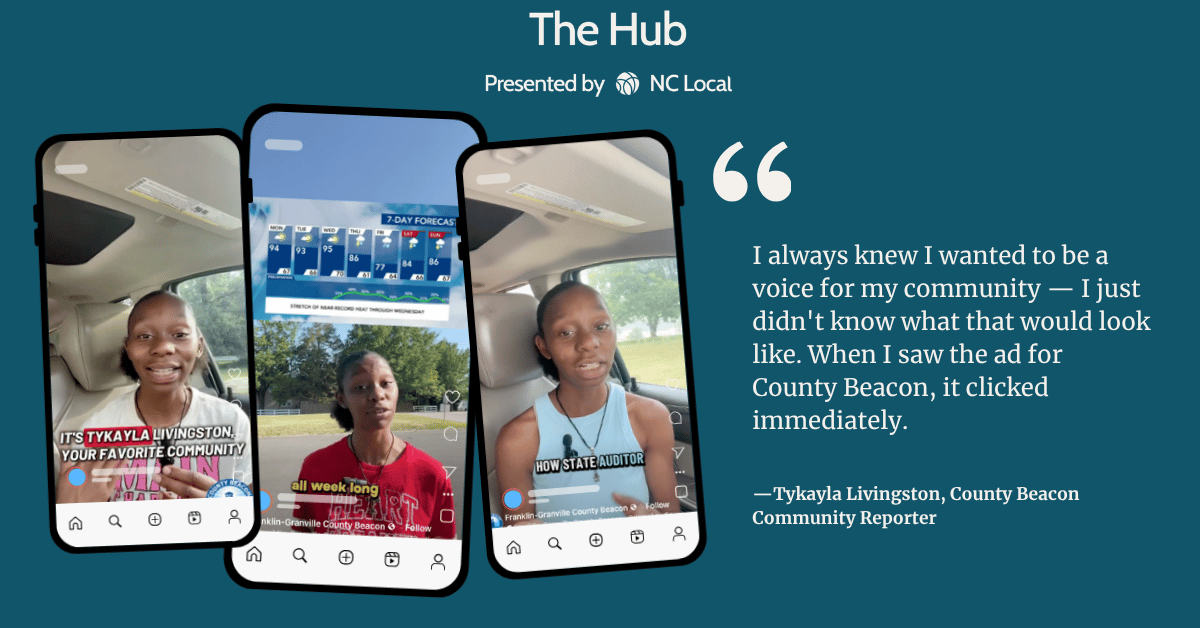
County Beacon uses a variety of formats to reach people. Tykayla makes videos from her car explaining what happens at the commissioners meeting and explores local restaurants and shops, posting on the paper’s Facebook as well as her personal TikTok. She recently reported what County Beacon Editor-in-Chief Bri Brough says is one of their most important stories so far: the Granville County Board of Elections' decision to move early voting sites out of majority-Black and brown communities.
We talked with Tykayla, along with Jeremy and Bri, about how County Beacon got its start, the information gaps they're working to close, and why they built this project with a community member instead of a traditional journalist. Our conversation has been edited for length and clarity.
How did County Beacon come together, and why Franklin and Granville counties specifically?
Jeremy Borden: It started with conversations with Down Home, since they've uplifted marginalized communities locally better than almost anyone in the state. Many Beacon Voices contributors were already affiliated with Down Home. The real shift was moving from informally amplifying their storytellers to asking: Should we actually build something together? Franklin and Granville made sense because Down Home already had growing, established chapters there, and we wanted to pilot what it looks like to build local media alongside an organization focused on long-term community organizing.
Bri Brough: My first year at Beacon, I was really focused on getting to know different parts of the state and trying to figure out what were the existing news and information ecosystems. What did they look like? How are they serving local communities? We definitely felt there was a gap in a lot of places in terms of folks having access to reliable, useful information that was meeting them where they were.
Why was it important that Tykayla come from the community itself?
Jeremy Borden: Traditional journalism has a real elitism problem around who gets to enter the field — formal credentials often screen out the people closest to the community. Tykayla was already acting as a community reporter before she had the title. That's exactly what made this project different from a typical hyperlocal news site.
Tykayla, what drew you to this work?
Tykayla Livingston: I came to Down Home in 2024 after years as an early childhood educator. I started teaching myself about education policy just to understand what was happening around me, and Down Home gave me spaces to keep learning rather than telling me what to think. I always knew I wanted to be a voice for my community — I just didn't know what that would look like. When I saw the ad for County Beacon, it clicked immediately.
What's the biggest information gap you're seeing in Franklin and Granville?
Tykayla Livingston: It's not access — it's understanding. Local officials will say, "it's on our website," but residents don't always know what to do with that information, and when they ask follow-up questions, it's read as complaining rather than genuine confusion. I sit in both spaces — with residents and with local government — so I can translate both directions. Most questions are simple: how, what, when, where. People also want to be part of the solution, not just heard. I've seen boards and committees sitting on vacancies even while residents are showing up asking to be involved.
Residents are starting to share their questions and concerns using the Beacon’s social media platforms. Bri, how is that shaping your practical approach to addressing information needs?
Bri Brough: Directly. After one community meeting, residents wanted to understand what local boards actually do and where the vacancies were — so we're building a guide to make that navigable. We're trying to build only what people are actually asking for, not what we assume they need.
What does the day-to-day reporting actually look like?
Tykayla Livingston: A lot of it is quick turnaround — compiling something like every county and town meeting happening in a month after someone asks. But just as often it's a video, sometimes recorded in my car right after a meeting, breaking down what happened in plain language.
How does County Beacon's engagement compare to other Beacon Media initiatives?
Jeremy Borden: This is fundamentally a social-first project. Most people aren't going to dig into a website or newsletter right away, especially in communities that haven't had a local resource built specifically for them — so we have to meet people where they already are. A lot of newsrooms treat social media as a funnel toward subscriptions or donations. We treat the social content itself as the service.
Bri Brough: We're a non-traditional outlet — all our content, including County Beacon's, is free for any publication to use or republish. It's hard to compare County Beacon's metrics to our other projects since the model is so different, but the throughline is the same: stronger, more informed communities, delivered through local messengers people already trust. |